
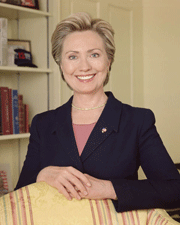
Hillary Clinton

Candidate for the 2008 Democratic presidential nomination
by Beth Rowen
 Related Links |
After one of the longest primary seasons in recent memory, Sen. Barack Obama secured the Democratic presidential nomination on June 3, 2008, edging out Sen. Hillary Clinton. Clinton and Obama competed fiercely for the support of working-class voters, and each candidate tried to paint the other as elitist.
Although she fell short of winning the Democratic presidential nomination, Clinton has amassed a long list of accomplishments. She was the first student to speak at Wellesley College’s commencement, the first female partner at Arkansas’s prestigious Rose Law firm, the first First Lady to hold a post-graduate degree, the first former First Lady to hold a seat in the U.S. Senate, and the first former First Lady to run for president. In addition, Obama named Clinton as his secretary of state. After a smooth hearing, the Senate confirmed her nomination by a vote of 94 to 2. She served as Secretary of State for Obama's first term. In early 2013, she stepped down and former senator John Kerry succeeded her.
Low-Profile Senator
In her run for the Senate in 2000, Clinton visited every county in New York—part of her “listening tour.” She successfully faced down the carpetbagger issue, and handily defeated Rep. Rick Lazio, 55% to 43%, in the general election.
As a freshman senator, Clinton assumed a bipartisan approach and a low profile. It was not an easy feat. Imagine David Ortiz trying to avoid stealing the limelight during a pickup ball game at the local field. Clinton got right to work, taking assignments on several Senate committees, including the Armed Services; Environment and Public Works; and Health, Education, Labor, and Pensions committees.
While remaining circumspect in the Senate, Clinton put herself in full PR mode for the 2003 publication of her memoir, Living History, which covered her eight years in the White House.
Early Supporter of War in Iraq
In areas of national security and international relations, Clinton initially supported the Bush administration—as did most Democrats after September 11, 2001. She voted for the USA Patriot Act in October 2001 and to renew it in 2006. (Clinton, however, helped draft a compromise bill that dealt with concerns that the provisions in the bill violated civil liberties.) She also supported 2002’s Iraq War Resolution that authorized President Bush to use force in Iraq. While never expressing regret for the vote, Clinton has said that she voted in favor of the resolution based on faulty intelligence reports. She also supported military action in Afghanistan, which began in October 2001 following the September 11 terrorist attacks.
On the home front, however, Clinton opposed Bush’s tax cuts in 2001 and 2003, calling them irresponsible. She also voted against the nominations of John Roberts and Samuel Alito to the U.S. Supreme Court. She said Alito would “roll back decades of progress and roll over when confronted with an administration too willing to flaunt the rules.”
Easily Reelected
Clinton breezed to victory in her reelection bid in 2006, defeating former Yonkers mayor John Spencer, 67% to 31%. During her second term, Clinton has consistently opposed Bush’s war strategy. She voted against his surge of 20,000 troops to Iraq and in favor of a resolution that required combat troops to be fully withdrawn by March 2008 (it failed). She also voted against a war-funding bill that gave the Bush administration $100 billion for the wars in Iraq and Afghanistan.
Political Shift
Clinton was born on October 26, 1947, in Chicago. As a high-school student and during her first few years as a student at Wellesley College, she was a staunch Republican. She campaigned for Barry Goldwater in 1964 and was a figurehead in the Young Republicans.
All the while, Clinton was a passionate social activist who battled racism and worked with children of migrant workers. The volatile events of the late 1960s led to Clinton's change in political philosophy. She supported Eugene McCarthy’s bid for the Democratic presidential nomination in 1968. A year later, her controversial commencement speech at Wellesley landed her in Life magazine, bringing the young woman from Illinois national attention.
Champion of Children’s Rights
As a student at Yale Law School, Clinton met two people who would determine the course of her adult life. The first was civil rights lawyer Marian Wright Edelman, a Yale alumna who headed the Washington Research Project (now known as the Children's Defense Fund). Clinton spent a summer working for the project, interviewing migrant workers and their families. She devoted the remainder of her law-school education to studying the rights of children and much of her professional career to championing the cause.
Love at first sight
Clinton met Bill Clinton during her second year at Yale. As the story goes, it was love at first sight. Both graduated in 1973 and maintained a long-distance relationship until the fall of 1974, when she turned down several offers from big-name firms and accepted a teaching post at the University of Arkansas School of Law, where Bill had been teaching. One of Hillary Clinton's first jobs after graduation put her in charge of legal procedures for the special counsel of the Watergate investigation, which ultimately led to President Nixon’s resignation.
A Name for Herself
While Bill was building his political career in Arkansas, Hillary was making a name for herself in legal circles. When Bill's election as Arkansas attorney general in 1976 (not long after their marriage in 1975) required them to move to Little Rock, Hillary taught at the University of Arkansas and headed its legal-aid clinic.
She joined the Rose Law Firm in 1977, and she continued to serve on several boards of directors of children's advocacy organizations, including the Legal Services Corp. She also established the Arkansas Advocates for Children and Families.
Life in the governor’s mansion
Hillary didn't give up her law career when Bill was elected governor in 1978. In 1980, she became a partner at Rose and had her only child, Chelsea. The Clintons were briefly ousted from the governor's mansion in 1980, but Bill came back, winning elections in 1984, 1986, 1988, and 1990.
Bill appointed Hillary to a series of high-level posts in his administration, including head of the Arkansas Education Standards Committee (she used the post to institute competency tests for teachers) and chairperson of the Rural Health Advisory Committee. These were not instances of nepotism: Hillary had earned herself national recognition for both her national service and her legal skills. The National Law Review twice selected her as one of the most influential lawyers in the country.
But even her experience as a high-profile public figure could not prepare her for the intense public scrutiny and press coverage that would chronicle her every move both on the campaign trail and in the White House.
First Lady
In 1993 President Clinton appointed his wife the leader of his Task Force on National Health Care Reform. While her ambition, thoroughness, and methodology were widely praised, her plan to reform the $800 billion industry screeched to a halt amid criticism that it was unrealistic as well as idealistic.
In fact, Clinton's entire tenure as First Lady was a rollercoaster ride, with the obvious marital problems, the health-care reform fiasco, and widespread criticism from both liberal feminists and conservatives. Feminists chided her for her stand-by-your-man reaction to her husband's infidelities; conservatives, perhaps intimidated by her intelligence and independence, criticized her hands-on role as co-President. Hillary added fuel to the fire when she blamed the President's mounting troubles on a “vast right-wing conspiracy.”
The former president proved to be an albatross for Hillary on the campaign trail. He emerged as mercurial and combative, making several divisive and combative statements about Obama.
Secretary of State
Clinton began her tenure as Secretary of State by reaching out to world leaders with the message that the U.S. was changing direction on foreign policy. She asked for and received a larger international affairs budget. She set up the Quadrennial Diplomacy and Development Review to set objectives for diplomatic missions around the world. She began the Global Hunger and Food Security Initiative as a way for the battle against hunger to be an ongoing matter for U.S. foreign policy and not just an issue the nation reacts to when there's an emergency. The initiative also focused on helping women farmers.
Clinton's time as Secretary of State had its challenges. During the 2011 uprisings in Middle East, Clinton had to respond to each uprising and handle the world's response to the U.S. backing some regimes, but not others. Obama relied on Clinton's advice and connections during this time. The September 11, 2012 attack in Benghazi that killed four Americans brought up questions for Clinton about the U.S. government's lack of preparation for attacks on diplomatic missions. In early 2013, Clinton gave her testimony to Congress on the matter. She accepted responsibility for the incident, but said she'd had no role in setting up the security for the diplomatic mission. When Congressional Republicans questioned her response to the incident, she vehemently defended her actions.
- More from Campaign 2008
Trending
Here are the facts and trivia that people are buzzing about.




