Katarina Witt

Near-flawless technique and charismatic style
by Mike Morrison
 Related LinksMemorable Moments |
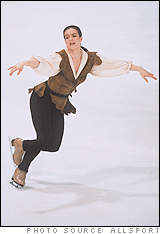
Perhaps no figure skater in history exuded more elegance, beauty, and grace on the ice than East German Katarina Witt. But while her beauty was well documented, and well displayed for that matter, it was her near-flawless technique and charismatic style on the ice that vaulted her to the top of the skating world in the 1980s.
Witt was born on Dec. 3, 1965, in Staaken, East Germany, and began skating by the age of five. By age nine she was already skating under the guidance of renowned East German coach Jutta Muller, and by age 11 she had landed her first triple jump.
It was in 1984 that Witt truly exploded onto the world's stage. At the ripe old age of 18, she won her first of four world championship titles. But she truly reached the pinnacle by dazzling the judges at the 1984 Winter Olympics in Sarajevo, edging American Rosalynn Sumners for the gold medal.
For the next several years, Witt simply dominated, winning world championships in 1985, 1987, and 1988. Only skating legend Sonja Henie (10), Carol Heiss (5), Herma Planck-Szabo (5), and Michelle Kwan (5) have won more. The combination of Witt's success on the ice and stunning good looks made her one of the most popular champions in the history of the sport.
The 1988 Winter Olympics in Calgary showcased the highly anticipated battle between Witt and American rival Debi Thomas, winner of the 1986 world championships.
Coincidentally, both elected to skate to Bizet's Carmen. Witt skated first and turned in a beautiful, moving performance, albeit a conservative one. The door was open for Thomas to take the gold, but her choice of a risky performance proved costly. Early in Thomas's routine, she two-footed a landing on a combination—a skating no-no. She never quite recovered.
Witt won the gold, becoming the first woman since Henie in 1936 to successfully defend her title. Canadian Elizabeth Manley won the silver, while a disappointed Thomas captured the bronze.
Witt gave up her amateur status after her performance in 1988, but when professionals were allowed back to Olympic competition in Lillehammer in 1994, she returned and finished seventh.
She continued on the professional circuits, participating in such events as "Discover Stars on Ice," and parlayed her talents into a successful career in the entertainment business. To her fans, she will forever be known as "Katarina the Great."
Trending
Here are the facts and trivia that people are buzzing about.