
Winter Olympics: Ski Jumping

Once a popular attraction at ski carnivals
by John Gettings and Christine Frantz
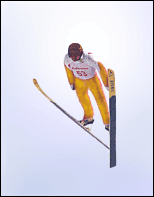 Eddie "the Eagle" Edwards Related Links
Memorable MomentsDid You Know?The youngest male athlete to win an Olympic gold medal was 16-year-old Toni Nieminen of Finland, who won the large hill ski jumping event at the 1992 Winter Games in Albertville, France. |
Ski jumping was born in Norway, the country that has given us practically all of our Nordic skiing events. A popular attraction at ski carnivals in the mid-1800s, the first official ski jumping competition was held in Norway in 1872. Norwegian immigrants brought ski jumping to America just before the turn of the century.
The large hill ski jumping competition has appeared at every Olympic Winter Games since 1924. Although its height has changed through the years, it has been fixed at 120 m (394 ft) since the 1992 Winter Games.
The normal hill event was introduced in 1964. Its height was set at 70 m (230 ft) and remained so until 1992, when it was moved up to its current height of 90 m (295 ft).
Nations compete in three events: individual normal hill, individual large hill, and team (which is contested on the large hill).
Each athlete attempts two jumps. Landings are videotaped for exact measuring purposes, and points are awarded based on the length of the jump. Longer jumps are awarded more points than shorter ones.
A panel of five judges rates each athlete's style on a scale from 0–20. The lowest and highest scores are dropped, making 60 a perfect score.
The skier, or team of skiers, with the highest combined total of distance points and style points is awarded the gold medal.
The ski jumping events will be held Feb. 11–20 at Pragelato.
Not surprisingly, Norway, Finland, and Austria have won the most ski jumping medals. The only American to win a ski jump gold medal was Anders Haugen in 1924.
With no U.S. skier ranked in the top 50 of the 2009 World Cup rankings there is little chance an American will medal in 2010.
Trending
Here are the facts and trivia that people are buzzing about.




