Sonja Henie

Ten world championships, four Olympic appearances, and three consecutive Olympic gold medals
by John Gettings
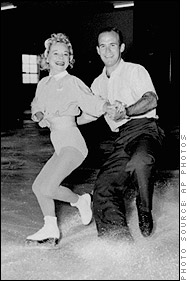 Sonja Henie and Dick Button Related LinksMemorable Moments |
Norwegian Sonja Henie won her first gold medal at the 1928 Olympics and at the next three Olympics no female figure skater could compete with her. Her routine and style set the new standard for the sport. . At 15 years, 10 months, Henie was the youngest woman ever to win a gold medal. She held that title for 70 years, until American figure skater Tara Lipinski, two months younger than Henie, won gold at the 1998 Nagano Games.
After the 1928 Games Henie went on to successfully defend her gold medal at the 1932 Winter Games and the 1936 Winter Games.
Ambitious as ever, Henie aimed to take her skating career in a new direction—Hollywood. She said she wanted to do what Fred Astaire was doing in the movies, only on skates.
She turned professional after the 1936 Games and by the end of the year saw the release of her first movie, One in a Million.
That film was the first of a dozen films Henie would star in over the next two decades. She also began to gain fame by starring in a wildly popular traveling ice-skating show. Her Hollywood Ice Review was a spectacle of costumes, music, and skating that toured the world until the early 1950s.
She died of complications from leukemia in 1969.
Today, more than three-quarters of a century after her Olympic debut, Henie's accomplishments have retained their luster. No woman figure skater since has won three straight gold medals, and only one ( Katarina Witt in 1984 and 1988) has ever successfully defended her title.
Trending
Here are the facts and trivia that people are buzzing about.