The Sacco-Vanzetti Case

What does the evidence say?
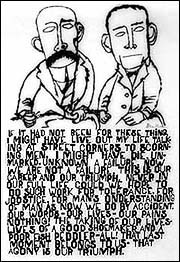 A poster by artist Ben Shan in the Library of Congress. " . . . Never in our full life can we do such a work for tolerance, for justice, for men's understanding of man, as we now do by an accident . . . The last moment belongs to us—that agony is our triumph!" |
On August 23, 1927, the Commonwealth of Massachusetts executed two Italian immigrants for a double murder. It is widely believed that the men's reputation as anarchists prevented them from receiving a fair trial. The case remains one of the most controversial in American history.
On April 15, 1920, a paymaster for a shoe company in South Braintree, Massachusetts, and his guard were shot and killed by two men who escaped with over $15,000. It was thought from reports of witnesses that the murderers were Italians.
Because Nicola Sacco and Bartolomeo Vanzetti had gone with two other Italians to a garage to claim a car that local police had connected with the crime, they were arrested. Both men were anarchists and feared deportation by the Department of Justice. Both had evaded the army draft. On their arrest they made false statements; both carried firearms; neither, however, had a criminal record, nor was there any evidence of their having had any of the money. In July, 1921, they were found guilty after a trial in Dedham, Massachusetts, and sentenced to death.
Many then believed that the conviction was unwarranted and had been influenced by the reputation of the accused as radicals when antiradical sentiment was running high. The conduct of the trial by Judge Webster Thayer was particularly criticized. Later much of the evidence against them was discredited.
In 1927 when the Massachusetts supreme judicial court upheld the denial of a new trial, protest meetings were held and appeals were made to Gov. Alvan T. Fuller. He postponed the execution and appointed a committee to advise him.
On Aug. 3 the governor announced that the judicial procedure in the trial had been correct. The execution of Sacco and Vanzetti on Aug. 23, 1927, was preceded by worldwide sympathy demonstrations. They were—and continue to be—widely regarded as martyrs.
However, new ballistics tests conducted with modern equipment in 1961 seemed to prove conclusively that the pistol found on Sacco had been used to murder the guard. This has led some authorities to conclude that Sacco was probably guilty of the crime, but that Vanzetti was innocent. The case was the subject of Maxwell Anderson's play Gods of the Lightning and is reflected in his Winterset. It is also the subject of Upton Sinclair's novel Boston and of sonnets by Edna St. Vincent Millay.
The Columbia Encyclopedia, Fifth Edition Copyright © 1993, Columbia University Press. Licensed from Inso Corporation. All rights reserved.
Trending
Here are the facts and trivia that people are buzzing about.