Fire Zone

Millions of acres are being consumed each year, so what's being done to save them?
By David Johnson and Mark Zurlo
 Related Links |
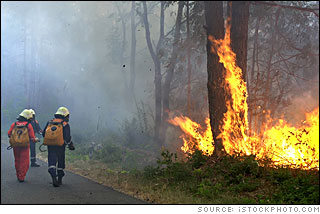
Of all nature's disasters, forest fires are often considered the most frightening. Moving at lightning speed, giant walls of flames can burn acres of land in just a few minutes. And although technology, including the use of fire-retardant chemicals, has greatly aided the fight against forest fires, they still take an enormous toll.
According to the National Interagency Fire Center, the 2006 fire season was the worst on record in terms of the number of fires and acres burned. There were 96,385 fires and 9,873,429 acres affected by fire in a year that was 125% more destructive than the 10-year average. These fires cost the federal government $1.5 billion to fight, and this figure does not include the money spent by local and state governments as part of the effort. In comparison, the 2014 fire season was an improvement, with 38,115 fires that consumed 2,706,158 acres. In August 2015, the National Interagency Fire Center (NIFC) in Boise, Idaho mobilized firefighters from Australia and New Zealand to assist with wildfire suppression efforts in the western United States, where more than 90 uncontained fires were burning. Our Australian and New Zealand partners were last mobilized in 2008 in response to similarly severe fire activity.
Western states such as California, Colorado, and Alaska have proven to be breeding grounds for wildfire throughout the past decade. It is estimated that two-thirds of forest fires are started accidentally by people, almost one quarter are intentionally set, while lightning causes 10%.
Beneficial Fires
Forest fires can have beneficial effects. Charcoal enriches soil, and some plant species flourish in the wake of conflagrations. The cones of the jack pine tree, for instance, will not release their seeds unless exposed to intense heat. Sequoia or Douglas fir trees grow best in open sunlight areas, such as those cleared by fire.
Natural fires also remove dead wood and tangled brush. For these reasons, the Forest Service of the U.S. Department of Agriculture, which administers 17% of all U.S. forest reserves, often allows fires, especially when started by lightning, to burn in carefully monitored areas.
Western Population Boom
As people move out of urban areas and closer to nature, they are sometimes putting themselves in the path of potential forest fires. Especially in dry western states, individual homes and even whole towns are increasingly threatened by nearby forest fires.
In 2013, 19 lost their lives in Arizona's Yarnell Hill fire, which burned 8,400 acres. The largest fire in California history raged in Aug. 2013, destroying 257,314 acres. In 2012, 346 homeowners lost their homes to Colorado's Waldo Canyon fire, of more than 1,800 consumed by fire nationally. In comparison, a single fire in 1991 in the hills of Oakland, California burned more than 3,000 homes. And in Cedar, California in 2003, more than 275,000 acres were charred, resulting in the loss of 2,400 structures and 15 lives. The state of Texas saw the largest fire of the 2006 season, with 907,245 acres, 80 structures, and 12 lives lost.
Satellites to the Rescue
Canadian fire fighters have tested an advanced satellite system designed to fight forest fires. Known as REMSAT (Real Time Emergency Management Via Satellite,) the system features a large blue box with a satellite dish attached to it. The system is especially valuable when electricity has been cut off.
When a forest fire breaks out, the box can be taken to the front lines or, if necessary, dropped from a helicopter. Three satellites communicate with the box, which can transmit detailed pictures of the blaze, pinpoint the exact location of fire fighters to the command center, and enable crews to exchange text messages.
In tests conducted in British Columbia, Canadian fire fighters set a house on fire and used smoke bombs to simulate a major fire similar to the one that threatened Los Alamos.
Pruning Dead Wood
Other fire prevention methods are less high tech and more natural. In 2003, the U.S. Forest Service worked with timber companies to cull out smaller trees and dense undergrowth on 18,000 acres of Colorado forest, not far from areas damaged by that year's raging fires.
More space between trees makes it harder for fires to jump from tree to tree. In addition, grasses, wildflowers, and other natural vegetation are less fire-prone than the dense brush that tends to grow in protected forests.
Scientists also say that fewer trees in an area can inhibit the spread of disease and enhance the probability that trees will survive droughts, when competition for water increases.
Results of Raging Fires
Annual wildlfire totals for 2003–2015
| Year-to-date statistics | Number of fires | Acres consumed |
|---|---|---|
| 2015 (1/1/15 - 9/1/15) | 43,819 | 8,202,557 |
| 2014 (1/1/14 - 8/27/14) | 38,115 | 2,706,158 |
| 2013 (1/1/13 - 8/27/13) | 33,496 | 3,536,623 |
| 2012 (1/1/12 - 10/4/12) | 49,072 | 8,828,875 |
| 2011 (1/1/11 - 10/4/11) | 60,887 | 7,776,367 |
| 2010 (1/1/10 - 10/4/10) | 57,411 | 2,980,632 |
| 2009 (1/1/09 - 10/4/09) | 71,193 | 5,614,320 |
| 2008 (1/1/08 - 10/4/08) | 68,557 | 4,750,746 |
| 2007 (1/1/07 - 10/4/07) | 73,536 | 8,234,888 |
| 2006 (1/1/06 - 10/4/06) | 83,952 | 9,093,297 |
| 2005 (1/1/05 - 10/4/05) | 53,484 | 8,169,411 |
| 2004 (1/1/03 - 10/4/04) | 61,441 | 7,732,724 |
| 2003 (1/1/03 - 10/4/03) | 49,706 | 3,191,563 |
For more information see:
National Interagency Fire Center
Sources: National Interagency Fire Center, CNN, ABC, Columbia Encyclopedia
Trending
Here are the facts and trivia that people are buzzing about.