African Americans in the Military

The Fight for Recognition of African-American soldiers
by Elissa Haney |
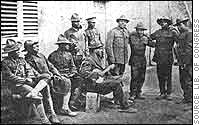 In World War II, Black soldiers were sent to N. Africa to join the Allied Forces.  Related Links |
Although African Americans have participated in every major U.S. war, the battle for integration and for recognition of the accomplishments of Black soldiers has been a slow process. It wasn't until after World War II that the U.S. armed forces became integrated, under a 1948 executive order by President Harry S. Truman.
Credit to Black people in the military has gradually been awarded where due and where long overdue. We have pulled out just a few historical Black regiments that exemplify the struggles and the contributions by African Americans in the armed forces before integration.
The 54th Massachusetts Infantry
One of the first Black units to join the Union forces in the Civil War, the Fifty-Fourth had the eyes of the nation upon it. The company, which was largely composed of freed Black slaves from various northern states, earned its fame in the July 18, 1863, battle at Battery Wagner. It was assigned the challenge of leading the assault on this Confederate fort, which was located on an island near Charleston, S.C.
Although the unsuccessful attack resulted in heavy casualties, the courageous act of one member of Company C brought the Fifty-Fourth widespread attention. During the battle, the unit managed to briefly capture a small section of the battery. The unit's leader, Col. Robert Gould Shaw, however, was fatally wounded in the process. Seeing that the color sergeant was down, Sgt. William H. Carney risked his life to take the flag and lead the troops to the parapet, upon which he planted the colors. When the soldiers were given the order to retreat, Carney again took the flag while facing heavy fire, before falling back. He was severely wounded by two bullets during the battle but survived to become the first African American to be presented a Congressional Medal of Honor, on May 23, 1900.
Buffalo Soldiers
After the Civil War, Congress authorized the creation of six segregated Black regiments to serve in the peace-time army, under white officers. The Ninth and Tenth Cavalries and the 38th through 41st Infantries—all composed of African-American soldiers—were thus formed.
The new cavalries were mainly stationed in the Southwest and the Great Plains, where it was their responsibility to build forts and maintain order in a frontier overrun by outlaws and occupied by Native Americans battling land-grabbing intruders. The Black troops earned the nickname "Buffalo Soldiers"—as much for their ability in battle as for their dark skin—from the Cheyenne Indians.
The men of the Ninth and Tenth Cavalries further proved their abilities in the Spanish-American War and in guarding the Mexican border. Members of both regiments fought in Cuba, participating in the battle at San Juan Hill. The Tenth also served under General John J. Pershing in the expedition against Mexican revolutionary Pancho Villa. In 1941, the two regiments merged to form the Fourth Cavalry Brigade, which was led by the army's first African-American general, Benjamin O. Davis, Sr., and would exist for only three years before all horse cavalry regiments were disbanded.
The Tuskegee Airmen
By the beginning of World War II, African Americans were putting increased pressure on the government to make conditions more equal for Black in the armed forces. Still reluctant to integrate the military, the government took a step forward in 1941 by creating the first all-Black military aviation program, at the Tuskegee Institute in Alabama. The action received a great deal of criticism from Black Americans who were outraged by their continued segregation.
In May 1943, the first group of Tuskegee-trained pilots was sent to North Africa to join the Allied forces. They were headed by Capt. Benjamin O. Davis, Jr., who would later become the first African-American Air Force general. The accomplishments made by the 99th Fighter Squadron, especially in it's collaboration with the all-white 79th Fighter Group in October 1943, helped pave the way for integration in the Air Force.
About the author
Trending
Here are the facts and trivia that people are buzzing about.