The History of the Internet

From a simple 300-mile transmission to a global network in cyberspace
by Ricco Villanueva Siasoco |
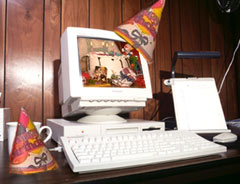 The Internet is over 40 years old. Related Links
External Links
"The Web is an abstract (imaginary) space of information. On the Net, you find computers—on the Web, you find document, sounds, videos, . . . information." |
In October 1969, a UCLA student named Charley Kline sent a simple transmission to a computer at the Stanford Research Institute (SRI), 300 miles to the north. Kline was working under the direction of Leonard Kleinrock, one of the earliest Internet pioneers. He typed the word "login" allowing him to use the computer at SRI as if he were sitting right next to it. That was the first communication in Internet history.
Of course the Internet is as ubiquitous now as a Big Mac. But to the scientists, engineers, and countless others who envisioned the global network of computers that is the Net as we know it today, the Internet was just a gleam in a few visionary minds.
What Exactly Is the Internet?
The Internet is a large computer network linking smaller networks to one another. Tim Berners-Lee, founder of the WWW Consortium, has a simple description of the Internet: "it's a bit like a postcard with a simple address on it. If you put the right address on a packet, and gave it to any computer which is connected as part of the Net, each computer would figure out which cable to send it down next so that it would get to its destination. That's what the Internet does. It delivers packets—anywhere in the world, normally well under a second."
In the Beginning, There Was ARPANET
The ARPANET was the precursor to the Internet. Developed by the Department of Defense in conjunction with several universities, the goal of ARPANET was to allow university-based researchers working for the Defense Department to share information with their colleagues in other U.S. cities. That first "login" message was sent from UCLA to Stanford; soon after, two more universities, UC Santa Barbara and University of Utah, joined the ARPANET system.
By 1971, there were about 30 universities participating in ARPANET. The public's first glimpse of the new computer network was in 1972, at the International Computer Communication Conference, where conferees latched onto a handy new application called electronic mail. The Internet as we know it was well on its way.
How to Keep Track of All This Data?
In the late 70s, Dr. Vinton Cerf was finalizing a common language for communicating between computers called TCP/IP (Transmission Control Protocol/Internet Protocol). Within the TCP/IP language, a protocol called FTP (file transfer protocol) became dominant, allowing users to access files on a remote computer. FTP allowed networks outside ARPANET to connect with the network initiated at UCLA as well as other networks beside ARPANET.
By 1984, the network had grown to include 1,000 host computers. The National Science Foundation was one of the first outside institutions hoping to connect to this body of information. Other government, non-profit, and educational institutions followed. Initial attempts to catalogue this rapidly expanding system of networks were simple. Among the first was Archie, a list of FTP information created by Peter Deutsch at McGill University in Montreal. However, the greatest innovation in the Internet was still to come, brewing in an MIT laboratory in Cambridge, Mass.
World Wide Web: One Big Slice of the Internet Pie
The World Wide Web, or the Web, is often confused with the Internet. In fact, it is just one part of the Internet, along with email, videoconferencing, and streaming audio channels.
In 1989, Tim Berners-Lee, now a scientist at the Massachusetts Institute of Technology, introduced a new system of communicating on the Internet which used hyperlinks and a user-friendly graphical interface. His slice of the Internet pie came to be known as the World Wide Web.
Berners-Lee says, "The Web is an abstract (imaginary) space of information. On the Net, you find computers—on the Web, you find documents, sounds, videos, . . . information. On the Net, the connections are cables between computers; on the Web, connections are hypertext links. The Web exists because of programs which communicate between computers on the Net. The Web could not be without the Net. The Web made the net useful because people are really interested in information (not to mention knowledge and wisdom!) and don't really want to have know about computers and cables."
Trending
Here are the facts and trivia that people are buzzing about.