History of the Olympic Torch, Flame, and Relay

by Mark Hughes
 Come rain or shine, the torch will burn on. Related LinksThemes of the Olympic Torch RelayEach Olympic torch relay has had a theme to share with the world. Notable themes have been:
|
History: Flame and torch
The ancient Greeks believed that fire was given to humankind by Prometheus, and considered fire to have sacred qualities. Mirrors were used to focus the sun's rays to ignite flames that would burn perpetually in front of Greek temples. Greek rituals also included torch relays, although this was not actually part of the Olympic Games.
The Olympic flame today
Today, the Olympic flame is lit in front of the ruins of the Temple of Hera in Olympia, Greece. The flame emphasizes the connection between the ancient games and the modern ones. In the past, a high priestess of the Temple of Hera would light the flame using a skaphia, the ancestor of parabolic mirrors.
Read more about the Symbolism of Fire.
History: Relay, Summer Games
The modern use of the Olympic Flame began in 1936. It coincided with the advent of a long relay of runners carrying torches to bring the flame from Olympia to the site of the games. Once there, the torch is used to light a cauldron that remains lit until it is extinguished in the Closing Ceremony.
1936 Berlin Games
The first such relay took place for the 1936 Berlin Games. Some 3,330 runners brought the flame through Greece, Bulgaria, Yugoslavia, Hungary, Austria, Czechoslovakia, and Germany. Similar relays have taken place for every Summer Game since.
Their legs must be tired
The 2004 relay was the first to start and end in Greece; it was also the first to visit every continent, crossing 34 cities in 27 countries before returning to Greece. The flame travels by plane between cities, and is relayed by foot within cities.
Honorable bearers
Being a torch-bearer is considered an honor, one given to local residents with a record of community service, in addition to athletes and celebrities.
We have the technology…
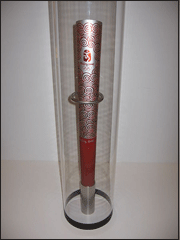
The torches generally burn a gas fuel, and are specially designed to resist the effects of wind and rain.
Relaying the Torch to Berlin
The Olympic torch relay began in 1936 at the Berlin Games. Carl Diem, the secretary general of the Organizing Committee of the Games of the XI Olympiad in Berlin, proposed using a torch relay to bring the flame from Olympia to the games in Germany. Modern historians have speculated that Adolf Hitler, then chancellor of Germany who believed in the supremacy of the Aryan race, pushed for the torch relay to symbolically link the Berlin games with the rituals and gods of Ancient Greece.
Losing the Olympic Spirit?
Critics state that the Olympic torch relay survives solely due to the support of commercial interests, rather than in the spirit of the original goals of the games: to promote greater contact and interchange between countries and athletes.
Protesting the Torch Relay
In 2008, protests by human rights groups disrupted the Olympic torch progression to Beijing. Protesters in Paris managed to briefly extinguish the torch and dozens of people were arrested in London after scuffling with police.
History: Relay, Winter Games
Since 1964, the Winter Games have also had a torch relay starting in Olympia. Of the three immediately preceding Winter Games, two (1952 and 1960) had torch relays starting in the fireplace of skiing pioneer Sondre Norheim, and one (1956) had a relay starting in Rome. The 1984 Winter Games were preceded by two torch relays, one from Norheim's fireplace, and the other from Olympia. The plan had been to mingle the two flames, lighting the cauldron with the combination, but this was disallowed; instead, only the Greek flame was used.
Trending
Here are the facts and trivia that people are buzzing about.