
Early 20th-Century Developments in Human Flight

Kitty Hawk to World War II
 The Wright brothers near Kitty Hawk, NC.
|
Although there is some debate about who was the first to fly an airplane, credit for this feat is usually given to Wilbur (1867–1912) and Orville Wright (1871–1948), who made four controlled, sustained flights in a powered heavier-than-air vehicle on Dec. 17, 1903, near Kitty Hawk, N.C. Interestingly, the Wrights never claimed to be the first to fly. The main claim of the Wright brothers, and their supporters, was that they were first to design and build a flying craft that gave the pilot adequate control while in the air. The unique feature of the Wright brothers' aircraft, beginning with their 1902 glider, was the ability to roll the wings right or left, to pitch the nose up or down, and to yaw the nose from side to side. A pilot must have control of all three dimensions—roll, pitch, and yaw—to navigate a plane. This development was perhaps the Wrights' greatest contribution to aviation.
One of the next major advancements in human flight came in response to a contest sponsored by The Daily Mail of London, which offered a prize to the first aviator to fly across the English Channel. Louis Blériot (1872–1936) won the contest, flying from Calais, France, to Dover, England, on July 25, 1909, in a monoplane of his own design with a 25-horsepower engine. His flight caused concern among the British that the airplane could eventually be used for military aggression, and the world came to see the airplane as a future weapon.
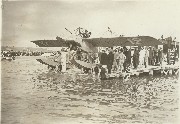 1913 Hydravion Race in Deauville, France
|
The pioneers of the seaplane were Henri Fabre (1882–1984) and Glenn H. Curtiss (1878–1930). Fabre is generally credited with making the first seaplane flight, on March 28, 1910, at Martigues, France. His seaplane, or hydravion, had a 50-horsepower Gnome rotary engine and was mounted on lightweight hollow wooden floats. The apparatus flew only short distances, however, and just two months later it was wrecked when it took a sudden nosedive into the Mediterranean. The first practical seaplane was constructed and flown by Curtiss in 1911, and in 1919 one of Curtiss's “flying boats” made the first transatlantic crossing (with stops). He became one of the most successful American aircraft builders in the decades following the invention of the airplane.
Aerobatics
 Antoine de Saint Exupery on a 50 franc note. Francs were replaced by Euros in 1999.
|
The American public may have known airplanes best for their acrobatic flying, or aerobatics, in the years immediately following the Wright brothers' flights because of large cash prizes offered by newspapers. Dubbed the “glorious year of flying,” 1913 was marked by races, competitions, and demonstrations. By flying upside-down and doing loops and other stunts, daredevil pilots proved the maneuverability of airplanes. Pilots also tested the mettle of airplanes in long-distance flights in 1913, including a 4,000-kilometer (2,500-mile) flight from France to Egypt (with stops) and the first nonstop flight from France to Tunisia across the Mediterranean Sea. The end of World War I left a large number of cheap airplanes available for barnstorming and stunt-flying and also for airmail, which was initiated in the mid-1920s. Famous pilots Charles Lindbergh (1902–1974) and Antoine de Saint Exupéry (1900–1944) were among the early airmail fliers.
Early Military Developments
Before 1914 militaries used airplanes mostly for surveying of enemy territory. (In 1913, the U.S. Army had only six active pilots and the fledgling U.S. aeronautical industry had fewer than 170 employees.) As World War I progressed, manufacturers began designing aircraft to carry guns, bombs, and torpedoes. Glenn H. Curtiss, the pioneer of the seaplane, established his own airplane company in 1916 and was a major supplier of aircraft equipment to the U.S. and Allied navies during World War I.
 The Fokker Eindecker was a German fighter plane in World War I.
|
On the other side of the Atlantic, Dutch-born aeronaut Anthony Herman Fokker (1890–1939) produced numerous planes for Germany, including the Fokker Eindecker (monoplane) fighter, which featured a machine gun that could fire through a moving propeller without hitting the blades. In the 1920s, Fokker established an aircraft company in New Jersey and set about designing aircraft for the fledgling U.S. commercial aviation industry. The first nonstop flight across the United States was made in a Fokker T-2 in 1923.
Another important development during World War I was the family of engines known as Liberty engines, which featured interchangeable parts and went on to be used in civilian as well as military applications through World War II and beyond.
Commercial Aviation
Commercial air passenger service began in the United States (and in the world) in 1914, with a regularly scheduled flight that carried passengers between St. Petersburg and Tampa, Fla. However, there was little demand for commercial aviation and it developed slowly until after World War II. Most of the development in the aeronautical industry prior to World War II happened in the military sphere and was overseen by the National Advisory Committee on Aeronautics (NACA), which was established by Congress in 1915. The period between the two World Wars was a time for improvements in airfoils, propellers, engines, and instruments and innovations in construction techniques and materials.
To regulate the aeronautic industry, the U.S. Congress passed the Air Commerce Act of 1926, which created a Bureau of Aeronautics within the Commerce Department. The bureau moderated commercial airlines, licensed pilots, and certified aircraft. Further regulation of passenger safety, route markings, and air traffic control was provided by the Civil Aeronautics Act of 1938 and the Civil Aeronautics Board and Civil Aeronautics Administration Act (1940).
Technological Advancements
Certain advancements during the 1920s in the design and technology of aircraft gave the United States a new role in the international sphere of aviation. Improvements in wind-tunnel testing, engine and airframe design, and maintenance equipment made for better-performing airplanes. As a result, private planes became less expensive and, in turn, grew in number and popularity.
The development of the autopilot can be traced back to 1908, when Elmer Sperry (1860–1930) introduced a type of gyrocompass that was later used in ship piloting systems (magnetic compasses were unreliable in steel-hulled ships). In 1929, Sperry's company tested a similar device for aircraft, as well as another device, the artificial horizon. These instruments, which enabled the pilot to fly without seeing the ground below, were rapidly installed aboard mail and commercial airplanes.
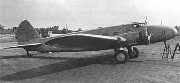 First modern airliner, Boeing 247 in 1933.
|
Important planes of the interwar period were Boeing's 247, introduced in 1933 and considered to be the first modern airliner. In order to compete, the Douglas Aircraft Company created its DC line: DC-1, DC-2, and DC-3. Boeing countered with its Model 307 Stratoliner. However, the DC-3, which went into service in 1936, is generally considered the first commercially popular (and profitable) plane. It had a number of innovative design features, including a retractable landing gear, and with twin 1,200-horsepower engines it could reach a maximum speed of 230 mph. A variant of the DC-3, the C-47, became the mainstay of the military's transport fleet in World War II.
Growing demand for passenger airline service soon pushed the aviation industry to even further advancements in passenger capacity and comfort, new elevation capabilities, and speed.
Trending
Here are the facts and trivia that people are buzzing about.




