Thomas Woodrow Wilson
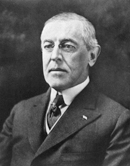
Thomas Woodrow Wilson
Birthplace: Staunton, Va.
(Thomas) Woodrow Wilson was born in Staunton, Va., on Dec. 28, 1856. A Princeton graduate, he turned from law practice to post-graduate work in political science at Johns Hopkins University, receiving his Ph.D. in 1886. He taught at Bryn Mawr, Wesleyan, and Princeton, and in 1902 was made president of Princeton. After an unsuccessful attempt to democratize the social life of the university, he welcomed an invitation in 1910 to be the Democratic gubernatorial candidate in New Jersey, and was elected. His success in fighting the machine and putting through a reform program attracted national attention.
In 1912, at the Democratic convention in Baltimore, Wilson won the nomination on the 46th ballot and went on to defeat Roosevelt and Taft in the election. Wilson proceeded under the standard of the New Freedom to enact a program of domestic reform, including the Federal Reserve Act, the Clayton Antitrust Act, the establishment of the Federal Trade Commission, and other measures designed to restore competition in the face of the great monopolies. In foreign affairs, while privately sympathetic with the Allies, he strove to maintain neutrality in the European war and warned both sides against encroachments on American interests.
Reelected in 1916 as a peace candidate, he tried to mediate between the warring nations; but when the Germans resumed unrestricted submarine warfare in 1917, Wilson brought the United States into what he now believed was a war to make the world safe for democracy. He supplied the classic formulations of Allied war aims and the armistice of Nov. 11, 1918, was negotiated on the basis of Wilson's Fourteen Points. In 1919 he strove at Versailles to lay the foundations for enduring peace. He accepted the imperfections of the Versailles Treaty in the expectation that they could be remedied by action within the League of Nations. He probably could have secured ratification of the treaty by the Senate if he had adopted a more conciliatory attitude toward the mild reservationists; but his insistence on all or nothing eventually caused the diehard isolationists and diehard Wilsonites to unite in rejecting a compromise.
In Sept. 1919 Wilson suffered a paralytic stroke that limited his activity. After leaving the presidency he lived on in retirement in Washington, dying on Feb. 3, 1924. He was married twice—in 1885 to Ellen Louise Axson, who died in 1914, and in 1915 to Edith Bolling Galt.
See also Encyclopedia: Woodrow Wilson.
Died: 2/3/1924| William Howard Taft | Biographies of the Presidents | Warren Gamaliel Harding |
Trending
Here are the facts and trivia that people are buzzing about.