Congo, Democratic Republic of the | Facts & Information

- Congo, Democratic Republic of the Profile
- History
- News and Current Events
Infoplease has everything you need to know about Congo, Democratic Republic of the. Check out our country profile, full of essential information about Congo, Democratic Republic of the's geography, history, government, economy, population, culture, religion and languages. If that's not enough, click over to our collection of world maps and flags.
Facts & Figures
Geography
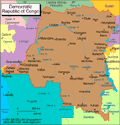
The Congo, in west-central Africa, is bordered by the Republic of Congo, the Central African Republic, the Sudan, Uganda, Rwanda, Burundi, Tanzania, Zambia, Angola, and the Atlantic Ocean. It is one-quarter the size of the U.S. The principal rivers are the Ubangi and Bomu in the north and the Congo in the west, which flows into the Atlantic. The entire length of Lake Tanganyika lies along the eastern border with Tanzania and Burundi.
Government
Transitional government.
History
Formerly the Belgian Congo, this territory was inhabited by ancient Negrito peoples (Pygmies), who were pushed into the mountains by Bantu and Nilotic invaders. The American correspondent Henry M. Stanley navigated the Congo River in 1877 and opened the interior to exploration. Commissioned by King Leopold II of the Belgians, Stanley made treaties with native chiefs that enabled the king to obtain personal title to the territory at the Berlin Conference of 1885.
Leopold accumulated a vast personal fortune from ivory and rubber through Congolese slave labor; 10 million people are estimated to have died from forced labor, starvation, and outright extermination during Leopold's colonial rule. His brutal exploitation of the Congo eventually became an international cause célèbre, prompting Belgium to take over administration of the Congo, which remained a colony until agitation for independence forced Brussels to grant freedom on June 30, 1960. In elections that month, two prominent nationalists won: Patrice Lumumba of the leftist Mouvement National Congolais became prime minister and Joseph Kasavubu of the ABAKO Party became head of state.
But within weeks of independence, the Katanga Province, led by Moise Tshombe, seceded from the new republic, and another mining province, South Kasai, followed. Belgium sent paratroopers to quell the civil war, and the United Nations flew in a peacekeeping force.
Newly Independent Congo Plunges into Civil War
Kasavubu staged an army coup in 1960 and handed Lumumba over to the Katangan forces. A UN investigating commission found that Lumumba had been killed by a Belgian mercenary in the presence of Tshombe, who was then the president of Katanga. U.S. and Belgian involvement in the assassination have been alleged. In a possibly related development, Dag Hammarskjold, UN secretary-general, died in a plane crash en route to a peace conference with Tshombe on Sept. 17, 1961.
Tshombe rejected a national reconciliation plan submitted by the UN in 1962. Tshombe's troops fired on the UN force in December, and in the ensuing conflict Tshombe capitulated on Jan. 14, 1963. The peacekeeping force withdrew, and, in a complete about-face, Kasavubu named Tshombe premier in order to fight a spreading rebellion. Tshombe used foreign mercenaries, and, with the help of Belgian paratroops airlifted by U.S. planes, defeated the most serious opposition, a Communist-backed regime in the northeast.
Power-Hungry Mobutu Gains Control, Wreaks Havoc
Kasavubu abruptly dismissed Tshombe in 1965 but was then himself ousted by Gen. Joseph-Desiré Mobutu, army chief of staff. The new president nationalized the Union Minière, the Belgian copper mining enterprise that had been a dominant force in the Congo since colonial days. Mobutu eliminated opposition to win the election in 1970. In 1975, he nationalized much of the economy, barred religious instruction in schools, and decreed the adoption of African names. He changed the country's name to Zaire and his own to Mobuto Sese Seko, which means “the all-powerful warrior who, because of his endurance and inflexible will to win, will go from conquest to conquest leaving fire in his wake.” In 1977, invaders from Angola calling themselves the Congolese National Liberation Front pushed into Shaba (Katanga) and threatened the important mining center of Kolwezi. France and Belgium provided military aid to defeat the rebels.
Laurent Kabila Topples Mobutu
Laurent Kabila and his long-standing but little-known guerrilla movement launched a seven-month campaign that ousted Mobutu in May 1997, ending one of the world's most corrupt and megalomaniacal regimes. The last of the CIA-nurtured cold war despots, Mobutu deftly courted France and the U.S., which used Zaire as a launching pad for covert operations against bordering countries, particularly Marxist Angola. Mobutu's disastrous policies drove his country into economic collapse while he siphoned off millions of dollars for himself.
The country was renamed the Democratic Republic of the Congo in 1997, which had been its name before Mobutu changed it to Zaire in 1971. But elation over Mobutu's downfall faded as Kabila's own autocratic style emerged, and he seemed devoid of a clear plan for reconstructing the country. In Aug. 1998, Congolese rebel forces, backed by Kabila's former allies, Rwanda and Uganda, gained control of a large portion of the country until Angolan, Namibian, and Zimbabwean troops came to Kabila's aid. In 1999, the Lusaka Accord was signed by all six of the countries involved, as well as by most, but not all, of the various rebel groups.
Son of Assassinated Leader Kabila Oversees End of Congo's Civil War
In Jan. 2001, Kabila was assassinated, allegedly by one of his bodyguards. His young and inexperienced son Joseph became the new president. He demonstrated a willingness to engage in talks to end the civil war. In April 2002, the government agreed to a power-sharing arrangement with Ugandan-supported rebels and signed a peace accord with Rwanda and Uganda. More than 2.5 million people are estimated to have died in the Congo's complex four-year civil war, which involved seven foreign armies and numerous rebel groups that often fought among themselves.
On July 17, 2003, the Congo's new power-sharing government was inaugurated, but the fighting and killing continued. In April 2003, hundreds of civilians were massacred in the eastern province of Ituri in an ethnic conflict. In 2004, an insurgency in Bukavu erupted, other areas of the Congo grew restive, and Rwanda continued to support various rebel groups fighting the government. By the end of 2004, the death toll from the conflict had reached 3.8 million.
Government and Rebels Led by Laurent Nkunda Declare a Cease-fire
Despite instability, political progress continued. In May 2005, a new constitution was adopted by the national assembly, and overwhelmingly ratified in Jan. 2006. On July 30, 2006, the first democratic election in the country since 1970 took place. President Kabila received 44.8% of the vote, which was not enough to win the election outright. Fighting broke out between factions supporting the two major candidates, setting off the worst violence the country has seen since the 2002 peace deal was signed. Kabila was declared the winner in the October run-off election, winning 58% of the vote, the country's first freely elected president in four decades.
In August 2007, a rebel general, Laurent Nkunda, led battles between his militia, made up of fellow Tutsis, and the Congolese Army. The fighting continued throughout the year, driving hundreds of thousands of people from their homes in eastern Congo and threatening to spiral the already fragile country back into civil war. Nkunda claimed he was protecting Tutsis from extremist Rwandan Hutus. In January 2008, the government and the rebels signed an agreement that had both sides withdrawing their troops and the rebels disarming and eventually being integrated into the national army. The cease-fire fell apart in August, and fighting resumed between Nkunda's militia and the army. By the end of October 2008, the rebels had captured the major army base of Rumangaboebel and were advancing towad Goma, the capital of North Kivu province. In addition, angry civilians attacked UN peacekeeping troops, who proved ineffectual in both thwarting the rebels and protecting citizens. Nkunda was arrested in January 2009, and a cease-fire was signed on March 23, 2009. Members of Nkunda's militia joined the government forces. The militaries of Congo and Rwanda worked together to eliminate remaining rebel fighters from eastern Congo. The joint mission lasts about five weeks.
A report released in January 2008 by the International Rescue Committee found that despite billions in aid, the deployment of the world's largest peacekeeping force, and successful democratic elections, some 45,000 people continue die each month in Congo, mostly from starvation and disease.
Kabila Reelected in Vote Marred by Violence
Prime Minister Antoine Gizenga resigned in September 2008, citing health reasons. He was succeeded by Adolphe Muzito.
Presidential elections were held in November 2011. Incumbent Kabila faced opposition leader and former prime minister Étienne Tshisekedi. The International Crisis Group deemed the election "unruly" and "chaotic" and other international observers said the vote was irregular and flawed. Nearly 20 people were killed in election-related violence. Nevertheless, Congo's election commission ruled in December that Kabila prevailed, 49% to 32%. In the run-up to the election, Kabila—perhaps sensing a threat from the opposition and popular dissatisfaction with his rule—amended the constitution to do away with a second round of voting and stacked the electoral commission.
In March 2012, Prime Minister Adolphe Muzito resigned. His resignation came a little over three months after the violent presidential elections. Deputy Prime Minister Louis Koyagialo was appointed to temporarily replace Muzito. On April 18, 2012, former Minister of Finance Augustin Matata Ponyo Mapon was named prime minister.
Lubanga Case Establishes Child Soldiers as an International Crime
On March 14, 2012, Thomas Lubanga was convicted of using child soldiers during the ethnic conflict in the Ituri region. A former militia leader, Lubanga had been on trial for three-years and may receive life imprisonment. The use of child soldiers occurred in 2002 and 2003. The ruling made by the International Criminal Court was significant. It established the use of child soldiers as an international crime.
Former Rebels Resume Battle With the Government
In the spring of 2012, the former rebels who were integrated into the army in 2009 mutinied, saying the government—rife with corruption—had reneged on terms of the cease-fire that was signed on March 23, 2009. The rebels, called the M23 movement, are led by Gen. Bosco Ntaganda, a Tutsi who is wanted by the International Criminal Court. M23 fought government troops throughout the year, taking over city after city. The violence peaked in November, when the rebels took Goma in eastern Congo. Rwanda, which is led by Tutsi Paul Kagame, is widely suspected of not only supplying arms to the rebels but also fighting alongside them.
The UN and leaders from 11 central African nations, including the presidents of Congo, Rwanda, Uganda, and Congo, signed a framework agreement in February 2013, pledging to work together to end the conflict with the rebels. In March, the UN Security Council authorized an "intervention brigade" of 3,000 troops to disarm the rebels. The brigade supplemented the 15,000 UN peacekeeping troops already in Congo. After heavy fighting in August, the UN brigade forced the rebels out of Goma. However, the signers of the framework agreement had made little progress in the peace process.
Ntaganda turned himself in to the U.S. embassy in Kigali, Rwanda, in March 2013. He was transferred to the Hague, where he will face charges of war crimes and crimes against humanity. It was not clear why he chose to surrender.
The M23 rebels surrendered in November 2013. The UN's more aggressive approach, an improved Congolese Army, and a reduction in aid to Rwanda contributed to the defeat of the rebels.
See also Encyclopedia: Congo (Kinshasa)
U.S. State Dept. Country Notes: Congo (Kinshasa)