
Taiwan | Facts & Information

- Taiwan Profile
- History
- News and Current Events
Facts & Figures
-
President-elect: Tsai Ing-wen (2016)
Premier: Simon Chang (2016)
Land area: 12,456 sq mi (32,261 sq km); total area: 13,892 sq mi (35,980 sq km)
Population (2014 est.): 23,359,928 (growth rate: 0.25%); birth rate: 8.55/1000; infant mortality rate: 4.49/1000; life expectancy: 79.84
Capital (2014 est.): Taipei, 6,950,646 (metro. area), 2,693,672 (city proper)
Other large cities: New Taipei, 3,913,595; Kaohsiung, 2,773,855; Taichung, 2,662,770; Tainan, 1,876,706; Hsinchu, 419,384
Monetary unit: New Taiwan dollar
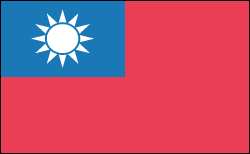
Republic of China
National name: Zhonghua Minguo
Languages: Chinese (Mandarin, official), Taiwanese (Min), Hakka dialects
Ethnicity/race: Taiwanese (including Hakka) 84%, mainland Chinese 14%, aborigine 2%
Religions: mixture of Buddhist, Confucian, and Taoist 93%, Christian 4.5%, other 2.5%
Literacy rate: 96.1% (2003)
Economic summary: GDP/PPP (2013 est.): $926.4 billion; per capita $39,600. Real growth rate: 2.2%. Inflation: 1.1%. Unemployment: 4.1%. Arable land: 24%. Agriculture: rice, vegetables, fruit, tea, flowers, pigs, poultry, fish. Labor force (2013 est.): 11.55 million; agriculture 5%, industry 36.2%, services 58.8% (2012 est). Industries: electronics, communications and information technology products, petroleum refining, chemicals, textiles, iron and steel, machinery, cement, food processing, vehicles, consumer products, pharmaceuticals. Natural resources: small deposits of coal, natural gas, limestone, marble, asbestos. Exports: $305.8 billion (2013 est.): electronics, flat panels, machinery; metals; textiles, plastics, chemicals; optical, photographic, measuring, and medical instruments. Imports: $268.5 billion (2013 est.): electronics, machinery, crude petroleum, precision instruments, organic chemicals, metals
Major trading partners: China, U.S., Hong Kong, Japan, Singapore (2012).
Communications: Telephones: main lines in use: 15.998 million (2012); mobile cellular: 29.455 million (2011). Broadcast media: free-to-air nationwide television networks operating roughly 75 TV stations; about 85% of households utilize multi-channel cable TV; national and regional radio networks with about 170 radio stations broadcasting (2008) Internet hosts: 6.272 million (2012). Internet users: 16.147 million (2009).
Transportation: Railways: total: 1,580 km (2010). Highways: total: 41,475 km; paved: 41,033 km (including 720 km of expressways); unpaved: 442 km (2009). Ports and harbors: Chilung (Keelung), Hualien, Kaohsiung, Taichung. Airports: 37 (2013).
International disputes: involved in complex dispute with Brunei, China, Malaysia, the Philippines, and Vietnam over the Spratly Islands, and with China and the Philippines over Scarborough Reef; the 2002 "Declaration on the Conduct of Parties in the South China Sea" has eased tensions but falls short of a legally binding "code of conduct" desired by several of the disputants; Paracel Islands are occupied by China, but claimed by Taiwan and Vietnam; in 2003, China and Taiwan became more vocal in rejecting both Japan's claims to the uninhabited islands of the Senkaku-shoto (Diaoyu Tai) and Japan's unilaterally declared exclusive economic zone in the East China Sea where all parties engage in hydrocarbon prospecting.
Geography
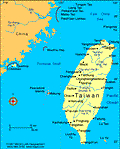
The Republic of China today consists of the island of Taiwan, an island 100 mi (161 km) off the Asian mainland in the Pacific; two off-shore islands, Kinmen (Quemoy) and Matsu; and the nearby islets of the Pescadores chain. It is slightly larger than the combined areas of Massachusetts and Connecticut.
Government
Multiparty democracy.
History
Taiwan was inhabited by aborigines of Malayan descent when Chinese from the areas now designated as Fukien and Kwangtung began settling it in the 7th century, becoming the majority. The Portuguese explored the area in 1590, naming it “the Beautiful” (Formosa). In 1624 the Dutch set up forts in the south, the Spanish in the north. The Dutch forced out the Spanish in 1641 and controlled the island until 1661, when Chinese general Koxinga took it over and established an independent kingdom. The Manchus seized the island in 1683 and held it until 1895, when it passed to Japan after the first Sino-Japanese War. Japan developed and exploited Formosa. It was the target of heavy American bombing during World War II, and at the close of the war the island was restored to China.
After the defeat of its armies on the mainland, the Nationalist government of Generalissimo Chiang Kai-shek retreated to Taiwan in Dec. 1949. Chiang dominated the island, even though only 15% of the population consisted of the 1949 immigrants, the Kuomintang. He maintained a 600,000-man army in the hope of eventually recovering the mainland. Beijing viewed the Taiwanese government with suspicion and anger, referring to Taiwan as a breakaway province of China.
The UN seat representing all of China was held by the Nationalists for over two decades before being lost in Oct. 1971, when the People's Republic of China was admitted and Taiwan was forced to abdicate its seat to Beijing.
Breaking from Mainland Influence
Chiang died at 87 of a heart attack on April 5, 1975. His son, Chiang Ching-kuo, continued as prime minister and was a dominant figure in the Taipei regime. In April 1991, President Lee Teng-hui formally declared an end to emergency rule, which had existed since Chiang's forces originally occupied the island. In the first full election in many decades, the governing Kuomintang in Dec. 1991 won 71% of the vote, affirming the island's opposition to reunification with China. In Feb. 1993 the president, himself a native Taiwanese, nominated Lien Chan, another native, to be prime minister, marking a further generational shift away from the mainland exiles.
In the island's first free presidential election, voters defied mainland intimidation and gave 54% of the vote to incumbent president Lee Teng-hui.
In 1998, Taiwan renewed its push for a separate UN seat—its sixth attempt in recent years. The move has been blocked each time by the Beijing government.
President Lee Teng-hui rankled mainland China by announcing in July 1999 that he was abandoning the long-standing “One China” policy that had kept the peace between the small island and its powerful neighbor and that he would from then on deal with China on a “state-to-state basis.” China, which had vowed to someday unite Taiwan with the mainland, retaliated by conducting submarine warfare exercises and missile tests near the island in an effort to intimidate its tiny brazen neighbor, as it had once before in 1996.
New President Brings New Beginning
In the March 2000 presidential race, voters elected pro-independence candidate Chen Shui-bian of the Democratic Progressive Party, ending more than 50 years of Nationalist rule.
Taiwan joined the World Trade Organization in Jan. 2002, just one day after China gained entry. In August President Chen outraged China when he asserted that Taiwan and China are separate countries and that a referendum on independence for Taiwan is a “basic human right.”
The day before the March 20, 2004, elections, President Chen Shui-bian and Vice President Annette Lu survived an assassination attempt. Chen won the election over Lien Chan by just 30,000 votes out of 13 million cast. The country's first-ever referendum failed because less than 50% of eligible voters weighed in on its questions. The referendum asked if Taiwan should arm itself with additional defensive weapons if China does not withdraw its missiles and if Taiwan should continue to negotiate with China.
Heightened Tensions
Tension between China and Taiwan intensified in March 2005, when China passed an antisecession law that said the country could use force if Taiwan moved toward achieving independence. “The state shall employ non-peaceful means and other necessary measures to protect China's sovereignty and territorial integrity,” the legislation stated. Taiwan president Chen Shui-bian called the bill a “law of aggression.” Hundreds of thousands of Taiwanese took to the streets to protest the bill.
In 2005, China met with several Taiwanese opposition leaders in an effort to undermine Taiwan's defiant president. Lien Chan, who heads the opposition Nationalist Party, traveled to China in April and met with President Hu Jintao. It was the first meeting between Nationalist and Communist Party leaders since 1949, when the defeated Nationalists retreated to Taiwan. Lien called the visit a “journey of peace.” In May, Hu met with another opposition leader, James Soong, chairman of the People First Party. In a joint communiqué intended to restart negotiations between Taiwan and China, they agreed to a principle of “two sides of the strait, one China.”
President Chen tested China in February 2006, when he announced that he was rescinding the National Unification Council, a group that was established in 1990 to deal with reunification issues with China. He stopped short of abolishing the council, saying, “Taiwan has no intention of changing the status quo.”
In June 2006, Taiwan's legislature initiated proceedings to oust President Chen because of allegations of corruption involving his family and senior administration officials, but the motion failed later that month. In November, prosecutors indicted Wu Shu-chen, the wife of President Chen Shui-ban, charging that she spent $450,000 in public funds on personal expenditures. Authorities also said that President Chen submitted fake receipts when drawing from the same fund and lied about how he spent the money.
Prime Minister Su Tseng-chang resigned in May 2007. President Chen Shui-bian appointed Chang Chun-hsiung as his successor.
Independence Rejected
In parliamentary elections in January 2008, the opposition Kuomintang soundly defeated Chen's Democratic Progressive Party, taking 81 out of 113 seats. President Chen resigned as head of the party. The result of vote was considered a rejection of Chen's policy of edging toward independence from China. Taiwan continued its move toward warmer relations with China in March, when Ma Ying-jeou, of Kuomintang, prevailed over Frank Hsieh, of the Democratic Progressive Party, 58.4% to 41.6%, in presidential elections. Ma's victory ended eight years of Democratic Progressive Party rule. Ma said he planned to pursue closer ties with China and spur Taiwan's economic growth. Ma, however, does not favor political reunification with China.
Ma reinforced his desire to pursue closer ties to mainland China in June when he outlined his economic plan. He called for access to China’s financial markets for Taiwanese businesses, regular passenger flights and cargo passage across the Taiwan Strait, among other proposals. He insisted, however, that China remove the short- and medium-range missiles facing Taiwan before he will engage in peace talks with China. Ma realized several of his goals in November, Chen Yunlin, the head of the Chinese organization that negotiates with Taiwan, visited the island, becoming the most senior mainland official to do so since 1949. He met President Ma and signed several pacts that will lead to a signficant increase in transportion and shipments of food between the two sides.
Political Leaders Stumble, Fall
Former president Chen, who lost a reelection bid in March 2008, was arrested in November 2008 and charged with corruption and embezzling money from a state affairs fund. Chen, who has long asserted that Taiwan and China are separate countries, denied the allegations, claiming he was being persecuted to appease China. He was convicted of the charges and in Sept. 2009 was sentenced to life in prison.
In Aug. 2009, Typhoon Morakot caused a mudslide in a rural mountain village in southern Taiwan that buried schools, homes, and killed at least 600 people. Prime Minister Liu Chao-shiuan resigned in September amid withering criticism of the government's slow response to the typhoon and its failure to evacuate residents before the storm hit.
Taiwan and China Benefit from Trade Agreement
Taiwan and China signed the Economic Co-operation Framework Agreement, a landmark free-trade agreement in June 2010 that lifted or reduced hundreds of tariffs for both sides. Officials from both Taiwan and China described the deal as the most important achievement since the 1949 civil war. Taiwan seemed poised to benefit more economically from the deal than China, and China saw a political benefit as the agreement brings the two closer together.
On June 30, 2011, ex-president Lee Teng-hui was indicted on charges of embezzlement. Upon delivery of the 23-page indictment, the 88-year-old Mr. Lee, accused of siphoning $7.79 million from a National Security Bureau fund during his presidency, became the second Tawainese president to be charged with fraud.
President Ma Ying-jeou was re-elected in January 2012 in a close race with Tsai Ing-wen, who was Taiwan's first female presidential candidate. The business community breathed a sigh of relief when Ma won reelection. Taiwan's economy has prospered since the 2010 free-trade agreement with China and relations have thawed. However, not all Taiwanese have benefitted as house prices have soared and the income disparity has grown. Tsai's supporters expressed fear that Ma was getting too close to China.
On February 6, 2012, Sean Chen assumed office as the premier. Almost exactly a year later, Sean Chen stepped down due to health problems. In his one year as the premier, he faced severe public criticism, partly due to the country's difficult economic issues. He was replaced by Vice Premier Jiang Yi-huah.
High-ranking officials from China and Taiwan met in Nanking, China, in February 2014. It was the first time since the 1949 split that minister-level officials held talks. While the meeting was largely symbolic, it signalled that both sides want to maintain stability and develop warmer ties.
Fallout over Closer Ties to China and Poor Economy
Hundreds of protesters, mostly students, occupied Parliament in March 2014, demonstrating against implementation of a service trade agreement with China. The deal is part of the controversial Economic Co-operation Framework Agreement Taiwan signed with China in 2010. Protesters said the trade agreement would hurt Taiwan's small businesses and give China further influence over Taiwan. They also objected to a lack of transparency in passing the agreement. President Ma defended the deal. "Regional economic integration is an unstoppable global trend. If we do not face this and join in the process, it will only be a matter of time before we are eliminated from the competition," he said. "For the sake of the nation's development, we truly have no choice."
Voters expressed their disappointment in the closer relations with China and its failure to improve Taiwan's stalled economy by voting against Kuomintang, the ruling party in the Nov. 2014 local elections. Premier Jiang Yi-huah took responsibility for his party's defeat, and his cabinet resigned soon after the election. President Ma Ying-jeou resigned as chairman of Kuomintang. He was replaced by Eric Chu, the mayor of Taipei. On Dec. 8, 2014, Mao Chi-kuo was named premier. Previously, he served as vice premier in Jaing Yi-huah's cabinet for almost two years.
In early Nov. 2015, a meeting was announced between the presidents of Taiwan and China. They met for first time since 1949, when the Chinese revolution ended. The meeting between Chinese President Xi Jinping and Taiwanese President Ma Ying-jeou was seen as a test on the thawing relations between the two countries. The two leaders met during the weekend of Nov. 7-8 in Singapore, a neutral territory on good terms with both countries. It was seen by many observers as the last chance for China to push for closer ties economically and politically before Taiwan headed into presidential and legislative elections in Jan. 2016.
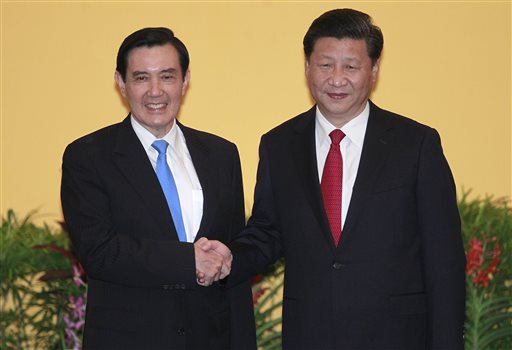
Taiwanese President Ma Ying-jeou and Chinese President Xi Jinping, Nov. 2015
Source: AP Photo/Chiang Ying-ying
Taiwan Elects First Female President
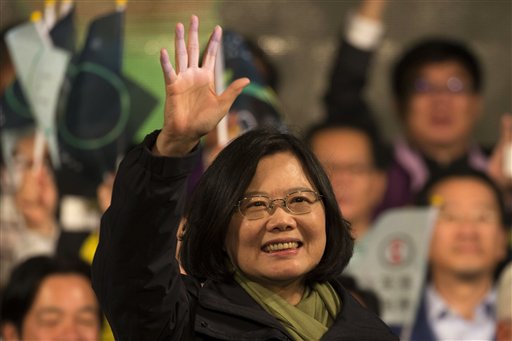
President-elect Tsai Ing-wen
Source: AP Photo/ Ng Han Guan
In Jan. 2016 presidential elections, Democratic Progressive Party chairwoman and nominee Tsai Ing-wen came in first with 56.1% of the vote, followed by Kuomintang's Eric Chu with 31%, and the People First Party's James Soong with 12.8%. The first woman elected president of Taiwan, Tsai was scheduled to take office on May 20, 2016. Tsai was also the first unmarried president elected as well as the first to have never held another elected post.
Two days after the election, Premier Mao Chi-Kuo attempted to resign, but President Ma Ying-jeou rejected the resignation, prompting Mao to take a leave of absence. Vice Premier Simon Chang became premier on Feb. 1.
On Feb. 6, 2016, a 6.4 magnitude earthquake hit Taiwan and killed at least 59 people. The death toll was expected to rise with 76 people still missing, presumably trapped under one collapsed residential building, according to Taiwan's Ministry of Interior. Three executives from the construction company of the collapsed building were arrested under suspicion of negligence. Government prosecutors made the arrests because the building, built in 1989, had not been properly reinforced.
See also Encyclopedia: Taiwan .
U.S. State Dept. Country Notes: Taiwan
Directorate General of Budget, Accounting and Statistics www.stat.gov.tw/ .
See also Timeline: Taiwan Key Events (1945–Present) .
Trending
Here are the facts and trivia that people are buzzing about.




