Geography
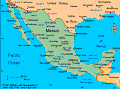
Mexico is bordered by the United States to the north and Belize and Guatemala to the southeast. Mexico is about one-fifth the size of the United States. Baja California in the west is an 800-mile (1,287-km) peninsula that forms the Gulf of California. In the east are the Gulf of Mexico and the Bay of Campeche, which is formed by Mexico's other peninsula, the Yucatán. The center of Mexico is a great, high plateau, open to the north, with mountain chains on the east and west and with ocean-front lowlands beyond.
Government
Federal republic.
History
At least three great civilizations—the Mayas, the Olmecs, and the Toltecs—preceded the wealthy Aztec empire, conquered in 1519–1521 by the Spanish under Hernando Cortés. Spain ruled Mexico as part of the viceroyalty of New Spain for the next 300 years until Sept. 16, 1810, when the Mexicans first revolted. They won independence in 1821.
From 1821 to 1877, there were two emperors, several dictators, and enough presidents and provisional executives to make a new government on the average of every nine months. Mexico lost Texas (1836), and after defeat in the war with the U.S. (1846–1848), it lost the area that is now California, Nevada, and Utah, most of Arizona and New Mexico, and parts of Wyoming and Colorado under the Treaty of Guadalupe Hidalgo. In 1855, the Indian patriot Benito Juárez began a series of reforms, including the disestablishment of the Catholic Church, which owned vast property. The subsequent civil war was interrupted by the French invasion of Mexico (1861) and the crowning of Maximilian of Austria as emperor (1864). He was overthrown and executed by forces under Juárez, who again became president in 1867.
Economic Growth
Following World War II, the government emphasized economic growth. During the mid-1970s, under the leadership of President José López Portillo, Mexico became a major petroleum producer. By the end of Portillo's term, however, Mexico had accumulated a huge external debt because of the government's unrestrained borrowing on the strength of its petroleum revenues. The collapse of oil prices in 1986 cut Mexico's export earnings. In Jan. 1994, Mexico joined Canada and the United States in the North American Free Trade Agreement (NAFTA), with the plan to phase out all tariffs over a 15-year period, and in Jan. 1996, it became a founding member of the World Trade Organization (WTO).
In 1995, the U.S. agreed to prevent the collapse of Mexico's private banks. In return, the U.S. won virtual veto power over much of Mexico's economic policy. In 1997, in what observers called the freest elections in Mexico's history, the PRI lost control of the lower legislative house and the mayoralty of Mexico City in a stunning upset. To increase democracy, President Ernesto Zedillo said in 1999 that he would break precedent and not personally choose the next PRI presidential nominee. Several months later, Mexico held its first presidential primary, which was won by former interior secretary Francisco Labastida, Zedillo's closest ally among the candidates.
Turn of the Century Brings Political Changes
In elections held on July 2, 2000, the PRI lost the presidency, ending 71 years of one-party rule. The new president, Vicente Fox Quesada of the conservative National Action Party (PAN), vowed tax reform, an overhaul of the legal system, and a reduction in power of the central government. By 2002, however, Fox had made little headway on his ambitious reform agenda. Disfavor with Fox was evident in 2003 parliamentary elections, when the PRI rebounded.
In 2004, a two-year investigation into the “dirty war,” which Mexico's authoritarian government waged against its opponents in the 1960s and 1970s, led to an indictment—later dropped—against former president Luis Echeverria for ordering the 1971 shooting of student protesters.
In 2005, Andrés Manuel López Obrador, the enormously popular mayor of Mexico City, emerged as a presidential candidate for the leftist Party of the Democratic Revolution. López Obrador seemed likely to defeat the party of the deeply unpopular incumbent, Vicente Fox. But in Oct. 2005, Felipe Calderón unexpectedly became the candidate of Fox's National Action Party (PAN), defeating Fox's chosen successor. By spring 2006, Felipe Calderón had caught up to López Obrador in opinion polls. In the July election, Calderón won 35.9% of the vote, a razor-thin margin over López Obrador, who received 35.3%. López Obrador appealed the election, but on Aug. 28, Mexico's top electoral court rejected López Obrador's allegations of fraud. His supporters held massive protest rallies before and after the verdict. Calderón was sworn in on Dec. 1. He vowed to make fighting the drug cartels a top priority, and he dispatched tens of thousands of soldiers and police to confront them.
Violence Plagues the Country
In May 2008, Attorney General Eduardo Medina Mora announced that over 4,000 people had been killed in drug-related violence since President Calderon took office—1,400 of the deaths occurred in 2008 alone.
In Aug. 2008, hundreds of thousands of protesters across the country marched for the more than 2,700 people who were killed and 300 kidnapped in drug-related violence since January 2008. In Dec. 2008, the number of killings registered between 1 January and 2 December was 5,376—a rise of 117% from the previous year. In Nov. 2008 alone, there were 943 drug-related murders.
In Dec. 2008, the U.S. released $197 million of a $400 million plan called the Merida Initiative to help Mexico fight the drug cartels, yet drug violence continued mostly unabated. By the end of 2009, an estimated 6,500 people had been killed in drug-related violence.
Late April and early May 2009 brought a new challenge: a flu outbreak. A new strain of influenza, known as swine flu, originated in Mexico and spread to at least 24 other countries. The World Health Organization declared that a pandemic was a possibility. Originally, Swine Flu was thought to be quite dangerous, though as time passed, Mexican authorities said they may have overestimated the threat. As a precaution, the Mexican government shut down all nonessential business for five days starting on May 1, 2009. Other governments limited travel to and from Mexico.
Despite Calderón's pledge to bring down the drug cartels, drug-related violence escalated into 2010. After the fatal shooting in March 2010 of a pregnant U.S. consulate employee by an alleged drug trafficker, Calderón stepped up his pressure on the U.S. to take responsibility for its role in the crisis; U.S. arms traffickers supply weapons to the cartels and drug users in the U.S. are consumers of Mexican drugs. As the violence spilled over into the U.S., officials did in fact acknowledge the country's role in the growing problem and the potential risks to U.S. national security. The U.S. and Mexico revised their counternarcotics strategy with a $330 million program intended to expand the Merida Initiative, which was begun under President Bush. The plan includes strengthening poor communities to give citizens alternatives to crime, better screening at the border, and shifting the focus of funding from military equipment to a civilian police force that will patrol Tijuana and Ciudad Juárez.
Drug-Related Violence Continues
More than 34,600 deaths due to drug-related violence have been reported in President Felipe Calderón's first four years of office. According to the government, 2010 was the heaviest year yet with 15,237 people being killed. In October 2010, the government announced its plan to do away with the country's 2,200 local police department and place all officers under one unified command.
In Feb. 2011, the U.S. began flying unarmed drones over Mexico to collect and turn over information to Mexican law enforcement agencies. One drone reportedly provided information on suspects linked to the Feb. 15 killing of Jaime Zapata, a U.S. Immigration and Customs Enforcement agent. In July 2011, violence broke out in several cities. Over 20 people were killed in Monterrey when armed men began firing on a bar. During the same weekend, 11 people were found dead from gunshot wounds just outside Mexico City and 10 decapitated heads were found in Torreon. Although authorities did not identify suspects in the killings, officials said that all of the incidents occurred in the wake of cartel fights.
On Nov. 11, 2011, Francisco Blake Mora, Mexico's secretary of the interior, died in a helicopter crash. The crash killed all eight passengers onboard. Due to his position, Mora, the country's second most powerful government official, led the battle against drug traffickers. His death was a major blow to Calderón's presidency. Calderón appointed Mora to his cabinet in July 2010. Mora became the second interior minister killed during Calderón's term. Calderón's first interior minister was killed in a plane crash almost exactly three years ago.
Enrique Peña Nieto Easily Wins Presidential Election
In Dec. 2011, Humberto Moreira resigned from his position as president of the Institutional Revolutionary Party. Moreira stepped down because of a financial scandal which threatened his party's chances in the 2012 presidential election. News media coverage connected Moreira to debt and loan irregularities in Coahulia, a state which he governed until Jan.2011.
His party's candidate, Enrique Peña Nieto, became the early frontrunner in the 2012 presidential election. He worked to convince voters that the Institutional Revolutionary Party has moved passed its history of corruption.
In Feb. 2012, Josefina Vázquez Mota was chosen as a presidential candidate for Mexico's National Action Party. Mota, an economist and former education secretary, becomes the first woman nominated by a major party to run for president. "I am going to be the first woman president in history," said Mota, accepting the nomination. After a narrow defeat in the 2006 Presidential election, Andrés Manuel López Obrador was nominated again by the Democratic Revolutionary Party to run in the 2012 election.
On July 1, 2012, Enrique Peña Nieto was elected president. A member of the Institutional Revolutionary Party (PRI), Peña Nieto received 38 percent of the vote, defeating both National Action Party candidate Josefina Vázquez Mota and Democratic Revolutionary Party candidate Andrés Manuel López Obrador, who lost the 2006 President election by a slim margin.
Peña Nieto's victory was another political shift in a country plagued with a violent, ongoing drug war and economic uncertainty. After ruling the country since 1929, Peña Nieto's party, PRI, suffered a huge defeat in 2000. Since 2000, the country has been in a period of multiparty democracy. During his campaign, Peña Nieto promised voters a change in Mexico's fight against the drug war. He vowed to focus more on reducing violence instead of making arrests and raids in attempts to block drugs from getting into the United States.
Massive Storms Hit Both Coasts in 2013
In Sept. 2013, Hurricane Ingrid, coming from the Pacific, and Tropical Storm Manuel, coming from the Gulf of Mexico, hit Mexico at the same time. The two storms caused flooding in several towns and cities. Major highways were cut off. Heavy rains caused deadly landslides. More than 120 people were killed. Thousands were left homeless. The government declared the storms, which were some of the most damaging in decades, a national emergency.
As the storms continued, stranded tourists had to be airlifted from Acapulco to Mexico City. Although several hotels in Acapulco were not damaged from flooding and mudslides, power failures and destroyed highways made getting food and other provisions to tourists impossible. At least 40,000 tourists were stranded in Acapulco.
NSA Leaks Strain Relationship with the U.S.
In Oct. 2013, the German weekly paper Der Spiegel reported that, according to documents leaked by Edward Snowden, the United States National Security Agency's surveillance program hacked into former Mexican President Felipe Calderon's email account and network. According to the report in Der Spiegel, the NSA's hacking involved "diplomatic, economic and leadership communications which continue to provide insight into Mexico's political system and internal stability."
Mexican authorities say they would seek answers from U.S. officials. Former President Calderon responded on Twitter that the hacking was an "affront to the institutions of the country, given that it took place when I was president."
World's Most Wanted Man Arrested
Drug cartel kingpin Joaquin Guzman Loera was arrested on Feb. 24, 2014. Loera, known worldwide as El Chapo and the Robin Hood of Sinaloa, was apprehended in the resort town of Mazatlán, Mexico, by Mexican marines and U.S. agents. Federal prosecutors wanted Loera brought to the U.S. to face several charges. However, lawyers for Loera sought and received an injunction against his extradition.
Loera headed the Sinaloa Cartel, which the U.S. considered the most powerful drug trafficking organization in the world. Forbes magazine had him ranked as one of the most powerful people in the world since 2009. When he was arrested in 2014, Loera faced charges in at least seven U.S. jurisdictions. On Feb. 25, 2014, a Mexican federal judge set Loera's trial in motion for several organized crime and drug-related charges. If found guilty, Loera would face up to 40 years in prison.
Missing College Students Spark Protests
Throughout the fall of 2014, thousands of protestors took to the streets in Mexico City, setting fires and blocking highways. The protests were over the 43 college students from Iguala who were abducted and presumed killed in September. The students disappeared after clashing with the police on Sept. 26. The police were in their vehicles when they opened fire on the students. According to the state prosecutor investigating the case, mass graves were found in Iguala, where the clash happened. The graves contained 28 burned bodies.
Twenty-two police officers were arrested after the incident with the students. The arrested officers were also members of or worked for a local gang, according to prosecutors. Investigators were still looking into the possibility of those police officers deliberately turning the students over to the local gang.
By the end of November, facing angry protestors demanding action, President Enrique Peña Nieto announced a plan to address corruption and issues with local police. Peña Nieto explained the plan during a 30-minute televised address. Part of his plan would be to disband local police forces. State government would control the police instead. Also, under Peña Nieto's new plan, the federal government could dissolve any local governments that it found to be corrupt.
See also Encyclopedia: Mexico .
U.S. State Dept. Country Notes: Mexico
National Institute of Statistics, Geography, and Informatics http://www.inegi.org.mx/inegi/default.aspx/ .
See also Presidents of Mexico since 1917 .