Geography
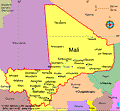
Most of Mali, in West Africa, lies in the Sahara. A landlocked country four-fifths the size of Alaska, it is bordered by Guinea, Senegal, Mauritania, Algeria, Niger, Burkina Faso, and the Côte d'Ivoire. The only fertile area is in the south, where the Niger and Senegal rivers provide water for irrigation.
Government
Republic.
History
Caravan routes have passed through Mali since A.D. 300. The Malinke empire ruled regions of Mali from the 12th to the 16th century, and the Songhai empire reigned over the Timbuktu-Gao region in the 15th century. Morocco conquered Timbuktu in 1591 and ruled over it for two centuries. Subjugated by France by the end of the 19th century, the land became a colony in 1904 (named French Sudan in 1920) and in 1946 became part of the French Union. On June 20, 1960, it became independent and, under the name of Sudanese Republic, was joined with the Republic of Senegal in the Mali federation. However, Senegal seceded from the federation on Aug. 20, 1960, and the Sudanese Republic then changed its name to the Republic of Mali on Sept. 22.
Economic Development and Democracy
In the 1960s, Mali concentrated on economic development, continuing to accept aid from both Soviet bloc and Western nations, as well as international agencies. In the late 1960s, it began retreating from close ties with China. But a purge of conservative opponents brought greater power to President Modibo Keita, and in 1968, the influence of the Chinese and their Malian sympathizers increased. The army overthrew the government on Nov. 19, 1968 and brought Mali under military rule for the next 20 years. Mali and Burkina Faso fought a brief border war from Dec. 25 to 29, 1985. In 1991, dictator Moussa Traoré was overthrown, and Mali made a peaceful transition to democracy. In 1992, Alpha Konaré became Mali's first democratically elected president.
In the early 1990s, the government fought the Tuaregs, nomads of Berber and Arab descent who inhabit the northern desert regions of Mali and have little in common with Mali's black African majority. The Tuaregs accused the government of marginalizing them politically and culturally. A peace agreement was signed in 1995, and thousands of Tuareg refugees returned to the country.
Mali's second multiparty national elections took place in May 1997, with President Konaré winning reelection.
Konaré won international praise for his efforts to revive Mali's faltering economy. His adherence to International Monetary Fund guidelines increased foreign investment and helped make Mali the second-largest cotton producer in Africa. Konaré was also the chairman of the 15-nation ECOWAS (the Economic Community of West African States), which in recent years has concentrated on brokering peace in Sierra Leone, Liberia, and Guinea. Konaré retired after serving the two five-year terms permitted by the constitution.
In June 2002, Amadou Toumani Touré was elected president. A highly popular and respected public figure, he engineered the 1991 coup that freed the country from military rule. In 2004, he appointed Ousmane Issoufi Maïga as the new prime minister.
In June 2006, the government signed a peace treaty ending a Tuareg rebellion that began earlier in the year. The president promised a significant development and anti-poverty program for the Tuaregs. However, there was a resurgence of rebel activity that began in August 2007, with rebels attacking and kidnapping soldiers, and lasted into 2009. The government retaliated and by February 2009, it had taken control of most of the Tuareg bases. The Tuaregs turned in their weapons.
Touré was reelected in April 2007, winning 68.3% of the vote. His opponent, Ibrahim Boubacar Keita, took 18.6%. In September, Prime Minister Ousmane Issoufi Maïga resigned, and Modibo Sidibé succeeded him. In April 2011, Cisse´ Mariam Kaidama Sidibe´ became Mali's first-ever female prime minister after the resignation of Modibo Sidibe´.
President Touré Overthrown in a Coup
In March 2012, President Touré was overthrown in a coup by mutineering soldiers who said they were acting in response to the government's response to the rebellion by the Tuaregs, nomadic insurgents of Berber and Arab descent who live in the north. The troops said they did not received adequate support from the government. Many of the Tuaregs had fought for Libyan leader Col. Muammar el-Qaddafi and returned to Mali after his downfall, emboldened and armed with weapons. The rebels scored a number of victories, taking over towns and demoralizing the country's military. The soldiers looted the presidential palace, suspended the constitution, and implemented a curfew. The coup did not impede the rebels. In fact, days after the coup, the rebels seized the city of Timbuktu, and thus gained control over much of the northern part of the country. They declared a cease-fire on April 5. The next day, however, the rebels said they had seceded from Mali and formed an independent state, called Azawad.
The Economic Community of West African States, a regional trade organization, imposed sanctions on the country, froze the assets Mali held in its bank, and sealed their borders with Mali. Mali had been considered one of the most stable democracies in Africa, and presidential elections had been set for April. President Touré said he planned to honor the country's term limits and not seek reelection.
In a deal negotiated by ECOWAS in April, coup leader Capt. Amadou Sanogo agreed to step down, ousted president Touré resigned, and former parliament speaker Dioncounda Traoré was sworn in as interim president. Cheick Modibo Diarra, an astrophysicist who had worked at NASA, was named interim prime minister. Traoré vowed to confront the rebels and hold elections, but did not give a timetable for the vote. Days later, however, several members of the opposition were arrested by the military, which suggested the junta was still clinging to power. Concern about Sanogo's refusal to relinquish power played out on May 21 when pro-military protesters stormed the presidential palace in Bamako and beat Traoré. ECOWAS intervened again and reached another deal with Sanogo that granted him the title of former head of state and gave him a pension in return for stepping down.
Another coup occurred in December 2012. Soldiers arrested Prime Minister Diarra and forced him to resign. President Traoré appointed Django Sissoko as prime minister. The coup further justified the claim by observers and activists that the military was still in control of Mali.
Islamist Militants Expand Their Area of Control
Over the summer of 2012, Al Qaeda in the Islamic Maghreb and Ansar Dine, another radical Islamist group, took advantage of the instability and an increasingly weak military and captured Timbuktu, Kidal, and Gao. The groups briefly allied themselves with the Tuareg rebels, but severed ties and declared the northern part of the country an Islamic state. They implemented and brutally enforced Shariah, or Islamic law. They also destroyed many ancient books and manuscripts and vandalized tombs, saying that worshipping saints violated the tenets of Islam. The Islamists continued to stretch their area of control into the fall, prompting concern that legions of Islamists would gather and train in northern Mali and threaten large swaths of Africa. ECOWAS (the Economic Community of West African States) began planning a military action to reclaim the north from the Islamists. However, by January 2013, the militants had pushed into the southern part of the country, crossing into the area controlled by the government. France sent about 2,150 troops to Mali to push them back. In addition to launching airstrikes on militant strongholds, France also deployed ground troops to combat the stubborn fighters. By the end of January, French troops had pushed the militants out of Gao and Timbuktu, forcing them back to northern Mali. Soldiers from other African nations were also deployed to Mali to aid in the effort and will take a more active role in both combat and training Malian troops once France withdraws from Mali.
On Jan. 16, 2013, Islamic militants entered neighboring Algeria from Mali and took dozens of foreign hostages at the BP-controlled In Amenas gas field. Algerian officials said the militants were members of an offshoot of al-Qaeda called Al Mulathameen and were acting in retaliation for France's intervention in Mali. On Jan. 17, Algerian troops stormed the complex and attacked the kidnappers. By the end of the standoff on Jan. 20, 29 militants and 37 hostages were killed. Three Americans were among the dead.
The UN Security Council voted in April to deploy about 12,000 troops and police officers to Mali to stabilize the northern region, oversee the return to civilian rule, and to train Malian soldiers so the country's armed forces can resume security of the country. The troops arrived in early July 2013.
The Tuaregs, the nomadic rebels who had taken over parts of the north, signed a ceasefire with the government in June 2013. They agreed to cede control of Kidal in the north. The peace deal set the stage for presidential elections, which were a prerequisite for an infusion of about $4 billion in international aid. The first round of the election was held in July, despite concern that the country was ill-prepared for them. Voting was largely peaceful. Ibrahim Boubacar Keita, a former prime minister and president of the National Assembly, won 39.2% of the vote, and former finance minister Soumaïla Cissé took 19.4%, necessitating a second round. Keita won in a landslide in the second round, which was held in August.
In May 2014, Mara visited the northern towns of Timbuktu, Kidal, and Gao. While Timbuktu and Gao have been mostly peaceful after the ceasefire was signed between the government and the Tuareg rebels, Kidal remains a rebel stronghold and a tinderbox, and rebels shot at him when he arrived. Mara called the provocation a "declaration of war," and about 1,500 Malian troops were dispatched to Kidal and attacked the rebels. The military was outmatched by the rebels, who killed 50 troops, took 50 prisoner, and captured a government fort in Kidal. Hundreds of troops surrendered. Defense Minister Soumeylou Boybeye Maiga resigned after the attack.
Ebola Outbreak Spreads to Mali
On Nov. 25, 2014, Mali's Ministry of Health confirmed two new cases of Ebola. This was seen as a setback because it happened after the country thought it had overcome an earlier outbreak of the virus. Both cases were connected to previous ones. One case was the 23-year-old fiancée of a 25-year-old nurse who died of the virus earlier in November. The second case was a family member of previously confirmed and deceased Ebola victims.
Mali's Ministry of Health planned to meet with Guinea health officials to discuss how to coordinate efforts to control the virus outbreak and reduce the chances of additional cases being imported to Mali. As of Dec. 31, 2014, the Ebola virus was still spreading in West Africa with 7,905 deaths and 20,206 known cases, according to the World Health Organization.
Dozens Are Taken Hostage at Bamako Hotel
Islamic extremists stormed into the Radisson Blu hotel in Bamako, Mali's capital, on Nov. 20, 2015. At least 170 people were taken hostage. The militants were armed with grenades and guns. U.S. and French special operation forces worked quickly with Malian troops and took back the hotel floor by floor. At least 27 people were killed, including two of the attackers.
An extremist group led by Moktar Belmoktar, a former Al Qaeda commander, claimed responsibility for the attack. With Mali being a former French colony, France saw it as another attack on its interests, coming just a week after the incidents in Paris.
See also Encyclopedia: Mali .
U.S. State Dept. Country Notes: Mali