Geography
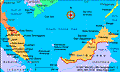
Malaysia is on the Malay Peninsula in southeast Asia. The nation also includes Sabah and Sarawak on the island of Borneo to the east. Its area slightly exceeds that of New Mexico.
Most of Malaysia is covered by forest, with a mountain range running the length of the peninsula. Extensive forests provide ebony, sandalwood, teak, and other wood.
Government
Constitutional monarchy.
History
The ancestors of the people that now inhabit the Malaysian peninsula first migrated to the area between 2500 and 1500 B.C. Those living in the coastal regions had early contact with the Chinese and Indians; seafaring traders from India brought with them Hinduism, which was blended with the local animist beliefs. As Muslims conquered India, they spread the religion of Islam to Malaysia. In the 15th century, Islam acquired a firm hold on the region when the Hindu ruler of the powerful city-state of Malacca, Parameswara Dewa Shah, converted to Islam.
British and Dutch interest in the region grew in the 1800s, with the British East India Company's establishment of a trading settlement on the island of Singapore. Trade soared, with Singapore's population growing from only 5,000 in 1820 to nearly 100,000 in just 50 years. In the 1880s, Britain formally established protectorates in Malaysia. At about the same time, rubber trees were introduced from Brazil. With the mass production of automobiles, rubber became a valuable export, and laborers were brought in from India to work the rubber plantations.
Forming the Independent State of Malaysia
Following the Japanese occupation of Malaysia during World War II, a growing nationalist movement prompted the British to establish the semiautonomous Federation of Malaya in 1948. But Communist guerrillas took to the jungles to begin a war of national liberation against the British, who declared a state of emergency to quell the insurgency, which lasted until 1960.
The independent state of Malaysia came into existence on Sept. 16, 1963, as a federation of Malaya, Singapore, Sabah (North Borneo), and Sarawak. In 1965, Singapore withdrew from the federation to become a separate nation. Since 1966, the 11 states of former Malaya have been known as West Malaysia, and Sabah and Sarawak as East Malaysia.
By the late 1960s, Malaysia was torn by rioting directed against Chinese and Indians, who controlled a disproportionate share of the country's wealth. Beginning in 1968, it was the government's goal to achieve greater economic balance through a national economic policy.
Economic Reform and Growth
In the 1980s, Dr. Mohamad Mahathir succeeded Datuk Hussein as prime minister. Mahathir instituted economic reforms that would transform Malaysia into one of the so-called Asian Tigers. Throughout the 1990s, Mahathir embarked on a massive project to build a new capital from scratch in an attempt to bypass congested Kuala Lumpur.
Beginning in 1997 and continuing through the next year, Malaysia suffered from the Asian currency crisis. Instead of following the economic prescriptions of the International Monetary Fund and World Bank, the prime minister opted for fixed exchange rates and capital controls. In late 1999, Malaysia was on the road to economic recovery, and it appeared Mahathir's measures were working.
Abdullah Badawi Tries to Reduce Government Corruption
In Oct. 2003, Mahathir retired after 22 years in office. His rule witnessed enormous economic growth, but was also characterized by repression and human rights abuses. Malaysia's new prime minister, Abdullah Badawi, had a more statesmanlike reputation, and in his first year in office he made headway on reducing corruption and instituting reforms. In March 2004, the ruling National Front coalition won an astonishing 90% of parliamentary seats, and Abdullah was reelected .
The governing coalition under Prime Minister Badawi suffered a stunning defeat in March 2008's parliamentary elections. Opposition parties quadrupled their representation in Parliament, and Badawi's coalition, although it won 136 of 222 seats in Parliament, lost its two-thirds majority, which is necessary to amend the constitution, and control of five state assemblies. It was the worst showing for the National Front coalition in four decades. Shortly after the election, Badawi trimmed his cabinet, removing several ministers who had been accused of corruption, and appointed a prominent lawyer to oversee judicial reform.
Popular Opposition Leader Fights Sodomy Charges
Leading opposition figure Anwar Ibrahim was arrested and jailed on suspicion of sodomy in July 2008—for a second time. Ten years earlier, when he was serving as deputy prime minister, he was convicted of sodomy and corruption. The conviction was overturned after he spent six years in jail. Anwar denied the charges both times, claiming to have been set up by the government—allegations that had a broad base of supporters, both domestically and abroad. Prior to each arrest, Anwar's political challenge to the governing party had been gaining momentum. Indeed, days before his most recent arrest, he had announced plans to run for Parliament. In August 2008, Anwar won a by-election to return to Parliament after a 10-year absence. He defeated the government party's candidate, 31,196 to 15,524. After a two-year trial, Anwar was acquitted of the sodomy charge in January 2012. The government appealed the acquital, and it was overturned in May 2014. He began a five-year jail sentence in February 2015. His daughter, Nurul Izzah Anwar, also an opposition politician, was arrested and charged with sedition in March 2015 for a speech she gave in Parliament defending her father and denouncing the ruling.
In March 2009, the ruling United Malays National Organization chose Najib Razak to succeed Abdullah Badawi as Prime Minister of the nation and leader of the party. Razak has promised to make big changes in the ruling party, which is facing renewed competition. However, Razak is largely viewed as an insider who is too entrenched in party politics to follow through on his promises of reform.
Halim Serves Second Term as King
In October 2011, Abdul Halim was elected as the Yang di-Pertuan Agong or Malaysia's the head of state. With the election, he became the first person to become head of state twice. He also became the country's oldest ruler ever at 84 years and 15 days old. Halim's official coronation was on April 11, 2012, although he began his second term in December 2011.
Violence on Borneo Unites Philippines and Malaysia Against Sulu Sultinate
A Filipino citizen living in Manila has laid claim—as sultan of Sulu—to the Malaysian state of Sabah on Borneo. Jamalul Kiram III’s claim is based on a token rent which Malaysia pays the royal house of Sulu for the use of Sabah. Calling themselves the Royal Army of Sulu, the clan members said they were descendants of the Sultanate of Sulu in the southern Philippines, which ruled parts of northern Borneo for centuries.
The April 2013 invasion by more than 200 Filipinos seemed to take both the Philippines and Malaysia by surprise. At least 60 have been killed in the ongoing conflict. The Malaysian government has been forced to take the worsening situation seriously, and launched an offensive on March 5, which included fighter jet air support.
Prime Minister Dissolves Parliament
On April 3, 2013, Prime Minister Najib Razak dissolved parliament and called for a general election in hopes reestablishing his National Front coalition’s mandate, which has been in place for almost six decades. Despite winning less than 47% of the popular vote, Najib’s coalition took 133 out of 222 parliamentary seats (district lines are drawn in the coalition’s favor). It was the coalition's worst-ever electoral performance in a general election. Anwar Ibrahim's three-party alliance, Pakatan Rakyat, took 89 seats—its best showing to date. It had hoped to unseat the ruling party with a pledge of a cleaner government. Anwar alleged the election was rigged, accusing the government of dispatching as many as 40,000 "dubious" voters to cast ballots in tight races.
Malaysia Airlines Flight Disappears
Malaysia Airlines Flight MH370, carrying 239 people, lost contact with ground controllers en route to Beijing, China, on March 8, 2014. The plane disappeared between Malaysia and Vietnam. Two days later, rescue crews continued to search for the missing plane. Meanwhile, officials reported that two passengers on board MH370 had used stolen passports and booked their tickets at the same time. All causes for what happened to the jetliner were being investigated, including hijacking.
For days, rescue crews searched for the plane and investigators hunted for clues about what happened. Finally, on March 24, Malaysia's Prime Minister Najib Razak announced that satellite data confirmed that the plane went down in the southern Indian Ocean, a remote location far off course. Many questions remained unanswered, including why the plane ended up where it did and why it went down.
Inmarsat, a British company, analyzed satellite data and the plane's flight path and determined the area where the plane went down. An Australian Air Force plane reported seeing "a grey or green circular object" and "an orange rectangular object" in the area, but the Australian government did not confirm that the debris was from the missing plane. The search for the plane continued throughout 2014 and 2015.
In Aug. 2015, Prime Minister Najib Razak announced that investigators had confirmed that a portion of a right wing flaperon found the previous month on Réunion, an island in the western Indian Ocean, was from Flight MH370. The investigators were from France, Malaysia, Boeing, and the U.S. National Transportation Safety Board. Initially, French officials stated that there was a "high probability" that the object was from Flight MH370. However, by Sept., the officials had uncovered and linked the serial numbers on the flapper to Flight MH370 and could say "with certainty" that it was a match.
Also in August, the Malaysian Anti-Corruption Commission reported that the $2.6 billion in Prime Minister Razak's account had come from donations and not from state-investment funding. However, the commission did not share where the donations came from or why they had been transferred to Razak. On Aug. 28, Anina Saaduddin, a member of Razak's own political party, filed a civil suit against him. The suit alleged that he defrauded the party and its members by failing to disclose that he'd received the donated funds and that he'd failed in his duties as party trustee.
See also Encyclopedia: Malaysia .
U.S. State Dept. Country Notes: Malaysia
Department of Statistics www.statistics.gov.my/ .