Latvia | Facts & Information

- Latvia Profile
- History
- News and Current Events
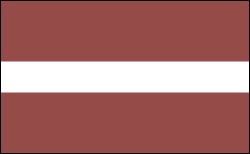
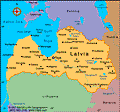
Facts & Figures
-
President: Raimonds Vejonis (2015)
Prime Minister: Laimdota Straujuma (2014)
Land area: 24,903 sq mi (64,500 sq km); total area: 24,938 sq mi (64,589 sq km)
Population (2014 est.): 2,165,165 (growth rate: –0.62%); birth rate: 9.79/1000; infant mortality rate: 7.91/1000; life expectancy: 73.44
Capital and largest city (2011 est.): Riga, 701,000
Monetary unit: euro
National name: Latvijas Republika
Languages: Latvian (official) 56.3%, Russian 33.8%, other 0.6% (includes Polish, Ukrainian, and Belarusian), unspecified 9.4% (2011)
Ethnicity/race: Latvian 61.1%, Russian 26.2%, Belarusian 3.5%, Ukrainian 2.3%, Polish 2.2%, Lithuanian 1.3%, other 3.4% (2013)
Religions: Lutheran 19.6%, Orthodox 15.3%, other Christian 1%, other 0.4%, unspecified 63.7% (2006)
National Holiday: Independence Day, November 18
Literacy: 99.8% (2011 est.)
Economic summary: GDP/PPP (2013 est.): $38.87 billion; per capita $19,100. Real growth rate: 4%. Inflation: 0.2%. Unemployment: 9.8%. Arable land: 17.96%. Agriculture: grain, sugar beets, potatoes, vegetables; beef, pork, milk, eggs; fish. Labor force: 1.022 million; agriculture 8.8%, industry 24%, services 67.2% (2010 est.). Industries: buses, vans, street and railroad cars; synthetic fibers, agricultural machinery, fertilizers, washing machines, radios, electronics, pharmaceuticals, processed foods, textiles; note—dependent on imports for energy and raw materials. Natural resources: peat, limestone, dolomite, amber, hydropower, wood, arable land. Exports: $12.67 billion (2013 est.): wood and wood products, machinery and equipment, metals, textiles, foodstuffs. Imports: $15.56 billion (2013 est.): machinery and equipment, chemicals, fuels, vehicles. Major trading partners: Germany, Sweden, Lithuania, Estonia, Russia, Finland, Poland, Italy (2011).
Communications: Telephones: main lines in use: 501,000 (2012); mobile cellular: 2.31 million (2012). Broadcast media: several national and regional commercial TV stations are foreign-owned, 2 national TV stations are publicly-owned; system supplemented by privately-owned regional and local TV stations; cable and satellite multi-channel TV services with domestic and foreign broadcasts available; publicly-owned broadcaster operates 4 radio networks with dozens of stations throughout the country; dozens of private broadcasters also operate radio stations (2007). Internet Service Providers (ISPs): 359,604 (2012). Internet users: 1.504 million (2009).
Transportation: Railways: total: 2,239 km (2008). Highways: total: 72,440 km; paved: 14,707 km; unpaved: 57,733 km (2010). Waterways: 300 km perennially navigable. Ports and harbors: Riga, Ventspils. Airports: 42 (2032).
International disputes: Russia demands better Latvian treatment of ethnic Russians in Latvia; boundary demarcated with Latvia and Lithuania; the Latvian parliament has not ratified its 1998 maritime boundary treaty with Lithuania, primarily due to concerns over oil exploration rights; as a member state that forms part of the EU's external border, Latvia has implemented the strict Schengen border rules with Russia.
Trending
Here are the facts and trivia that people are buzzing about.