France | Facts & Information

- France Profile
- History
- News and Current Events
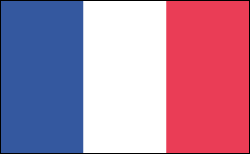
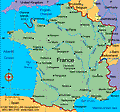
Infoplease has everything you need to know about France. Check out our country profile, full of essential information about France's geography, history, government, economy, population, culture, religion and languages. If that's not enough, click over to our collection of world maps and flags.
Facts & Figures
-
President: Emmanuel Macron (2017)
Prime Minister: Élisabeth Borne (2022)
Land area: 247,270 sq mi (640,427 sq km); total area: 248,572 sq mi (643,801 sq km)
Population (2022 est.): 68,305,148 (growth rate: 0.32%); birth rate: 11.66/1000; infant mortality rate: 3.15/1000; life expectancy: 82.59
Capital and largest city (2022 est.): Paris, 11.142 million
Other large cities: Lyon 1.748 million; Marseille-Aix-en-Provence 1.620 million; Lille 1.073 million; Toulouse 1.049 million; Bordeaux 991,000 (2022)
Monetary unit: Euro (formerly French franc)
National name: République Française
Languages: French (official) 100%, declining regional dialects and languages (Provencal, Breton, Alsatian, Corsican, Catalan, Basque, Flemish, Occitan, Picard); note - overseas departments: French, Creole patois, Mahorian (a Swahili dialect)
Ethnicity/race: Celtic and Latin with Teutonic, Slavic, North African (Algerian, Moroccan, Tunisian), Indochinese, Basque minorities
Religions: Roman Catholic 47%, Muslim 4%, Protestant 2%, Buddhists 2%, Orthodox 1%, Jewish 1%, other 1%, none 33%, unspecified 9%
National Holiday: Fete de la Federation, July 14
Literacy rate: 99% (2011 est.)
Economic summary: GDP/PPP (2020 est.): $2,832,170,000,000; per capita $42,000. Real growth rate: 1.49%. Inflation: 1.1%. Unemployment: 8.12%. Arable land: 33.4%. Agriculture: wheat, cereals, sugar beets, potatoes, wine grapes; beef, dairy products; fish. Labor force: 27.742 million; services 77.2%, industry 20%, agriculture 2.8% (2020). Industries: machinery, chemicals, automobiles, metallurgy, aircraft, electronics; textiles, food processing; tourism. Natural resources: coal, iron ore, bauxite, zinc, uranium, antimony, arsenic, potash, feldspar, fluorospar, gypsum, timber, fish. Exports: $746.91 billion (2020 est.): machinery and transportation equipment, aircraft, plastics, chemicals, pharmaceutical products, iron and steel, beverages. Major trading partners (exports): Germany 14%, United States 8%, Italy 7%, Spain 7%, Belgium 7%, United Kingdom 7% (2019). Imports: $803.66 billion (2020 est.): machinery and equipment, vehicles, crude oil, aircraft, plastics, chemicals. Major trading partners (imports): Germany 18%, Belgium 9%, Italy 9%, Spain 7%, China 7%, Netherlands 6%, United Kingdom 5% (2019).
Communications: Telephones: main lines in use: 37.759 million (2020); mobile cellular: 72.751 million (2020). Broadcast media: a mix of both publicly operated and privately owned TV stations; state-owned France Televisions operates 4 networks, one of which is a network of regional stations, and has part-interest in several thematic cable/satellite channels and international channels; a large number of privately owned regional and local TV stations; multi-channel satellite and cable services provide a large number of channels; public broadcaster Radio France operates 7 national networks, a series of regional networks, and operates services for overseas territories and foreign audiences; Radio France Internationale (RFI), under the Ministry of Foreign Affairs, is a leading international broadcaster; a large number of commercial FM stations, with many of them consolidating into commercial networks (2008). Television broadcast stations: 584 (plus 9,676 repeaters). Internet hosts: 17.266 million (2012). Internet users: 57,272,921 (2020).
Transportation: Railways: total: 29,640 km (2014). Roadways: total: 1,028,446 km; paved: paved: 951,220 km (including 10,490 km of expressways); unpaved: 0 km (2011). Waterways: 8,500 km (1,686 km accessible to craft of 3,000 metric tons) (2011). Ports and harbors: Bordeaux, Calais, Dunkerque, La Pallice, Le Havre, Marseille, Nantes, Paris, Rouen, Strasbourg. Airports: 464 (2021 est.).
International disputes: Madagascar claims the French territories of Bassas da India, Europa Island, Glorioso Islands, and Juan de Nova Island; Comoros claims Mayotte; Mauritius claims Tromelin Island; territorial dispute between Suriname and the French overseas department of French Guiana; France asserts a territorial claim in Antarctica (Adelie Land); France and Vanuatu claim Matthew and Hunter Islands, east of New Caledonia.
Geography
France is about 80% the size of Texas. In the Alps near the Italian and Swiss borders is western Europe's highest point—Mont Blanc (15,781 ft; 4,810 m). The forest-covered Vosges Mountains are in the northeast, and the Pyrénées are along the Spanish border. Except for extreme northern France, the country may be described as four river basins and a plateau. Three of the streams flow west—the Seine into the English Channel, the Loire into the Atlantic, and the Garonne into the Bay of Biscay. The Rhône flows south into the Mediterranean. For about 100 mi (161 km), the Rhine is France's eastern border. In the Mediterranean, about 115 mi (185 km) east-southeast of Nice, is the island of Corsica (3,367 sq mi; 8,721 sq km).
Government
Fifth republic.
History
Archeological excavations indicate that France has been continuously settled since Paleolithic times. The Celts, who were later called Gauls by the Romans, migrated from the Rhine valley into what is now France. In about 600 B.C., Greeks and Phoenicians established settlements along the Mediterranean, most notably at Marseille. Julius Caesar conquered part of Gaul in 57–52 B.C., and it remained Roman until Franks invaded in the 5th century A.D.
The Treaty of Verdun (843) divided the territories corresponding roughly to France, Germany, and Italy among the three grandsons of Charlemagne. Charles the Bald inherited Francia Occidentalis, which became an increasingly feudalized kingdom. By 987, the crown passed to Hugh Capet, a princeling who controlled only the Ile-de-France, the region surrounding Paris. For 350 years, an unbroken Capetian line added to its domain and consolidated royal authority until the accession in 1328 of Philip VI, first of the Valois line. France was then the most powerful nation in Europe, with a population of 15 million.
France Gains Territory in the Hundred Year's War
The missing pieces in Philip Valois's domain were the French provinces still held by the Plantagenet kings of England, who also claimed the French crown. Beginning in 1338, the Hundred Years' War eventually settled the contest. After France's victory in the final battle, Castillon (1453), the Valois were the ruling family, and the English had no French possessions left except Calais. Once Burgundy and Brittany were added, the Valois dynasty's holdings resembled modern France. Protestantism spread throughout France in the 16th century and led to civil wars. Henry IV, of the Bourbon dynasty, issued the Edict of Nantes (1598), granting religious tolerance to the Huguenots (French Protestants). Absolute monarchy reached its apogee in the reign of Louis XIV (1643–1715), the Sun King, whose brilliant court was the center of the Western world.
Birth of French Republic
After a series of costly foreign wars that weakened the government, the French Revolution plunged France into a bloodbath beginning in 1789 with the establishment of the First Republic and ending with a new authoritarianism under Napoléon Bonaparte, who had successfully defended the infant republic from foreign attack and then made himself first consul in 1799 and emperor in 1804. The Congress of Vienna (1815) sought to restore the pre-Napoleonic order in the person of Louis XVIII, but industrialization and the middle class, both fostered under Napoléon, built pressure for change, and a revolution in 1848 drove Louis Philippe, last of the Bourbons, into exile. Prince Louis Napoléon, a nephew of Napoléon I, declared the Second Empire in 1852 and took the throne as Napoléon III. His opposition to the rising power of Prussia ignited the Franco-Prussian War (1870–1871), which ended in his defeat, his abdication, and the creation of the Third Republic.
Germany Occupies France During World War II
A new France emerged from World War I as the continent's dominant power. But four years of hostile occupation had reduced northeast France to ruins. Beginning in 1919, French foreign policy aimed at keeping Germany weak through a system of alliances, but it failed to halt the rise of Adolf Hitler and the Nazi war machine. On May 10, 1940, Nazi troops attacked, and, as they approached Paris, Italy joined with Germany. The Germans marched into an undefended Paris and Marshal Henri Philippe Pétain signed an armistice on June 22. France was split into an occupied north and an unoccupied south, Vichy France, which became a totalitarian German puppet state with Pétain as its chief. Allied armies liberated France in Aug. 1944, and a provisional government in Paris headed by Gen. Charles de Gaulle was established. The Fourth Republic was born on Dec. 24, 1946. The empire became the French Union; the national assembly was strengthened and the presidency weakened; and France joined NATO. A war against Communist insurgents in French Indochina, now Vietnam, was abandoned after the defeat of French forces at Dien Bien Phu in 1954. A new rebellion in Algeria threatened a military coup, and on June 1, 1958, the assembly invited de Gaulle to return as premier with extraordinary powers. He drafted a new constitution for a Fifth Republic, adopted on September 28, which strengthened the presidency and reduced legislative power. He was elected president on Dec. 21, 1958.
France next turned its attention to decolonialization in Africa; the French protectorates of Morocco and Tunisia had received independence in 1956. French West Africa was partitioned and the new nations were granted independence in 1960. Algeria, after a long civil war, finally became independent in 1962. Relations with most of the former colonies remained amicable. De Gaulle took France out of the NATO military command in 1967 and expelled all foreign-controlled troops from the country. De Gaulle's government was weakened by massive protests in May 1968 when student rallies became violent and millions of factory workers engaged in wildcat strikes across France. After normalcy was reestablished in 1969, de Gaulle's successor, Georges Pompidou, modified Gaullist policies to include a classical laissez-faire attitude toward domestic economic affairs. The conservative, pro-business climate contributed to the election of Valéry Giscard d'Estaing as president in 1974.
Economic Troubles Under Mitterand
Socialist François Mitterrand attained a stunning victory in the May 10, 1981, presidential election. The victors immediately move to carry out campaign pledges to nationalize major industries, halt nuclear testing, suspend nuclear powerplant construction, and impose new taxes on the rich. The Socialists' policies during Mitterrand's first two years created a 12% inflation rate, a huge trade deficit, and devaluations of the franc. In March 1986, a center-right coalition led by Jacques Chirac won a slim majority in legislative elections. Chirac became prime minister, initiating a period of “cohabitation” between him and the Socialist president, Mitterrand. Mitterrand's decisive reelection in 1988 led to Chirac being replaced as prime minister by Michel Rocard, a Socialist. Relations cooled with Rocard, however, and in May 1991 Edith Cresson—also a Socialist—became France's first female prime minister. But Cresson's unpopularity forced Mitterrand to replace her with a more well-liked Socialist, Pierre Bérégovoy, who eventually was embroiled in a scandal and committed suicide. During his tenure, Mitterrand succeeded in helping to draft the Maastricht Treaty and, after winning a slim victory in a referendum, confirmed close economic and security ties between France and the European Union (EU).
Jacques Chirac Gains French Presidency
On his third try, Chirac won the presidency in May 1995, campaigning vigorously on a platform to reduce unemployment. Elections for the national assembly in 1997 gave the Socialist coalition a majority. Shortly after becoming president, Chirac resumed France's nuclear testing in the South Pacific, despite widespread international protests as well as rioting in the affected countries. Socialist leader Lionel Jospin became prime minister in 1997. In the spring of 1999, the country took part in the NATO air strikes in Kosovo, despite some internal opposition.
Jean-Marie Le Pen, leader of the right-wing anti-immigrant National Front Party, shocked France in April 2002 with his second-place finish in the first round of France's presidential election. He took 17% of the vote, eliminating Lionel Jospin, the Socialist prime minister, who tallied 16%. Jospin, stunned by the result, announced that he was retiring from politics and threw his support behind incumbent president Jacques Chirac, who won with an overwhelming 82.2% of the vote in the runoff election. Chirac's center-right coalition won an absolute majority in parliament. In July 2002, Chirac survived an assassination attempt by a right-wing extremist.
During the fall 2002 and winter 2003 diplomatic wrangling at the United Nations over Iraq, France repeatedly defied the U.S. and Britain by calling for more weapons inspections and diplomacy before resorting to war. Relations between the U.S. and France have remained severely strained over Iraq.
France sent peacekeeping forces to assist two African countries in 2002 and 2003, Côte d'Ivoire and the Democratic Republic of the Congo.
After becoming Prime Minister in 2002, Jean-Pierre Raffarin's plan to overhaul the national pension system sparked numerous strikes across France in May and June 2003, involving tens of thousands of sanitation workers, teachers, transportation workers, and air traffic controllers. In August, a deadly heat wave killed an estimated 10,000 mostly elderly people. The deaths occurred during two weeks of 104°F (40°C) temperatures.
In 2004, the French government passed a law banning the wearing of Muslim headscarves and other religious symbols in schools. The government maintained that the wearing of conspicuous religious symbols threatened the country's secular identity; others contended that the law curtailed religious freedom.
In March 2004 regional elections, the Socialist Party made enormous gains over Chirac's Union for a Popular Movement (UMP) Party. Unpopular economic reforms are credited for the UMP's defeat.
On May 29, 2005, French voters rejected the European Union constitution by a 55%–45% margin. Reasons given for rejecting the constitution included concerns about forfeiting too much French sovereignty to a centralized European government and alarm at the EU's rapid addition of 10 new members in 2004, most from Eastern Europe. In response, President Chirac, who strongly supported the constitution, replaced Prime Minister Jean-Pierre Raffarin with Dominique de Villepin, a former foreign minister.
Protests and Riots Result from Social Inequality and High Unemployment
Rioting erupted on Oct. 27, 2005, in the impoverished outskirts of Paris and continued for two weeks, spreading to 300 towns and cities throughout France. It was the worst violence the country has faced in four decades. The rioting was sparked by the accidental deaths of two teenagers, one of French-Arab and the other of French-African descent, and grew into a violent protest against the bleak lives of poor French-Arabs and French-Africans, many of whom live in depressed, crime-ridden areas with high unemployment and who feel alienated from the rest of French society.
In March and April 2006, a series of protests took place over a proposed labor law that would allow employers to fire workers under age 26 within two years without giving a reason. The law was intended to control high unemployment among France's young workers. The protests continued after President Chirac signed a somewhat amended bill into law. But on April 10, Chirac relented and rescinded the law, an embarrassing about-face for the government.
Presidential elections held in April 2007 pitted Socialist Ségolène Royal against conservative Interior Minister Nicolas Sarkozy, the nominee for the Union for a Popular Movement. Late in the race, centrist candidate Francois Bayrou emerged as a contender. Sarkozy, with 30.7%, and Royal, taking 25.2%, prevailed in the first round of voting. Sarkozy went on to win the runoff election, taking 53.1% of the vote to Royal's 46.9%.
Nicolas Sarkozy Spearheads Effort to Improve U.S.–France Relations
Sarkozy immediately extended an olive branch to the United States, saying "I want to tell them [Americans] that France will always be by their side when they need her, but that friendship is also accepting the fact that friends can think differently." The dialogue signalled a marked shift from the tense French-American relationship under Chirac.
On his first day in office, Sarkozy named former social affairs minister François Fillon as prime minister, replacing Dominique de Villepin. He also appointed Socialist Bernard Kouchner, a co-founder of the Nobel-prize-winning Médecins Sans Frontières, as foreign minister. Workers in the public sector staged a 24-hour strike in October to protest Sarkozy's plan to change their generous retirement packages that allow workers to retire at age 50 with a full pension. Strikers relented after nine days and agreed to negotiate.
In July, Sarkozy launched the Union for the Mediterranean—an international body of 43 member nations. The union seeks to end conflict in the Middle East by addressing regional unrest and immigration.
On July 21, 2008, Sarkozy won a narrow victory (539 to 357 votes—one vote more than the required three-fifths majority) for constitutional changes that strengthen parliamentary power, limit the presidency to two five-year terms, and end the president's right of collective pardon. The changes, approved in July, also allow the president to address Parliament for the first time since 1875. The Socialist opposition asserted that the changes actually boost the power of the presidency, making France a "monocracy."
The French Parliament approved a bill in July 2008 that ends the 35-hour work week and tightens criteria for strikes and unemployment payments. The new bill is intended to decrease unemployment and allow businesses and employees to negotiate directly about working hours.
In November 2008, the Socialist party voted for a new leader, revealing a deeply divided member body. Martine Aubry, the mayor of Lille, defeated former party leader Segolene Royal by only 42 votes. Over 40 percent of Socialist party members declined to vote and internal disputes ensued.
Five sticks of dynamite were planted in a Parisian Printemps on December 15, 2008, by a previously unknown group called the Afghan Revolutionary Front, which demanded the withdrawal of French troops from Afghanistan and warned of another strike if Sarkozy did not remove the troops.
France Makes Headlines with Ban on Headscarves and DSK Scandal
In April 2011, France banned the wearing of full veils in public, becoming the first European nation to impose the restriction. The ban caused protests in Paris and several other cities. The new restriction has many Muslims worried about their rights as French citizens. Covering the face is considered by some Muslims as a religious obligation. Supporters of the ban view it as necessary to preserve French culture and to combat what they claim are separatist actions in Muslims.
On May 14, 2011, Dominique Strauss-Kahn, head of the International Monetary Fund (IMF) and a leading political figure in France, was arrested for sexually assaulting a maid at a Manhattan hotel. Strauss-Kahn was removed from an Air France Plane at Kennedy International Airport and taken into custody. On May 18, he resigned as managing director of the IMF. Strauss-Kahn was expected to announce his candidacy for the French presidency soon. He had been considered a favorite to oust President Nicolas Sarkozy. A grand jury indicted him on multiple charges, including committing a criminal sex act, attempted rape, and sexual abuse. Reaction in France was a mixture of anger, disbelief, and embarrassment, with polls showing that most people thought he was set up.
On July 1, 2011, Strauss-Kahn was released from house arrest. Prosecutors, who initially believed they had a strong case, acknowledged that the accuser has credibility issues. The hotel maid accused Strauss-Kahn of sexual assault in May. Since then she has admitted to prosecutors that she lied about what happened after the incident. In her initial statement she said that after the assault, she waited in a hallway for Strauss-Kahn to leave the room, but later admitted that she had cleaned a nearby room and his room before reporting the incident. The woman also reportedly lied about her income to qualify for housing as well as the number of children she has to increase her tax refund.
Sarkozy Loses Reelection Bid
In the first round of presidential elections in April 2012, incumbent Nicolas Sarkozy placed second behind Socialist candidate François Hollande. Marine Le Pen, the candidate of the far right National Front placed third. Much of the campaign focused on Europe's response to the debt crisis, with Hollande saying that the austerity measures pushed by Sarkozy and German chancellor Angela Merkel actually exacerbated the crisis by stifling growth. He also said he would generate revenue by increasing taxes on the wealthy. Throughout the runoff campaign, Sarkozy attempted to cozy up to Le Pen supporters by taking a hardline stance against immigration. He failed to win Le Pen's support, however, and prior to the runoff, she announced she was casting a blank vote. In the second round, Hollande defeated Sarkozy, 52% to 48%.
Hollande's Socialist Party won an absolute majority in both the Senate and National Assembly in June parliamentary elections. With the Socialists in control of the legislature, 21 out of 22 regions of France, and most of the government departments, the party has more power than any other government in the history of the Fifth Republic and puts Hollande in a position to follow through with his campaign pledge to increase spending.
France Deploys Troops to Mali
By January 2013, Islamist militants in Mali had extended their strongholds into areas controlled by the government, prompting concern that legions of Islamic terrorists would gather and train in Mali and threaten large swaths of Africa. At the request of the Malian government, France sent about 2,150 troops to Mali to help push back the militants. Some engaged in ground combat with the militants. By the end of January, the militants had retreated bacak to the north.
On April 23, 2013, the lower house in France's National Assembly voted 331 to 225 in favor of same-sex marriage. The legislation was expected to be approved quickly by the Constitutional Council and signed into law by President François Hollande. The vote made France the 14th nation in the world to pass legislation for same-sex marriage.
President Hollande backed the law despite months of protests against it. Opposition to what was referred to as the "marriage for all" law came from Roman Catholics in the country's rural areas, conservative politicians, as well as Christian, Jewish and Muslim leaders. Violence against the gay community increased in the weeks leading up to the vote. Once the vote passed, Justice Minister Christiane Taubira called the new legislation "very beautiful reform."
NSA Leaks Strain Relationship with the U.S. and Hollande's Party Suffers Huge Losses
In October 2013, documents leaked to the media by Edward Snowden about the National Security Agency's surveillance program revealed that in one 30-day period between Dec. 2012 and Jan. 2013, the NSA collected information on some 70 million digital communications in France. President Hollande expressed outrage and France's government summoned the U.S. ambassador to France, Charles Rivkin, to a meeting at the foreign ministry.
President Hollande's Socialist Party suffered huge losses in France's March 2014 elections. Prime Minister Jean-Marc Ayrault resigned after the election. He was replaced by Minister of the Interior Manuel Valls. The only place where Hollande's party didn't receive devastating losses was in Paris where Socialist Party member Anne Hidalgo was elected the city's first female mayor.
Sale of Warship to Russia Delayed; Begins Airstrikes in Iraq
Given Russia's role in the protracted crisis in Ukraine, France announced in Sept. 2014 that it would delay the delivery of Mistral warships to Russia. The countries reached a $1.6 billion deal in 2011 to have France build the amphibious assault ships. Several hundred members of the Russian Navy had already arrived in France to learn how to operate the ships.
In late September 2014, Hollande announced that France would aid Iraqis and Kurds in northern Iraq in their fight against ISIS, the radical Islamic group that has taken over large swaths of Iraq and Syria. Airstrikes quickly followed in northern Iraq.
Seventeen Are Killed in Terrorist Attacks in France; Train Attack Thwarted by Americans and a Briton
On January 7, 2015, two masked gunmen stormed the Paris office of Charlie Hebdo, a satirical weekly magazine, and killed 12 people, including the paper's top editor, Stephane Charbonnier, several cartoonists, and two police officers. A third suspect, Hamyd Mourad, who was driving the getaway car, turned himself in to authorities. The two gunmen were believed to be brothers Said Kouachi and ChC)rif Kouachi, who are of Algerian descent. News reports said the brothers have connections to Al Qaeda in Yemen and that Said trained with militants there. Reports also said the two had been monitored by police and intelligence officials. It was the worst terrorist attack in France since World War II.
The provocative magazine, established in 1968, is known for publishing charged cartoons that satirize not only the Prophet Muhammad, but also the pope, most religions, and several world leaders. The magazine's office was firebombed in 2011 after it ran an issue "guest edited" by the Prophet Muhammad. After the attack, thousands of people throughout France began holding signs reading, "Je suis Charlie," which translates to "I am Charlie."
Two days after the massacre, the Kouachi brothers took a hostage at a printing facility about 30 miles northeast of Paris. French police launched an assault on the building, freeing the hostage and killing the suspects. In another incident in Paris on Jan. 9, Amedy Coulibaly allegedly took several hostages at a kosher supermarket, which was rigged with explosives. Police killed Coulibaly, but four hostages also died. Coulibaly is blamed for the shooting death of a female police officer on Jan. 8. Coulibaly reportedly has ties to the Kouachi brothers. In a video released after his death, Coulibaly said he had pledged allegiance to ISIS. French officials said they believe the three men were part of a larger militant cell. In all, 17 people died in the spate of attacks.
On Jan. 11, about 1.5 million people and more than 40 heads of state, including French president Hollande, German chancellor Angela Merkel, Israeli prime minister Benjamin Netanyahu, and Palestinian Authority president Mahmoud Abbas, marched in Paris to show solidarity with the French, to call for an end to violent extremism, to support or freedom of expression, and to mourn the victims of the terrorist attacks. The crowd was made up of people of many races and creeds. The U.S. was sharply criticized for not sending a high-ranking official to the rally.
France deployed 10,000 troops to Jewish schools, synagogues and other "sensitive" locations on Jan. 12. Yemen-based Al Qaeda in the Arabian Peninsula claimed responsibility for the attack in a statement and a video released on Jan. 14. It said that the leader of Al Qaeda, Ayman al-Zawahri, ordered the attack in retaliation for the magazine's caricatures of the Prophet Muhammad.
In August 2015, three Americans: Alek Skarlatos, a specialist in the National Guard, Airman First Class Spencer Stone, and college student Anthony Sadler, and Briton Chris Norman overpowered a man armed with an AK-47, a pistol, and a box cutter as he walked down the aisle on a train outside of Paris. They were awarded the Legion of Honor, France's highest honor by President Hollande for their bravery and thwarting a potentially devastating attack.
Three Coordinated Attacks by ISIS Kill Dozens in Paris
On Nov. 13, 2015, ISIS launched three coordinated attacks in Paris, killing 129 people and wounding hundreds. Eighty-nine people died in an assault at a concert hall, the Bataclan, where an American rock band, the ironically-titled Eagles of Death Metal, performed at the time. Dozens of others were killed in attacks on restaurants and a soccer stadium where France was playing a match against Germany. Seven of the eight terrorists died during the attacks. French authorities were still looking for the last remaining attacker. The attacks were the worst violence France has seen since World War II.
French president François Hollande called the attack "an act of war," and retaliated with airstrikes on Raqqa, Syria, ISIS's self-declared capital. The United States joined France in the airstrikes, sending warplanes the following week.
Belgian police arrested Salah Abdeslam in Brussels, Belgium, in March 2016. Abdeslam is believed to be the ISIS logistics chief for the November 2015 Paris attacks, and the only major player in the Paris attacks that is still alive. Days later, two bombs exploded at the Zaventem international airport and a metro station in Brussels, killing more than 30 people. Authorities believe the terrorist attack was in related to the arrest of Abdeslam.
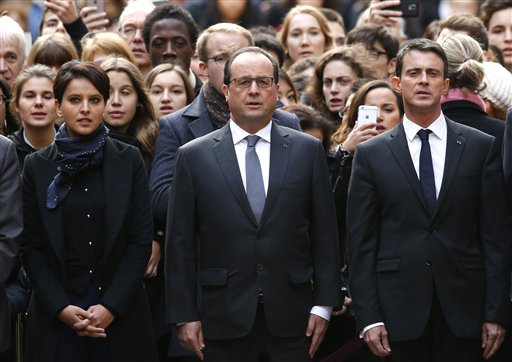
Education Minister Najat Vallaud-Belkacem, President Hollande, and Education Minister Najat Vallaud-Belkacem, stand among students during a minute of silence, Nov. 16, 2015
Source: Guillaume Horcajuelo, Pool via AP
See also French dependencies.
See also Encyclopedia: France .
U.S. State Dept. Country Notes: France
National Institute of Statistics and Economic Studies (INSEE) (In French only) www.insee.fr/fr/home/home_page.asp .
National Institute for Demographic Studies (INED) www.ined.fr .
Trending
Here are the facts and trivia that people are buzzing about.