Albania | Facts & Information

- Albania Profile
- History
- News and Current Events
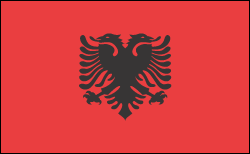
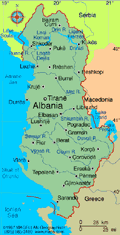
Infoplease has everything you need to know about Albania. Check out our country profile, full of essential information about Albania's geography, history, government, economy, population, culture, religion and languages. If that's not enough, click over to our collection of world maps and flags.
Facts & Figures
-
President: Ilir Meta (2017)
Prime Minister: Edi Rama (2013)
Land area: 10,579 sq mi (27,400 sq km); total area: 11,100 sq mi (28,748 sq km)
Population (2022 est.): 3,095,344 (growth rate: 0.22%); birth rate: 12.69/1000; infant mortality rate: 10.82/1000; life expectancy: 79.47
Capital and largest city (2022 est.): Tirana, 512,000
Other large cities: Durres, 28,9628; Elbasan, 266,245 (2018 est.)
Monetary unit: Lek
National name: Republika e Shqiperise
Languages: Albanian 98.8% (official - derived from Tosk dialect), Greek 0.5%, other 0.6% (including Macedonian, Roma, Vlach, Turkish, Italian, and Serbo-Croatian), unspecified 0.1% (2011 est.)
Ethnicity/race: Albanian 82.6%, Greek 0.9%, other 1% (including Vlach, Roma (Gypsy), Macedonian, Montenegrin, and Egyptian), unspecified 15.5% (2011 est.)
Religions: Muslim 56.7%, Roman Catholic 10%, Orthodox 6.8%, atheist 2.5%, Bektashi (a Sufi order) 2.1%, other 5.7%, unspecified 16.2% (2011 est.)
National Holiday: Independence Day, November 28
Literacy rate: 98.1% (2018 est.)
Economic summary: GDP/PPP (2020 est.): $37.73 billion; per capita $13,300. Real growth rate: 2.24% (2020 est.). Inflation: 1.4% (2019 est.). Unemployment: 5.83% official rate (2019 est.). Note: These are official rates that may not include those working at near-subsistence farming. Arable land: 22.3% (2018). Agriculture: wheat, corn, potatoes, vegetables, fruits, sugar beets, grapes; meat, dairy products. Labor force: 1.104 million; agriculture 41.4%, industry 18.3%, services 40.3% (2018 est.). Industries: food processing, textiles and clothing; lumber, oil, cement, chemicals, mining, basic metals, hydropower. Natural resources: petroleum, natural gas, coal, bauxite, chromite, copper, iron ore, nickel, salt, timber, hydropower. Exports: $3.47 billion (2020 est.): textiles and footwear; asphalt, metals and metallic ores, crude oil; vegetables, fruits, tobacco. Imports: $5.67 billion (2020 est.): machinery and equipment, foodstuffs, textiles, chemicals. Major trading partners: Italy, Spain, Greece, Turkey, Germany, China, France.
Communications: Telephones: main lines in use: 223,469 (2020); mobile cellular: 2,618,880 (2020). Radio broadcast stations: 2 public, 78 private (2019). Television broadcast stations: 3 public, 60+ private (2020). Internet hosts: 508,937 (2020). Internet users: 2,043,251 (2020).
Transportation: Railways: total: 677 km (2020). Highways: total: 18,000 km; paved: 7,020 km; unpaved: 10,980 km (2011). Waterways: 41 km (2011). Ports and harbors: Durres, Sarande, Shengjin, Vlore. Airports: 3 (2021).
International disputes: The Albanian Government calls for the protection of the rights of ethnic Albanians in neighboring countries, and the peaceful resolution of interethnic disputes; some ethnic Albanian groups in neighboring countries advocate for a "greater Albania," but the idea has little appeal among Albanian nationals; the mass emigration of unemployed Albanians remains a problem for developed countries, chiefly Greece and Italy
Trending
Here are the facts and trivia that people are buzzing about.