
Literary Hoaxes

 |
Read about best-selling memoirs that were revealed to mix fact and fiction
by Mark Hughes, Liz Olson, and Beth Rowen
Related Links |
Greg Mortenson
Mortenson, author of the best-selling memoir Three Cups of Tea and hero to many throughout the world for building 140 schools for girls in remote regions of Pakistan and Afghanistan, was dealt a stunning fall from grace in April 2011 when a segment on 60 Minutes alleged that several of the key events detailed in his book were exaggerated or fabricated. Mortenson gained wide fame with the 2006 publication of Three Cups of Tea, which chronicled how he turned a failed attempt to climb K2, the second-highest mountain in the world, into a mission to educate girls in Afghanistan and Pakistan. In his memoir, Mortenson said he became lost, ill, and disoriented during the 1993 climb and was nursed back to health by villagers in Korphe, Pakistan, a remote, mountainous village. He vowed to return and build schools in the area. Steve Kroft, the CBS correspondent, reported on 60 Minutes that Mortenson was never lost and his first visit to Korphe wasn't until 1994. In an interview with the Bozeman Daily Chronicle after the 60 Minutes broadcast, Mortenson said, "The time about our final days on K2 and ongoing journey to Korphe village and Skardu is a compressed version of events that took place in the fall of 1993."
Mortenson also said in the book that he was kidnapped and held for eight days by members of the Taliban. Kroft said instead that Mortenson was an honored guest of—and protected by—tribal leaders in a village in South Waziristan. In addition, 60 Minutes accused Mortenson of exaggerating the number of schools he built and using money donated to the Central Asia Institute, the nonprofit he established to fund the construction of the schools, to promote his books and as "his personal ATM." Despite Mortenson's tainted reputation, his work and effort in Afghanistan and Pakistan cannot be denied and have undoubtedly improved the life and future of scores of young women in a region historically hostile to them.
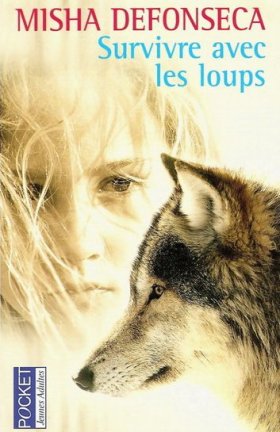
Misha Defonseca
A Belgium writer has admitted that her World War II era memoir is fantasy. In the memoir, Misha: A Memoire of the Holocaust Years, Misha Defonseca (1937- ), also known as Monique De Wael, described the adventures of a 4-year-old Jewish girl left alone during the Holocaust when the Nazis deported her parents for being resistance fighters. In the story, the child killed a German soldier in self-defense, escaped from the Warsaw Ghetto, was rescued by a pack of wolves that then protected her from the Nazis, and traveled 1,900 miles across Europe to find her parents. None of it was true. A Belgium historian, Maxime Steinberg, was researching the registry archive of Jewish families from that period and discovered that there were no Jewish families by the name of Defonseca or De Wael. In fact, Monique De Wael is not Jewish, she was never in the Warsaw Ghetto, she did not kill a German soldier, and there was not a pack of wolves. In a 2008 statement, she acknowledged that the story was fantasy and that she never fled her home in Brussels to find her parents. The book, Misha: A Memoire of the Holocaust Years, has been translated into 18 languages as well as being made into a French film called Survivre avec les Loups (“Surviving With Wolves”).
James Frey
James Frey acknowledged in 2006 that he had fabricated and embellished parts of his 2003 memoir, A Million Little Pieces, a story of personal redemption that sold about 3.5 million copies. His publisher, Doubleday, justified Frey's liberties, saying the memoir is a subjective genre. The controversy led to a discussion about the increasingly blurred line between fact and fiction and the public's acceptance of altered reality as truth. Oprah Winfrey chose the memoir as a selection in her book club and initially came to Frey's defense. She later withdrew her support for him, saying she “felt duped.”
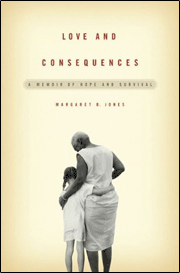
Margaret B. Jones
In 2008, Riverhead Books published Love and Consequences by Margaret B. Jones—a memoir based on her childhood as a half white, half Native American foster child who grew up running drugs for the Bloods gang in South Los Angeles. In her highly praised memoir, Jones describes her African-American foster mother, who raised Margaret and four grandchildren, and a foster bother, who was shot and killed by the Crips outside their home. In reality, Margaret B. Jones is actually Margaret Seltzer, a white girl who was raised by biological parents in the San Fernando Valley and graduated from a private high school in North Hollywood. After seeing a photograph of Seltzer and her daughter in the New York Times, Seltzer's older sister, Cynthia Hoffman, reported that Love and Consequences was a fabricated story. Riverhead Books recalled all copies of Love and Consequences and canceled the author's book tour.
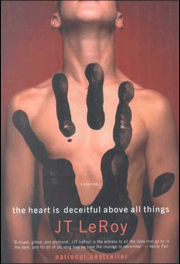
JT Leroy
Writer JT Leroy was exposed as a fake during the winter. Leroy's critically acclaimed semi-autobiographical books, The Heart Is Deceitful Above All Things and Sarah, chronicled the life of a repeatedly abused West Virginia teenager who travels to San Francisco, becomes a prostitute and drug addict, and gets infected with HIV. Leroy's hardscrabble life and redemption as a writer attracted the attention and affection of celebrities. Laura Albert and Geoffrey Knoop, a couple from San Francisco, said they rescued the boy and encouraged him to write. Leroy's agent, however, confirmed in 2006 that the person who has claimed to be Leroy is actually Savannah Knoop, Geoffrey's half sister. Many people believe that Albert created the Leroy character and wrote the books and articles credited to Leroy.
- More from The Hoax Files
Trending
Here are the facts and trivia that people are buzzing about.




