Geography
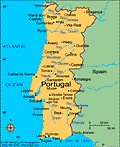
Portugal occupies the western part of the Iberian Peninsula and is slightly smaller than Indiana. The country is crossed by three large rivers that rise in Spain, flow into the Atlantic, and divide the country into three geographic areas. The Minho River, part of the northern boundary, cuts through a mountainous area that extends south to the vicinity of the Douro River. South of the Douro, the mountains slope to the plains around the Tejo River. The remaining division is the southern one of Alentejo. The Azores stretch over 340 mi (547 km) in the Atlantic and consist of nine islands with a total area of 902 sq mi (2,335 sq km). Madeira, consisting of two inhabited islands, Madeira and Porto Santo, and two groups of uninhabited islands, lie in the Atlantic about 535 mi (861 km) southwest of Lisbon.
Government
Parliamentary democracy.
History
An early Celtic tribe, the Lusitanians, are believed to have been the first inhabitants of Portugal. The Roman Empire conquered the region in about 140 BC Toward the end of the Roman Empire, the Visigoths had invaded the entire Iberian Peninsula.
Portugal won its independence from Moorish Spain in 1143. King John I (1385–1433) unified his country at the expense of the Castilians and the Moors of Morocco. The expansion of Portugal was brilliantly coordinated by John's son, Prince Henry the Navigator. In 1488, Bartolomeu Dias reached the Cape of Good Hope, proving that Asia was accessible by sea. In 1498, Vasco da Gama reached the west coast of India. By the middle of the 16th century, the Portuguese empire extended to West and East Africa, Brazil, Persia, Indochina, and the Malayan peninsula.
In 1581, Philip II of Spain invaded Portugal and held it for 60 years, precipitating a catastrophic decline in Portuguese commerce. Courageous and shrewd explorers, the Portuguese proved to be inefficient and corrupt colonizers. By the time the Portuguese monarchy was restored in 1640, Dutch, English, and French competitors had begun to seize the lion's share of the world's colonies and commerce. Portugal retained Angola and Mozambique in Africa, and Brazil (until 1822).
The End of the Monarchy
The corrupt King Carlos, who ascended the throne in 1889, made João Franco the prime minister with dictatorial power in 1906. In 1908, Carlos and his heir were shot dead on the streets of Lisbon. The new king, Manoel II, was driven from the throne in the revolution of 1910, and Portugal became a French-style republic. Traditionally friendly to Britain, Portugal fought in World War I on the Allied side in Africa as well as on the Western Front. Weak postwar governments and a revolution in 1926 brought Antonio de Oliveira Salazar to power. As minister of finance (1928–1940) and prime minister (1932–1968), Salazar ruled Portugal as a virtual dictator. He kept Portugal neutral in World War II but gave the Allies naval and air bases after 1943. Portugal joined NATO as a founding member in 1949 but did not gain admission to the United Nations until 1955.
Portugal's foreign and colonial policies met with increasing difficulty both at home and abroad beginning in the 1950s. In fact, the bloodiest and most protracted wars against colonialism in Africa were fought against the Portuguese. Portugal lost the tiny remnants of its Indian empire—Goa, Daman, and Diu—to Indian military occupation in 1961, the year an insurrection broke out in Angola. For the next 13 years, Salazar, who died in 1970, and his successor, Marcello Caetano, fought independence movements amid growing world criticism. Leftists in the armed forces, weary of a losing battle, launched a successful revolution on April 25, 1974. After the 1974 revolution, the new military junta gave up its territories, beginning with Portuguese Guinea in Sept. 1974, which became the Republic of Guinea-Bissau. The decolonization of the Cape Verde Islands and Mozambique was effected in July 1975. Angola achieved independence later that same year, thus ending a colonial involvement on that continent that had begun in 1415. Full-scale international civil war, however, followed Portugal's departure from Angola, and Indonesia forcibly annexed independent East Timor. Also in 1975, the government nationalized banking, transportation, heavy industries, and the media. Portugal continued to experience social, economic, and political upheavals for the next decade.
A Free Market and Stable Economy
Portugal was admitted to the European Economic Community (now European Union) on Jan. 1, 1986, and on Feb. 16, Mario Soares became the country's first civilian president in 60 years. Aníbal Cavaço Silva, an advocate of free-market economics and the Social Democratic candidate, had been elected as prime minister in 1985, signaling a more politically stable era. General elections in Oct. 1995 went to the Socialist Party, which fell just short of an absolute majority in the assembly. Lisbon mayor Jorge Sampaio, a Socialist, won the race for president in Jan. 1996. Portugal's Socialist government continued to take advantage of rosy economic conditions in 1997, and in 1999, Portugal became a founding member of the European Economic and Monetary Union (EMU).
Portugal gave up its last colony, Macao , on Dec. 20, 1999, turning the small Asian seaport over to China.
In 2002, center-right Social Democrat leader José Manuel Durão Barroso became prime minister. In the summer of 2003, more than a thousand people died during an unprecedented heat wave that caused fires to ravage Portugal's forests. Prime Minister Barroso resigned in July 2004 to become president of the European Commission. Pedro Santana Lopes, the new leader of the Social Democrats, succeeded him as prime minister. In Feb. 2005 elections, the Socialist Party won 45% of the vote, and José Sócrates became prime minister.
Prime Minister Sócrates Resigns Over Handling of Financial Crisis
Running a minority government proved to be a painstaking process, as Sócrates was forced to negotiate legislation on a micro level. Sócrates' situation was complicated by the international financial crisis the peaked in Europe in 2010 and hit Portugal particularly hard. Mired in debt, high unemployment, and an enormous budget deficit, the government was forced to implement austerity measures, including tax hikes and spending cuts. When those measures failed to shore up the economy, two additional rounds of tax hikes and spending cuts were implemented. They were not popular with either the people or businesses. In March 2011, opposition parties in Parliament thwarted Sócrates' proposal for a fourth round of deficit-reduction steps, and Sócrates resigned. Sócrates headed the caretaker government, and requested a bailout from the European Union. Portugal received a $116 billion aid package in May. Under the agreement, Portugal agreed to reduce its deficit to 3% of gross domestic product by 2013. Portugal is the third European country, behind Ireland and Greece, to receive a bailout.
June 2011 witnessed the victory of the Social Democrat's Pedro Passos Coelho over the Socialist Party and incumbent prime minister Sócrates. Prime Minister Coelho's first order of business: the implementation of the 78 billion euro ($115 billion) bailout agreed on by the previous government, the EU, and the IMF.
In Sept. 2012, the lenders agreed to relax the terms of Portugal's bailout by reducing the 2013 budget deficit target to 4.5% from 3% of GDP. Still, the country struggled to come up with an acceptable budget program that would get the job done without alienating the Portuguese.
Just before a planned review of the Portuguese bailout in July 2013 by the EU, the IMF, and creditors, the Portuguese finance minister, Vítor Gaspar, resigned, followed by the foreign minister and head of the People's Party, Paulo Portas. Treasury Secretary Maria Luis de Albuquerque was named as the new finance minister. Portugal recently began its third year of recession and high unemployment.
In January 2016 presidential elections, Marcelo Rebelo de Sousa won 52% of the vote, with his closest rival, independent leftist Antonio Sampaio da Novoa, far behind, with 23% of the vote. A TV pundit and law professor, Rebelo de Sousa was the overwhelming favorite in the election. During his victory speech, Rebelo de Sousa said, "I want to restore national unity - our country is emerging from a deep economic and social crisis." He also promised to "be a free and independent president." He would assume office on March 9.
See also Encyclopedia: Portugal .
U.S. State Dept. Country Notes: Portugal
National Institute of Statistics www.ine.pt