Geography
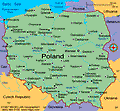
Poland, a country the size of New Mexico, is in north-central Europe. Most of the country is a plain with no natural boundaries except the Carpathian Mountains in the south and the Oder and Neisse rivers in the west. Other major rivers, which are important to commerce, are the Vistula, Warta, and Bug.
Government
Democratic republic.
History
Great (north) Poland was founded in 966 by Mieszko I, who belonged to the Piast dynasty. The tribes of southern Poland then formed Little Poland. In 1047, both Great Poland and Little Poland united under the rule of Casimir I the Restorer. Poland merged with Lithuania by royal marriage in 1386. The Polish-Lithuanian state reached the peak of its power between the 14th and 16th centuries, scoring military successes against the (Germanic) Knights of the Teutonic Order, the Russians, and the Ottoman Turks.
Lack of a strong monarchy enabled Russia, Prussia, and Austria to carry out a first partition of the country in 1772, a second in 1792, and a third in 1795. For more than a century thereafter, there was no Polish state, just Austrian, Prussian, and Russian sectors, but the Poles never ceased their efforts to regain their independence. The Polish people revolted against foreign dominance throughout the 19th century. Poland was formally reconstituted in Nov. 1918, with Marshal Josef Pilsudski as chief of state. In 1919, Ignace Paderewski, the famous pianist and patriot, became the first prime minister. In 1926, Pilsudski seized complete power in a coup and ruled dictatorially until his death on May 12, 1935.
Despite a ten-year nonaggression pact signed in 1934, Hitler attacked Poland on Sept. 1, 1939. Soviet troops invaded from the east on Sept. 17, and on Sept. 28, a German-Soviet agreement divided Poland between the USSR and Germany. Wladyslaw Raczkiewicz formed a government-in-exile in France, which moved to London after France's defeat in 1940. All of Poland was occupied by Germany after the Nazi attack on the USSR in June 1941. Nazi Germany's occupation policy in Poland was designed to eradicate Polish culture through mass executions and to exterminate the country's large Jewish minority.
The Polish government-in-exile was replaced with the Communist-dominated Polish Committee of National Liberation by the Soviet Union in 1944. Moving to Lublin after that city's liberation, it proclaimed itself the Provisional Government of Poland. Some former members of the Polish government in London joined with the Lublin government to form the Polish Government of National Unity, which Britain and the U.S. recognized. On Aug. 2, 1945, in Berlin, President Harry S. Truman, Joseph Stalin, and Prime Minister Clement Attlee of Britain established a new de facto western frontier for Poland along the Oder and Neisse rivers. (The border was finally agreed to by West Germany in a nonaggression pact signed on Dec. 7, 1970.) On Aug. 16, 1945, the USSR and Poland signed a treaty delimiting the Soviet-Polish border. Under these agreements, Poland was shifted westward. In the east, it lost 69,860 sq mi (180,934 sq km); in the west, it gained (subject to final peace conference approval) 38,986 sq mi (100,973 sq km).
A "People's Democracy"
A new constitution in 1952 made Poland a “people's democracy” of the Soviet type. In 1955, Poland became a member of the Warsaw Treaty Organization, with its foreign policy identical to that of the USSR. The government undertook persecution of the Roman Catholic Church as a remaining source of opposition. Wladyslaw Gomulka was elected leader of the United Workers (Communist) Party in 1956. He denounced the Stalinist terror, ousted many Stalinists, and improved relations with the church. Most collective farms were dissolved, and the press became freer. A strike that began in shipyards and spread to other industries in Aug. 1980 produced a stunning victory for workers when the economically hard-pressed government accepted for the first time in a Marxist state the right of workers to organize in independent unions.
Led by Solidarity, an independent union founded by an electrician, Lech Walesa, workers launched a drive for liberty and improved conditions. A national strike for a five-day workweek in Jan. 1981 led to the dismissal of Prime Minister Pinkowski and the naming of the fourth prime minister in less than a year, Gen. Wojciech Jaruzelski. Martial law was declared on Dec. 13, when Walesa and other Solidarity leaders were arrested, and Solidarity was outlawed. Martial law formally ended in 1984 but the government retained emergency powers. Increasing opposition to the government because of the failing economy led to a new wave of strikes in 1988. Unable to quell the dissent entirely, the government relegalized Solidarity and allowed it to compete in elections.
Solidarity members won a stunning victory in 1989, taking almost all the seats in the Senate and all of the 169 seats they were allowed to contest in the Sejm. This gave them substantial influence in the new government. Tadeusz Mazowiecki was appointed prime minister. Lech Walesa won the presidential election of 1990 with 74% of the vote. In 1991, the first fully free parliamentary election since World War II resulted in representation for 29 political parties. Efforts to turn Poland into a market economy, however, led to economic difficulties and widespread discontent. In the second democratic parliamentary election of Sept. 1993, voters returned power to ex-Communists and their allies. Solidarity's popularity and influence continued to wane. In 1995, Aleksander Kwasniewski, leader of the successor to the Communist Party, the Democratic Left, won the presidency over Walesa in a landslide.
In 1999, Poland became part of NATO, along with the Czech Republic and Hungary.
The Demise of the Solidarity Party
In Sept. 2001 parliamentary elections, former Communists, reconstituted as the center-left Democratic Left Alliance, won 41% of the vote. The election seemed to mark the demise of Solidarity, which did not win a single seat.
Poland was a staunch supporter of the United States and Britain during the Iraq war and sent 200 troops to Iraq (60 were combat soldiers). In Sept. 2003, Poland became the leader of a 9,000-strong multinational stabilizing force in Iraq. It contributed 2,000 of its own soldiers. In April 2005, Poland announced it would withdraw all troops from Iraq at the end of the year.
On May 1, 2004, Poland joined the EU. Prime Minister Leszek Miller resigned on May 2, 2004. His popularity had plummeted to 10% because of the country's continued economic troubles and a number of corruption scandals. Former finance minister Marek Belka succeeded him.
Coalitions Prove Too Fragile to Govern
In 2005, conservative Lech Kaczynski became the new president, replacing former Communist Aleksander Kwasniewski, and Kazimierz Marcinkiewicz was appointed prime minister. In July 2006, the immensely popular and well-respected prime minister resigned abruptly, a move many believe was the result of his difficulties in working with President Kaczynski. The president then appointed his twin brother—Jaroslaw Kaczynski, leader of the Law and Justice Party—as prime minister.
Prime Minister Kaczynski formed a fragile majority coalition with two small parties, the Self-Defence Party and the League of Polish Families. After months of political turmoil, the coalition fell apart in Aug. 2007, as Kaczynski sacked four ministers from the partner parties. In September, Kaczynski called for early elections and Parliament voted to dissolve itself.
The pro-European Union Civic Platform won October's elections, and formed a coalition government with the Peasants Party. Donald Tusk became prime minister in November.
On Aug. 14, 2008, Poland, after months of stalling, agreed to allow the United States to install an anti-missile system on its soil. The move by Poland was seen as a strategic one intended to defend itself from the threat of a similar incursion by Russia and to establish closer ties with the West. Russia said that Poland was not in danger of retaliation. On Aug. 20, U.S. Secretary of State Condeleezza Rice and Poland's Foreign Minister Radek Sikorski, signed the deal in Warsaw. Rice stressed that the missile system, which is scheduled to be in operation by 2012, is "defensive and aimed at no one." President Barack Obama abandoned plans for the missile shield in September 2009, opting instead to install a smaller, more mobile system that can destroy short- and medium-range Iranian missiles.
Death of President Kaczynski Stuns the Nation
President Kaczynski, his wife, and dozens of high-ranking government officials were killed on April 10, 2010, when their plane crashed in the Katyn Woods in Smolensk, Russia. The group was headed to a ceremony commemorating the 70th anniversary of the Katyn massacre, in which more than 20,000 elite Polish troops were killed by members of the Soviet secret police during World War II. A total of 96 people perished in the crash, including Poland's deputy foreign minister, 12 members of Parliament, the chiefs of the army and the navy, and the president of the national bank. Despite the shocking and devastating turn of events, the officials who stepped in to ease the transition were praised for their composure and professionalism in the face of crisis. Bronislaw Komorowski, the leader of the lower house of Parliament, assumed the role as acting president.
The symbolism of the timing and site of the catastrophe cannot be ignored. The Katyn massacre remains a contentious issue between Poland and Russia. Just days earlier, Russian prime minister Vladimir Putin became the first Russian leader to honor the Polish victims.
Kaczynski's twin brother and former prime minister, Jaroslaw Kaczynski, ran for president against Bronislaw Komorowski of the governing Civic Platform party. Komorowski took both the first and second rounds of the election and was sworn in as president in July.
Parliamentary elections in Oct. 2010 saw Prime Minister Donald Tusk's Civic Platform party win plurality over Jaroslaw Kaczynski and the Law and Justice party. The center-right Civic Platform took 39% of the vote, with 30% going to the conservative challenger, the Law and Justice Party. With the win, the Civic Platform became the first Polish party to win two consecutive terms since communism's fall in 1989.
Four consecutive days of protests in Warsaw beginning Sept. 11, 2013 put more pressure on the weakened government of Donald Tusk and his Civic Platform (PO) party. Organized by unions, the protests were one sympton of growing discontent with the center-right government in Poland over issues including the pension system, euro entry, and economic policy. The real necessity for a coalition government loomed large for the next parliamentary elections in 2015.
Prime Minister Tusk Named New European Council President
In late August 2014, Prime Minister Tusk was named the next president of the European Council. Therefore, on September 9, Tusk resigned as prime minister. Six days later, President Komorowski asks Ewa Kopacz to form a new government. She assumed the office of prime minister on Sept. 22.
Kopacz became the second female prime minister after Hanna Suchocka. A member of the Civic Platform Party like her predecessor Tusk, Kopacz faced overcoming her party's recent leaked tape scandal in time to win the general election in 2015.
In the May 2015 presidential run-off, Andrzej Duda upset incumbent Bronislaw Komorowski. The conservative Law and Justice party candidate, Duda received over 51% of the vote. Komorowski received 48%. Duda took office on August 6, 2015.
Beata Szydlo became Poland's third female prime minister on Nov. 16, 2015. She also became the second woman in the world to succeed a woman (Ewa Kopacz) as prime minister. At age 35, Szydlo was elected mayor of Gmina Brzeszcze. She was elected to the Sejm, the lower house of Poland's parliament, in 2005. Szydlo's Law and Justice party won the 2015 General Election over the governing Civic Platform party, taking 37.6% of the vote.
See also Encyclopedia: Poland .
U.S. State Dept. Country Notes: Poland
Central Statistical Office www.stat.gov.pl/english/index.htm .