Daily Almanac for
Jul 24, 2008
Info search tips
Bio search tips

Travel to Liechtenstein — Unbiased reviews and great deals from TripAdvisor

Liechtenstein

Principality of Liechtenstein

National name: Fuerstentum Liechtenstein

Ruler: Prince Hans Adam II (1989)

Head of Government: Otmar Hasler (2001)

Current government officials

Total area: 62 sq mi (161 sq km)

Population (2007 est.): 34,247 (growth rate: 0.7%); birth rate: 10.0/1000; infant mortality rate: 4.6/1000; life expectancy: 79.8; density per sq mi: 551

Capital and largest city (2003 est.): Vaduz, 5,300

Monetary unit: Swiss franc

Languages: German (official), Alemannic dialect

Ethnicity/race: Alemannic 86%; Italian, Turkish, and other 14%

Religions: Roman Catholic, 77%, Protestant, 7%; unknown, 11% (2002)

Literacy rate: 100% (1981 est.)

Economic summary: GDP/PPP (1999 est.): $825 million; per capita $25,000. Real growth rate: 11%. Inflation: 1% (2001). Unemployment: 1.3% (Sept. 2002). Arable land: 25%. Agriculture: wheat, barley, corn, potatoes; livestock, dairy products. Labor force: 29,000 of whom 13,900 commute from Austria, Switzerland, and Germany to work each day (2001); industry 47.4%, services 51.3%, agriculture 1.3% (2001). Industries: electronics, metal manufacturing, dental products, ceramics, pharmaceuticals, food products, precision instruments, tourism, optical instruments. Natural resources: hydroelectric potential, arable land. Exports: $2.47 billion (1996): small specialty machinery, connectors for audio and video, parts for motor vehicles, dental products, hardware, prepared foodstuffs, electronic equipment, optical products. Imports: $917.3 million (1996): agricultural products, raw materials, machinery, metal goods, textiles, foodstuffs, motor vehicles. Major trading partners: EU (Germany, Austria, France, Italy, UK), U.S., Switzerland (2004).

Communications: Telephones: main lines in use: 20,072 (2000); mobile cellular: n.a. Radio broadcast stations: AM 0, FM 4, shortwave 0 (1998). Radios: 21,000 (1997). Television broadcast stations: n.a. (linked to Swiss networks) (1997). Televisions: 12,000 (1997). Internet Service Providers (ISPs): 44 (Liechtenstein and Switzerland) (2000). Internet users: n.a.

Transportation: Railways: total: 18.5 km; note: owned, operated, and included in statistics of Austrian Federal Railways (2002). Highways: total: 250 km; paved: 250 km; unpaved: 0 km. Ports and harbors: none. Airports: none.

International disputes: Liechtenstein's royal family claims restitution for 1,600 sq km of land in the Czech Republic confiscated in 1918.

Major sources and definitions

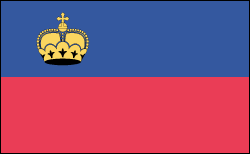
Flag of Liechtenstein

Geography

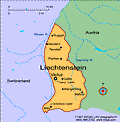
Tiny Liechtenstein, not quite as large as Washington, DC, lies on the east bank of the Rhine River south of Lake Constance between Austria and Switzerland. It consists of low valley land and Alpine peaks. Falknis (8,401 ft; 2,561 m) and Naafkopf (8,432 ft; 2,570 m) are the tallest.

Government

Hereditary constitutional monarchy.

History

The Liechtensteiners are descended from the Alemanni tribe that came into the region after A.D. 500. Founded in 1719, Liechtenstein was a member of the German Confederation from 1815 to 1866, when it became an independent principality. It abolished its army in 1868 and has managed to stay neutral and undamaged in all European wars since then. Liechtenstein still claims 1,600 sq km of Czech territory (the royal family's ancestral home) confiscated in 1918; the Czech Republic insists that restitution does not go back before Feb. 1948, when the Communists seized power. In a referendum on July 1, 1984, male voters granted women the right to vote in national (but not local) elections.

Blacklisted in 2000 as a center for money laundering, Liechtenstein toughened its laws and made major efforts to clean up its financial practices. In 2002, the country was removed from the OECD's (Organization of Economic Cooperation and Development) blacklist.

In March 2003, Liechtenstein's people overwhelmingly voted to give its prince more powers, including the right to dismiss governments and approve judicial nominees. Prince Hans Adam II had threatened to leave the country if his demands for more authority were not met. Before the vote, he had already possessed more power than any other European monarch.

In Aug. 2003 he announced that he would give up the day-to-day ruling of the country in one year's time. In Aug. 2004, his son, Prince Alois, 36, became regent of Liechtenstein, while Hans Adam II remained the official head of state.

See also Encyclopedia: Liechtenstein.
U.S. State Dept. Country Notes: Liechtenstein


Information Please® Database, © 2007 Pearson Education, Inc. All rights reserved.

Libya Countries Lithuania
    • Cite
    • Print
    • Bookmark

More on Liechtenstein from Infoplease:

  • Liechtenstein - Liechtenstein Liechtenstein , officially Principality of Liechtenstein, principality (2005 est. ...
  • Liechtenstein - Liechtenstein Profile: History, Political Conditions, Economy, U.S.-Liechtenstein Relations
  • Liechtenstein - Map of Liechtenstein & articles on flags, geography, history, statistics, disasters current events, and international relations.
  • Liechtenstein: Bibliography - Bibliography See P. Raton, Liechtenstein: History and Institutions of the Principality (1970); T. ...
  • Liechtenstein: History - History The Liechtenstein ruling house is an old Austrian family. The principality was created in ...