|
Travel to Liberia — Unbiased reviews and great
deals from TripAdvisor
Liberia
|
Republic of Liberia
President: Ellen Johnson-Sirleaf
(2006)
Current government officials
Land area: 37,189 sq mi (96,320 sq km);
total area: 43,000 sq mi (111,370 sq km)
Population (2007 est.): 3,193,942
(growth rate: 4.8%); birth rate: 43.7/1000; infant mortality rate:
149.7/1000; life expectancy: 40.4; density per sq mi: 86
Capital and largest city (2003 est.):
Monrovia, 1,348,900 (metro. area), 550,200
(city proper)
Monetary unit: Liberian dollar
Languages:
English 20% (official), some 20 ethnic-group
languages
Ethnicity/race:
indigenous African tribes 95% (including
Kpelle, Bassa, Gio, Kru, Grebo, Mano, Krahn, Gola, Gbandi, Loma,
Kissi, Vai, Bella, Mandingo, and Mende), Americo-Liberians 2.5%
(descendants of former U.S. slaves), Congo People 2.5% (descendants
of former Caribbean slaves)
Religions:
traditional 40%, Christian 40%, Islam 20%
Literacy rate: 58% (2003 est.)
Economic summary: GDP/PPP (2007
est.): $1.34 billion; per capita $400. Real growth rate:
9.4%. Inflation: 11.2%. Unemployment: 85% (2003 est.).
Arable land: 4%. Agriculture: rubber, coffee, cocoa,
rice, cassava (tapioca), palm oil, sugarcane, bananas; sheep, goats;
timber. Labor force: agriculture 70%, industry 8%, services
22% (2000 est.). Industries: rubber processing, palm oil
processing, timber, diamonds. Natural resources: iron ore,
timber, diamonds, gold, hydropower. Exports: $910 million
f.o.b. (2004 est.): rubber, timber, iron, diamonds, cocoa, coffee.
Imports: $4.839 billion f.o.b. (2004 est.): fuels, chemicals,
machinery, transportation equipment, manufactured goods; foodstuffs.
Major trading partners: Denmark, Germany, Poland, U.S.,
Greece, Thailand, South Korea, Japan, Singapore, Croatia (2004).
Communications: Telephones: main lines
in use: 6,700 (2000); mobile cellular: 0 (1998). Radio broadcast
stations: AM 0, FM 7, shortwave 2 (2001). Radios: 790,000
(1997). Television broadcast stations: 1 (plus four low-power
repeaters) (2001). Televisions: 70,000 (1997). Internet
Service Providers (ISPs): 2 (2001). Internet users: 500
(2000).
Transportation: Railways: total: 490 km;
note: none of the railways are in operation (2002). Highways:
total: 10,600 km; paved: 657 km; unpaved: 9,943 km (1999 est.).
Ports and harbors: Buchanan, Greenville, Harper, Monrovia.
Airports: 47 (2002).
International disputes: rebels and
refugees contribute to border instabilities with Sierra Leone, Côte
d'Ivoire, and Guinea; the Ivorian Government accuses Liberia of
supporting Ivorian rebels.
Major sources and definitions
|
|
Geography
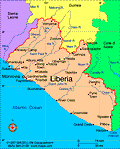
Lying on the Atlantic in the southern part of West Africa, Liberia is
bordered by Sierra Leone, Guinea, and Côte d'Ivoire. It is comparable in
size to Tennessee. Most of the country is a plateau covered by dense
tropical forests, which thrive under an annual rainfall of about 160 in. a
year.
Government
Republic.
History
Africa's first republic, Liberia was founded in 1822 as a result of the
efforts of the American Colonization Society to settle freed American
slaves in West Africa. The society contended that the immigration of
blacks to Africa was an answer to the problem of slavery as well as to
what it felt was the incompatibility of the races. Over the course of
forty years, about 12,000 slaves were voluntarily relocated. Originally
called Monrovia, the colony became the Free and Independent Republic of
Liberia in 1847.
The English-speaking Americo-Liberians, descendants of former American
slaves, make up only 5% of the population but have historically dominated
the intellectual and ruling class. Liberia's indigenous population is
composed of 16 different ethnic groups.
The government of Africa's first republic was modeled after that of the
United States, and Joseph Jenkins Roberts of Virginia was elected the
first president. Ironically, Liberia's constitution denied indigenous
Liberians equal rights with the lighter-skinned American emigrants and
their descendants.
After 1920, considerable progress was made toward opening up the
interior, a process that was speeded up in 1951 by the establishment of a
43-mile (69-km) railroad to the Bomi Hills from Monrovia. In July 1971,
while serving his sixth term as president, William V. S. Tubman died
following surgery and was succeeded by his longtime associate, Vice
President William R. Tolbert, Jr.
Tolbert was ousted in a military coup on April 12, 1980, by Master Sgt.
Samuel K. Doe, backed by the U.S. government. Doe's rule was characterized
by corruption and brutality. A rebellion led by Charles Taylor, a former
Doe aide, and the National Patriotic Front of Liberia (NPFL), started in
Dec. 1989; the following year, Doe was assassinated. The Economic
Community of West African States (ECOWAS) negotiated with the government
and the rebel factions and attempted to restore order, but the civil war
raged on. By April 1996, factional fighting by the country's warlords had
destroyed any last vestige of normalcy and civil society. The civil war
finally ended in 1997.
In what was considered by international observers to be a free
election, Charles Taylor won 75% of the presidential vote in July 1997.
The country had next to no health care system, and the capital was without
electricity and running water. Taylor supported Sierra Leone's brutal
Revolutionary United Front (RUF) in the hopes of toppling his neighbor's
government and in exchange for diamonds, which enriched his personal
coffers. As a consequence, the UN issued sanctions.
In 2002, rebels—Liberians United for Reconciliation and Democracy
(LURD)—intensified their attacks on Taylor's government. By June 2003,
LURD and other rebel groups controlled two-thirds of the country. Finally,
on Aug. 11, Taylor stepped down and went into exile in Nigeria. Gyude
Bryant, a businessman seen as a coalition builder, was selected by the
various factions as the new president. By the time he was exiled, Taylor
had bankrupted his own country, siphoning off $100 million. According to
the New York Times, Taylor left Liberia the world's poorest nation.
In 2004, international donors promised more than $500 million in aid.
In a Nov. 2005 presidential run-off election, Ellen Johnson-Sirleaf, a
Harvard-educated economist who had worked at the World Bank, defeated
George Weah, a former world-class soccer star. In Jan. 2006 she became
Africa's first female president.
In 2006, former president Taylor, in exile in Nigeria, was turned over
to an international court in the Hague to face trial on charges of crimes
against humanity for supporting rebel troops in Sierra Leone's brutal
civil war that claimed the lives of about 300,000 people in the 1990s.
Taylor refused to appear in court when his trial opened in June 2007. His
trial resumed in January 2008.
See also Encyclopedia: Liberia. U.S. State Dept. Country Notes:
Liberia
Information Please® Database, © 2007 Pearson Education,
Inc. All rights reserved.
More on Liberia from Infoplease:
- Liberia - Liberia Liberia (New Lat.,=place of freedom), officially Republic of Liberia, republic (2005 est. ...
- Liberia - Liberia Profile: People, Government and Political Conditions, Economy, Foreign Relations, U.S.-Liberia Relations
- Liberia: meaning and definitions - Liberia: Definition and Pronunciation
- Monrovia, city, Liberia - Monrovia Monrovia , city (1986 est. pop. 465,000), capital of the Republic of Liberia, NW Liberia, ...
- Liberia - Map of Liberia & articles on flags, geography, history, statistics, disasters current events, and international relations.
|
|