|
Travel to Kiribati — Unbiased reviews and great deals from
TripAdvisor
Kiribati
|
Republic of Kiribati
President: Anote Tong (2003)
Current government officials
Total area: 313 sq mi (811 sq km)
Population (2007 est.): 107,817 (growth
rate: 2.2%); birth rate: 30.5/1000; infant mortality rate:
46.0/1000; life expectancy: 62.5; density per sq mi: 389
Capital and largest city (2003 est.):
Tarawa, 26,600
Monetary unit: Australian dollar
Languages:
English (official), I-Kiribati
(Gilbertese)
Ethnicity/race:
Micronesian 98.8%, other 1.2%
Religions:
Roman Catholic 52%, Protestant
(Congregational) 40%, some Seventh-Day Adventist, Muslim, Baha'i,
Latter-day Saints, and Church of God (1999)
Literacy rate: n.a.
Economic summary: GDP/PPP (2007
est.): $348 million; per capita $3,600. Real growth rate: 2%.
Inflation: 0.2%. Unemployment: 2%; under-employment
70% (1992 est.). Arable land: 3%. Agriculture: copra,
taro, breadfruit, sweet potatoes, vegetables; fish. Labor force:
7,870 economically active, not including subsistence farmers
(2001 est.). Industries: fishing, handicrafts. Natural
resources: phosphate (production discontinued in 1979).
Exports: $17 million f.o.b. (2004 est.): copra 62%, coconuts,
seaweed, fish. Imports: $62 million c.i.f. (2004):
foodstuffs, machinery and equipment, miscellaneous manufactured
goods, fuel. Major trading partners: France, Japan, U.S.,
Thailand, Australia, Fiji, New Zealand (2004).
Member of Commonwealth of Nations
Communications: Telephones: main lines
in use: 4,500 (2002); mobile cellular: 600 (2004) Radio broadcast
stations: AM 1, FM 1, shortwave 1; note: the FM and shortwave
stations may be inactive (2002). Radios: 17,000 (1997).
Television broadcast stations: 1 (not reported to be active)
(2002). Televisions: 1,000 (1997). Internet Service
Providers (ISPs): 41 (2007). Internet users: 2,000
(2006).
Transportation: Railways: 0 km.
Highways: total: 670 km (1999 est.); paved: n.a.; unpaved:
n.a. Waterways: small network of canals, totaling 5 km, in
Line Islands. Ports and harbors: Banaba, Betio, English
Harbor, Kanton. Airports: 19 (2007).
International disputes: none.
Major sources and definitions
|
|
Geography
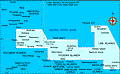
Kiribati, formerly the Gilbert Islands, consists of three widely
separated main groups of southwest Pacific islands: the Gilberts on the
equator, the Phoenix Islands to the east, and the Line Islands farther
east. Ocean Island, producer of phosphates until it was mined out in 1981,
is also included in the 2 million square miles of ocean. Most of the
islands of Kiribati are low-lying coral atolls built on a submerged
volcanic chain and encircled by reefs.
Government
Republic.
History
Kiribati was first settled by early Austronesian-speaking peoples long
before the 1st century A.D. Fijians and Tongans
arrived about the 14th century and subsequently merged with the older
groups to form the traditional I-Kiribati Micronesian society and culture.
The islands were first sighted by British and American ships in the late
18th and early 19th centuries, and the first British settlers arrived in
1837. A British protectorate since 1892, the Gilbert and Ellice Islands
became a Crown colony in 1915–1916. Kiritimati (Christmas) Atoll became a
part of the colony in 1919; the Phoenix Islands were added in 1937.
Tarawa and others of the Gilbert group were occupied by Japan during
World War II. Tarawa was the site of one of the bloodiest battles in U.S.
Marine Corps history when marines landed in Nov. 1943 to dislodge the
Japanese defenders. The Gilbert Islands and Ellice Islands (now Tuvalu)
were separated in 1975 and granted internal self-government by Britain.
Kiribati became independent on July 12, 1979.
Kiribati's 1995 act of moving the international date line far to the
east, so that it encompassed Kiribati's Line Islands group, courted
controversy. The move, which fulfilled one of President Tito's campaign
promises, was intended to enable Kiribati to become the first country to
see the dawn on Jan. 1, 2000, and welcome the new millennium—an event of
significance for tourism. In 1999, Kiribati gained UN membership.
In 2002, Kiribati passed a controversial law enabling it to shut down
newspapers. The legislation followed the launching of Kiribati's first
successful nongovernment-run newspaper. Anote Tong of the opposition
party, Boutokaan Te Koaua, was elected president in 2003. He was reelected
in 2007, taking 65% of the vote to Nabuti Mwemwenikarawa's 33%.
See also Encyclopedia: Kiribati. U.S. State Dept. Country Notes:
Kiribati
Information Please® Database, © 2007 Pearson Education,
Inc. All rights reserved.
More on Kiribati from Infoplease:
- Nauru, Kiribati, and Tonga - U.N.'s Freshmen Class Fascinating facts about Nauru, Kiribati, and Tonga This article was ...
- Kiribati - Kiribati Kiribati , officially Republic of Kiribati (2005 est. pop. 103,000), 342 sq mi (886 sq ...
- Kiribati - World—Country Profiles U.S. Department of State Background Note Kiribati GEOGRAPHY AND PEOPLE ...
- Kiribati - Map of Kiribati & articles on flags, geography, history, statistics, disasters current events, and international relations.
- Current Government Officials: Kiribati - World > Heads of State Info Kiribati Chiefs of State and Cabinet Members of Foreign Governments ...
|
|