Geography
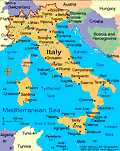
Italy, slightly larger than Arizona, is a long peninsula shaped like a boot, surrounded on the west by the Tyrrhenian Sea and on the east by the Adriatic. It is bounded by France, Switzerland, Austria, and Slovenia to the north. The Apennine Mountains form the peninsula's backbone; the Alps form its northern boundary. The largest of its many northern lakes is Garda (143 sq mi; 370 sq km); the Po, its principal river, flows from the Alps on Italy's western border and crosses the Lombard plain to the Adriatic Sea. Several islands form part of Italy; the largest are Sicily (9,926 sq mi; 25,708 sq km) and Sardinia (9,301 sq mi; 24,090 sq km).
Government
Republic.
History
The migrations of Indo-European peoples into Italy probably began about 2000 B.C. and continued until 1000 B.C. From about the 9th century B.C. until it was overthrown by the Romans in the 3rd century B.C., the Etruscan civilization was dominant. By 264 B.C., all Italy south of Cisalpine Gaul was under the leadership of Rome. For the next seven centuries, until the barbarian invasions destroyed the western Roman Empire in the 4th and 5th centuries A.D., the history of Italy is largely the history of Rome. From 800 on, the Holy Roman Emperors, Roman Catholic popes, Normans, and Saracens all vied for control over various segments of the Italian peninsula. Numerous city-states, such as Venice and Genoa, whose political and commercial rivalries were intense, and many small principalities flourished in the late Middle Ages. Although Italy remained politically fragmented for centuries, it became the cultural center of the Western world from the 13th to the 16th century.
Italy Becomes a Unified Peninsula
In 1713, after the War of the Spanish Succession, Milan, Naples, and Sardinia were handed over to the Hapsburgs of Austria, which lost some of its Italian territories in 1735. After 1800, Italy was unified by Napoléon, who crowned himself king of Italy in 1805; but with the Congress of Vienna in 1815, Austria once again became the dominant power in a disunited Italy. Austrian armies crushed Italian uprisings in 1820–1821 and 1831. In the 1830s, Giuseppe Mazzini, a brilliant liberal nationalist, organized the Risorgimento (Resurrection), which laid the foundation for Italian unity. Disappointed Italian patriots looked to the House of Savoy for leadership. Count Camille di Cavour (1810–1861), prime minister of Sardinia in 1852 and the architect of a united Italy, joined England and France in the Crimean War (1853–1856), and in 1859 helped France in a war against Austria, thereby obtaining Lombardy. By plebiscite in 1860, Modena, Parma, Tuscany, and the Romagna voted to join Sardinia. In 1860, Giuseppe Garibaldi conquered Sicily and Naples and turned them over to Sardinia. Victor Emmanuel II, king of Sardinia, was proclaimed king of Italy in 1861. The annexation of Venetia in 1866 and of papal Rome in 1870 marked the complete unification of peninsular Italy into one nation under a constitutional monarchy.
The Rise and Fall of Mussolini
Italy declared its neutrality upon the outbreak of World War I on the grounds that Germany had embarked upon an offensive war. In 1915, Italy entered the war on the side of the Allies but obtained less territory than it expected in the postwar settlement. Benito (“Il Duce”) Mussolini, a former Socialist, organized discontented Italians in 1919 into the Fascist Party to “rescue Italy from Bolshevism.” He led his Black Shirts in a march on Rome and, on Oct. 28, 1922, became prime minister. He transformed Italy into a dictatorship, embarking on an expansionist foreign policy with the invasion and annexation of Ethiopia in 1935 and allying himself with Adolf Hitler in the Rome-Berlin Axis in 1936. When the Allies invaded Italy in 1943, Mussolini's dictatorship collapsed; he was executed by partisans on April 28, 1945, at Dongo on Lake Como. Following the armistice with the Allies (Sept. 3, 1943), Italy joined the war against Germany as a cobelligerent. A June 1946 plebiscite rejected monarchy and a republic was proclaimed. The peace treaty of Sept. 15, 1947, required Italian renunciation of all claims in Ethiopia and Greece and the cession of the Dodecanese islands to Greece and of five small Alpine areas to France. The Trieste area west of the new Yugoslav territory was made a free territory (until 1954, when the city and a 90-square-mile zone were transferred to Italy and the rest to Yugoslavia).
Italy Moves to Stabilize Its Economy
Italy became an integral member of NATO and the European Economic Community (later the EU) as it successfully rebuilt its postwar economy. A prolonged outbreak of terrorist activities by the left-wing Red Brigades threatened domestic stability in the 1970s, but by the early 1980s the terrorist groups had been suppressed. “Revolving door” governments, political instability, scandal, and corruption characterized Italian politics in the 1980s and 1990s.
Italy adopted the euro as its currency in Jan. 1999. Treasury Secretary Carlo Ciampi, who is credited with the economic reforms that permitted Italy to enter the European Monetary Union, was elected president in May 1999. Italy joined its NATO partners in the Kosovo crisis. Aviano Air Base in northern Italy was a crucial base for launching air strikes into Kosovo and Yugoslavia.
Berlusconi Proves to Be Resilient and Persistent
In June 2001, Silvio Berlusconi, a conservative billionaire, was sworn in as prime minister. He pledged to reduce unemployment, cut taxes, revamp the educational system, and reform the bureaucracy. His critics were alarmed by the apparent conflict of interest of a prime minister who also owned 90% of Italy's media. He was accused of Mafia connections and was under indictment for tax fraud and bribery. Found guilty in three out of four of his trials, he was acquitted in all of them on appeal. Several other cases are pending.
In April 2005, regional elections had disastrous results for Berlusconi's center-right coalition. The dismal state of the economy was blamed for the poor showing. In parliamentary elections held April 2006, the center-left Union coalition led by Romano Prodi won 49.8% of the vote and Berlusconi's House of Liberties coalition won 49.7%—a mere 25,000 vote difference. Berlusconi refused to concede and called for a recount. He eventually relented, and Prodi was given the go-ahead by the newly installed president Giorgio Napolitano to form a government. Prodi served as prime minister once before (1996–98) and also as president of the European Union. Prodi's government proved fragile almost immediately. Indeed, he submitted his resignation in Feb. 2007, just nine months into his term, after a key foreign-policy vote about the deployment of troops to Afghanistan and an expansion of a U. S. military base failed in the Senate. Days later, the Senate, facing the prospect of Silvio Berlusconi returning to power, narrowly passed a vote of confidence in Prodi's government and he remained in office. Less than a year later, in Jan. 2008, the Udeur party bolted from his coalition, costing Prodi his majority in the senate. He survived a no-confidence vote in the lower house of Parliament, but lost in the Senate, 161 to 156, forcing his government to resign. Parliament was dissolved, and elections were set for April. Berlusconi saw the crisis as an opportunity for a political comeback. On April 15, 2008, with support from the Northern League, Berlusconi and his center-right government won the elections, ensuring him a third term as prime minister.
On May 8, 2008, Berlusconi was sworn in for his third term as prime minister and announced his cabinet, which remains dominated by center-right politicians and includes few women.
On July 23, 2008, the Senate and lower chamber approved a bill that grants immunity to the four most powerful elected officials while they are in office, including the prime minister, the president, and the speakers of the two chambers of Parliament.
Italy Faces Challenges and Berlusconi Faces Charges
After two consecutive quarters of negative growth, Italy was declared officially in recession in November 2008.
An earthquake of magnitude 6.3 hit central Italy in April 2009. At least 275 people were killed and 28,000 were left homeless. The town of L'Aquila was the epicenter of the earthquake, but as many as 26 towns were affected.
Silvio Berlusconi's coalition lost its majority in August 2010 amid a row with Gianfranco Fini, the leader of the Party of Freedom. Tension between the former allies had been escalating and culminated when Fini and more than 30 deputies broke with the party to form a "party within a party." The split led to a vote of confidence in December 2010, which Berlusconi barely survived.
In January 2011, Italy's Constitutional Court partially lifted Berlusconi's immunity. The ruling reactivated three trials against him, including one in which David Mills, his former tax lawyer, was convicted of taking a bribe in exchange for false testimony. In February 2011, prosecutors in Milan filed criminal charges against Berlusconi. The charges were for prostitution and abuse of office. Prosecutors say that Berlusconi paid Karima el-Mahroug for sex before she turned 18. Mahroug, a nightclub dancer nicknamed Ruby Heart-Stealer, claims that she did not have sex with the prime minister. She does say that he paid her 7,000 Euros when she attended a party at his villa for the first time in the spring of 2010. Berlusconi vowed to continue governing and to fight the charges. On Feb. 13, 2011, thousands of protestors poured into the streets in Italian cities as well as other cities worldwide to demonstrate against Berlusconi's treatment of women, his latest sex scandal, and his habit of putting television showgirls in political office.
In May 2011, the Berlusconi-backed incumbent candidate for mayor of Milan, Letizia Moratti, was defeated. Berlusconi had said he considered the election a test of his standing and popularity in his hometown. He has a history of becoming personally involved in local elections and the loss of a candidate he publicly campaigned for was a clear sign of his fading influence. Giuliano Pisapia, a center-left candidate, beat Ms. Moratti by more than six points.
Italy's economic woes continued into 2011. In July, the country's borrowing costs rose to 5.7%, its highest rate in more than a decade. Despite implementing an aggressive deficit-reduction plan, by summer 2011 Italy was spending 16% of its budget on interest payments, and foreigners held about 800 billion euros ($1.4 trillion) of Italy's debt, a sum greater than that of Greece, Ireland, and Portugal combined. Compounding the problem was years of sluggish growth, which has impeded Italy's ability to reduce its debt.
Mario Monti Helps to Stabilize Economy
Parliament passed a 54 billion euro ($74 billion) austerity package in September, which sparked protests and a confidence vote on Berlsuconi in parliament that he narrowly won. With no sign that Italy's debt crisis was abating and its economy too big for a bail out, the European Union demanded another round of austerity measures in November. By this point—and with interest rate topping 7%, neither the public nor Berlusconi's allies in parliament had much faith in his leadership. The dissonance was demonstrated when members of his coalition in the lower house of parliament defected in a vote on the budget. Berlusconi, who had somehow managed to weather political and personal scandals that would have ended most political careers, confronted a crisis too big even for him. He promised to resign once the measures passed parliament. Italy's Senate passed the plan on November 11, 2011, and Berlusconi stepped down on November 12. Mario Monti, an economist and former antitrust commissioner for the European Commission, took over, leading a cabinet of technocrats to implement the austerity plan.
In his first six weeks in office, Monti pushed through a series of reform measures that raised the retirement age, increased property taxes, overhauled government agencies, and cracked down on tax cheats. His reforms helped to stabilize the foundering economy and restore investor confidence. However, he was criticized for focusing too much on austerity rather than growth. Monti resigned in December 2012 after losing the support of Berlusconi's People of Freedom (PdL) party.
Parliamentary elections held in February 2013 were inconclusive, leaving the country in political gridlock. The center-left Democratic Party, led by Pier Luigi Bersani, narrowly prevailed over Berlusconi's center-right People of Liberty party in the lower house, 29.5% to 29.2%. The Democratic Party, however, did not secure a majority in the Senate, and thus could not form a government. In a stunning turn, the Five Star Movement, the protest party headed by comedian Beppe Grillo, won 25% of the vote, placing third. Monti's party placed last. Stock markets in the EU tumbled amid the uncertainty over the future of Europe's third largest economy.
Berlusconi Removed from Senate
On Nov. 28, 2013, long-term Italian politician Silvio Berlusconi was stripped of his Senate seat in the face of a plague of legal troubles.
On Dec. 10, 2013, Italy's center-left Democratic party gained a new, charismatic, reformist leader in Matteo Renzi, whom watchers say might provide a challenge to Prime Minister Enrico Letta's government. Renzi's power group includes seven women and five men with an average age of 35. Renzi's center-left Democrats backed the Prime Minister and his Democrats in a Senate confidence vote on Dec. 11, which Prime Minister Letta won 173 to 127 after promising broad-ranging and long-overdue reforms.
Matteo Renzi Becomes Italy's Youngest Prime Minister
Il Rottomatore, "Demolition Man," Matteo Renzi, 39, has once again shaken up Italian politics. After negotiating an unprecedented pact in January 2014 with opposition leader Berlusconi—who can no longer hold political office after being ousted from the Senate, but still leads the center-right party— Renzi was sworn in as prime minister on Feb. 22, 2014. Renzi named a 16-member cabinet including Pier Carlo Padoan as finance minister and Angelino Alfano as Interior Minister. For the first time in Italian history, half of the governing cabinet is made up of women, and the average age is 48.
In spring of 2014, Silvio Berlusconi, Italy's former prime minister, was sentenced to one year of community service following his conviction last year for tax fraud. Berlusconi, 77, must assist with Alzheimer's patients in a nursing home outside of Milan. The following month, Berlusconi's conviction for allegedly paying for underage sex was overturned in Milan's appeals court. Still, Berlusconi could not run for public office because of the tax fraud conviction.
Parliament elected Sergio Mattarella president on Feb. 3, 2015. The first native of Sicily to become Italy's president, he previously served as Minister of Education, Minister of Defense, and as a judge on the Constitutional Court. Mattarella's presidential election was a political victory for Prime Minister Renzi. Mattarella was Renzi's candidate for president. His election would aid in Renzi passing reforms to help with the country's economic recovery.
On March 11, 2015, Berlusconi's acquittal on charges of paying for sex with an underage dancer was confirmed by Italy's highest court. Since his community service for the tax fraud charges was also complete, the former prime minister could focus on supporting his divided Forza Italia party in the upcoming May regional elections.
See also Encyclopedia: Italy .
U.S. State Dept. Country Notes: Italy
National Statistical Institute www.istat.it .