Israel | Facts & Information

- Israel Profile
- History
- News and Current Events
Infoplease has everything you need to know about Israel. Check out our country profile, full of essential information about Israel's geography, history, government, economy, population, culture, religion and languages. If that's not enough, click over to our collection of world maps and flags.
Plus, test your country knowledge with our Middle Eastern history and geography quiz, and see How Well Do You Know Israel?
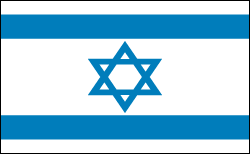
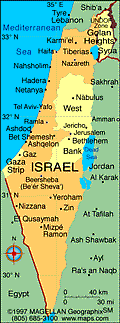
Facts & Figures
-
President: Reuven Rivlin (2014)
Prime Minister: Benjamin Netanyahu (2009)
Land area: 7,849 sq mi (20,329 sq km); total area: 8,019 sq mi (20,770 sq km)
Population (2014 est.): 7,821,850 (growth rate: 1.46%); birth rate: 18.44/1000; infant mortality rate: 3.98/1000; life expectancy: 81.28
Capital and largest city (2009 est.): Jerusalem, 791,000 Note: Israel proclaimed Jerusalem as its capital in 1950. While many countries maintain their embassies in Tel Aviv, the U.S. moved theirs to Jerusalem in 2018.
Other large cities: Tel Aviv-Yafo 3.381 million; Haifa 1.054 million
Monetary unit: Shekel
National name: Medinat Yisra'el
Languages: Hebrew (official), Arabic, English
Ethnicity/race: Jewish 75.1% (of which Israel-born 73.6%, Europe/America/Oceania-born 17.9%, Africa-born 5.2%, Asia-born 3.2%), non-Jewish 24.9% (mostly Arab) (2012 est.)
Religions: Jewish 75.1%, Muslim 17.4%, Christian 2%, Druze 1.6%, other 3.9% (2012 est.)
National Holiday: Independence Day, April or May 14
Literacy rate: 97% (2004 est.)
Economic summary: GDP/PPP (2014 est.): $273.2 billion; per capita $36,200. Real growth rate: 3.3%. Inflation: 3.9%. Unemployment: 1.7%. Arable land: 13.68%. Agriculture: citrus, vegetables, cotton; beef, poultry, dairy products. Labor force: 3.493 million; agriculture 1.65%; industry 18.1%; services 80.3% (2012). Industries: high-technology projects (including aviation, communications, computer-aided design and manufactures, medical electronics, fiber optics), wood and paper products, potash and phosphates, food, beverages, and tobacco, caustic soda, cement, construction, metals products, chemical products, plastics, diamond cutting, textiles, footwear. Natural resources: timber, potash, copper ore, natural gas, phosphate rock, magnesium bromide, clays, sand. Exports: $62.32 billion (2012 est.): machinery and equipment, software, cut diamonds, agricultural products, chemicals, textiles and apparel. Imports: $67.03 billion (2013 est.): raw materials, military equipment, investment goods, rough diamonds, fuels, grain, consumer goods. Major trading partners: U.S., Belgium, Hong Kong, Germany, Switzerland, UK, China (2006).
Communications: Telephones: main lines in use: 3.594 million (2012); mobile cellular 9.225 million (2012). Broadcast media: state broadcasting network, operated by the Israel Broadcasting Authority (IBA), broadcasts on 2 channels, one in Hebrew and the other in Arabic; 5 commercial channels including a channel broadcasting in Russian, a channel broadcasting Knesset proceedings, and a music channel supervised by a public body; multi-channel satellite and cable TV packages provide access to foreign channels; IBA broadcasts on 8 radio networks with multiple repeaters and Israel Defense Forces Radio broadcasts over multiple stations; about 15 privately owned radio stations; overall more than 100 stations and repeater stations (2008). Internet hosts: 2.483 million (2012). Internet users: 4.525 million (2009).
Transportation: Railways: total: 975 km (2008). Roadways: total: 18,566 km; paved: 18,566 km (including 449 km of expressways) (2011). Ports and terminals: Ashdod, Elat (Eilat), Hadera, Haifa. Airports: 47 (2013).
International disputes: West Bank and Gaza Strip are Israeli-occupied with current status subject to the Israeli-Palestinian Interim Agreement - permanent status to be determined through further negotiation; Israel continues construction of a "seam line" separation barrier along parts of the Green Line and within the West Bank; Israel announced its intention to pull out Israeli settlers and withdraw from the Gaza Strip and four settlements in the northern West Bank in 2005; Golan Heights is Israeli-occupied (Lebanon claims the Shab'a Farms area of Golan Heights); since 1948, about 350 peacekeepers from the UN Truce Supervision Organization (UNTSO) headquartered in Jerusalem monitor ceasefires, supervise armistice agreements, prevent isolated incidents from escalating, and assist other UN personnel in the region.
Geography
Israel, slightly larger than Massachusetts, lies at the eastern end of the Mediterranean Sea. It is bordered by Egypt on the west, Syria and Jordan on the east, and Lebanon on the north. Its maritime plain is extremely fertile. The southern Negev region, which comprises almost half the total area, is largely a desert. The Jordan, the only important river, flows from the north through Lake Hule (Waters of Merom) and Lake Kinneret (also called Sea of Galilee or Sea of Tiberias), finally entering the Dead Sea 1,349 ft (411 m) below sea level—the world's lowest land elevation.
Government
Parliamentary democracy.
History
Palestine, considered a holy land by Jews, Muslims, and Christians, and homeland of the modern state of Israel, was known as Canaan to the ancient Hebrews. Palestine's name derives from the Philistines, a people who occupied the southern coastal part of the country in the 12th century B.C.
A Hebrew kingdom established in 1000 B.C. was later split into the kingdoms of Judah and Israel; they were subsequently invaded by Assyrians, Babylonians, Egyptians, Persians, Romans, and Alexander the Great of Macedonia. By A.D. 135, few Jews were left in Palestine; most lived in the scattered and tenacious communities of the Diaspora, communities formed outside Palestine after the Babylonian exile. Palestine became a center of Christian pilgrimage after the emperor Constantine converted to that faith. The Arabs took Palestine from the Byzantine empire in 634–640. Interrupted only by Christian Crusaders, Muslims ruled Palestine until the 20th century. During World War I, British forces defeated the Turks in Palestine and governed the area under a League of Nations mandate from 1923.
State of Israel Gives Jews a Homeland
As part of the 19th-century Zionist movement, Jews had begun settling in Palestine as early as 1820. This effort to establish a Jewish homeland received British approval in the Balfour Declaration of 1917. During the 1930s, Jews persecuted by the Hitler regime poured into Palestine. The postwar acknowledgment of the Holocaust—Hitler's genocide of 6 million Jews—increased international interest in and sympathy for the cause of Zionism. However, Arabs in Palestine and surrounding countries bitterly opposed prewar and postwar proposals to partition Palestine into Arab and Jewish sectors. The British mandate to govern Palestine ended after the war, and, in 1947, the UN voted to partition Palestine. When the British officially withdrew on May 14, 1948, the Jewish National Council proclaimed the State of Israel.
U.S. recognition came within hours. The next day, Arab forces from Egypt, Jordan, Syria, Lebanon, and Iraq invaded the new nation. By the cease-fire on Jan. 7, 1949, Israel had increased its original territory by 50%, taking western Galilee, a broad corridor through central Palestine to Jerusalem, and part of modern Jerusalem. Chaim Weizmann and David Ben-Gurion became Israel's first president and prime minister. The new government was admitted to the UN on May 11, 1949.
Israel Expands Its Territory Through War
The next clash with Arab neighbors came when Egypt nationalized the Suez Canal in 1956 and barred Israeli shipping. Coordinating with an Anglo-French force, Israeli troops seized the Gaza Strip and drove through the Sinai to the east bank of the Suez Canal, but withdrew under U.S. and UN pressure. In the Six-Day War of 1967, Israel made simultaneous air attacks against Syrian, Jordanian, and Egyptian air bases, totally defeating the Arabs. Expanding its territory by 200%, Israel at the cease-fire held the Golan Heights, the West Bank of the Jordan River, Jerusalem's Old City, and all of the Sinai and the east bank of the Suez Canal.
In the face of Israeli reluctance even to discuss the return of occupied territories, the fourth Arab-Israeli war erupted on Oct. 6, 1973, with a surprise Egyptian and Syrian assault on the Jewish high holy day of Yom Kippur. Initial Arab gains were reversed when a cease-fire took effect two weeks later, but Israel suffered heavy losses.
Peace Treaty with Egypt Brings Temporary Calm to Mideast
A dramatic breakthrough in the tortuous history of Mideast peace efforts occurred on Nov. 9, 1977, when Egypt's president Anwar Sadat declared his willingness to talk about reconciliation. Prime Minister Menachem Begin, on Nov. 15, extended an invitation to the Egyptian leader to address the Knesset in Jerusalem. Sadat's arrival in Israel four days later raised worldwide hopes, but an agreement between Egypt and Israel was long in coming. On March 14, 1979, the Knesset approved a final peace treaty, and 12 days later, Begin and Sadat signed the document, together with President Jimmy Carter, in a White House ceremony. Israel began its withdrawal from the Sinai, which it had annexed from Egypt, on May 25.
Although Israel withdrew its last settlers from the Sinai in April 1982, the fragile Mideast peace was shattered on June 9, 1982, by a massive Israeli assault on southern Lebanon, where the Palestinian Liberation Organization was entrenched. The PLO had long plagued Israelis with acts of terrorism. Israel destroyed PLO strongholds in Tyre and Sidon and reached the suburbs of Beirut on June 10. A U.S.-mediated accord between Lebanon and Israel, signed on May 17, 1983, provided for Israeli withdrawal from Lebanon. Israel eventually withdrew its troops from the Beirut area but kept them in southern Lebanon, where occasional skirmishes would continue. Lebanon, under pressure from Syria, canceled the accord in March 1984.
Jewish Settlements Increase Tension Between Israelis and Palestinians
A continual source of tension has been the relationship between the Jews and the Palestinians living within Israeli territories. Most Arabs fled the region when the state of Israel was declared, but those who remain now make up almost one-fifth of the population of Israel. They are about two-thirds Muslim, as well as Christian and Druze. Palestinians living on the West Bank and the Gaza Strip fomented the riots begun in 1987, known as the intifada. Violence heightened as Israeli police cracked down and Palestinians retaliated. Continuing Jewish settlement of lands designated for Palestinians has added to the unrest.
In 1988, the leader of the PLO, Yasir Arafat, reversed decades of PLO polemic by acknowledging Israel's right to exist. He stated his willingness to enter negotiations to create a Palestinian political entity that would coexist with the Israeli state.
In 1991, Israel was struck by Iraqi missiles during the Persian Gulf War. The Israelis did not retaliate in order to preserve the international coalition against Iraq. In 1992, Yitzhak Rabin became prime minister. He halted the disputed Israeli settlement of the occupied territories.
Netanyahu Steps Back from Oslo Accord
Highly secretive talks in Norway resulted in the landmark Oslo Accord between the PLO and the Israeli government in 1993. The accord stipulated a five-year plan in which Palestinians of the West Bank and the Gaza Strip would gradually become self-governing. Arafat became president of the new Palestinian Authority. In 1994, Israel signed a peace treaty with Jordan; Israel still has no formal agreement with Syria or Lebanon.
On Nov. 4, 1995, Prime Minister Rabin was slain by a Jewish extremist, jeopardizing the tentative progress toward peace. Shimon Peres succeeded him until May 1996 elections for the Knesset gave Israel a new hard-line prime minister, Benjamin Netanyahu, by a razor-thin margin. Netanyahu reversed or stymied much of the Oslo Accord, contending that it offered too many quick concessions and jeopardized Israelis' safety.
Israeli-Palestinian peace negotiations in 1997 were repeatedly undermined by both sides. Although the Hebron Accord was signed in January, calling for the withdrawal of Israeli troops from Hebron, the construction of new Jewish settlements on the West Bank in March profoundly upset progress toward peace.
Progress Toward Peace Inconsistent
Terrorism erupted again in 1997 when radical Hamas suicide bombers claimed the lives of more than 20 Israeli civilians. Netanyahu, accusing Palestinian Authority president Arafat of lax security, retaliated with draconian sanctions against Palestinians working in Israel, including the withholding of millions of dollars in tax revenue, a blatant violation of the Oslo Accord. Netanyahu also persisted in authorizing right-wing Israelis to build new settlements in mostly Arab East Jerusalem. Arafat, meanwhile, seemed unwilling or unable to curb the violence of Arab extremist.
An Oct. 1998 summit at Wye Mills, Md., generated the first real progress in the stymied Middle East peace talks in 19 months, with Netanyahu and Arafat settling several important interim issues called for by the 1993 Oslo Accord. The peace agreement, however, began unraveling almost immediately. By the end of April 1999, Israel had made 41 air raids on Hezbollah guerrillas in Lebanon. The guerrillas were fighting against Israeli troops and their allies, the South Lebanon Army militia, who occupied a security zone set up in 1985 to guard Israel's borders. Public pressure in Israel to withdraw the troops grew.
Labor Party leader Ehud Barak won the 1999 election and announced that he planned not only to pursue peace with the Palestinians, but to establish relations with Syria and end the low-grade war in southern Lebanon with the Iranian-armed Hezbollah guerrillas. In Dec. 1999, Israeli-Syrian talks resumed after a nearly four-year hiatus. By Jan. 2000, however, talks had broken down over Syria's demand for a detailed discussion of the return of all of the Golan Heights. In Feb., new Hezbollah attacks on Israeli troops in southern Lebanon led to Israel's retaliatory bombing as well as Barak's decision to pull out of Lebanon. Israeli troops pulled out of Lebanon on May 24, 2000, after 18 consecutive years of occupation.
Violence Between Israelis and Palestinians Reaches New Heights
Peace talks in July 2000 at Camp David between Barak and Arafat ended unsuccessfully, despite President Clinton's strongest efforts—the status of Jerusalem was the primary sticking point. In September, Likud Party leader Ariel Sharon visited the compound called Temple Mount by Jews and Haram al-Sharif by Muslims, a fiercely contested site that is sacred to both faiths. The visit set off the worst bloodshed in years, with the deaths of around 400 people, mostly Palestinians. The violence (dubbed the Al-Aksa intifada) and the stalled peace process fueled growing concerns about Israeli security, paving the way for hard-liner Sharon's stunning landslide victory over Barak in Feb. 2001. Attacks on both sides continued at an alarming rate. Palestinians carried out some of the most horrific suicide bombings and terrorist attacks in years (Hamas and the Al-Aksa Martyr Brigade claimed responsibility for the majority of them), killing Israeli civilians at cafés, bus stops, and supermarkets. In retaliation, Israel unleashed bombing raids on Palestinian territory and sent troops and tanks to occupy West Bank and Gaza cities.
In 2003, in an attempt to restart the stalled Israeli-Palestinian peace process, Israel and the United States resolved to circumvent Arafat, whom Sharon called “irrelevant” and an obstacle. Under U.S. pressure, Arafat reluctantly appointed a prime minister in April, who was to replace him in negotiating the peace process, Mahmoud Abbas, formerly Arafat's second-in-command. On May 1, the “Quartet” (the U.S., UN, EU, and Russia) unfurled the “road map” for peace, which envisioned the creation of a Palestinian state by 2005. Although Sharon publicly acknowledged the need for a Palestinian state and Abbas committed himself to ending Palestinian violence, by fall 2003, it became clear that the road map led to a dead end as Palestinian attacks on Israeli civilians continued, and Israel stepped up its “targeted killings” of Palestinian militants. Sharon also persisted in building the highly controversial security barrier dividing Israeli and Palestinian areas.
In May 2004, the UN Security Council condemned Israel's attack on the Rafah refugee camp in the Gaza Strip, the largest Israeli military operation in Gaza in decades. In July, in response to a ruling by Israel's supreme court about the construction of the West Bank barrier, Israel revised the route so that it did not cut into Palestinian land. The UN estimated that the original route would have taken almost 15% of West Bank territory for Israel.
Israel Withdraws Settlers from Gaza
Yasir Arafat's death in Nov. 2004 significantly altered the political landscape. Mahmoud Abbas was easily elected the Palestinian president in Jan. 2005, and at a summit in February, Abbas and Sharon agreed to an unequivocal cease-fire. A continued threat to this cease-fire were Palestinian militant groups, over whom Abbas had little control.
On Aug. 15, the withdrawal of some 8,000 Israeli settlers began. The evacuation involved 21 Gaza settlements as well as 4 of the more isolated of the West Bank's 120 settlements. The majority of Israelis supported Prime Minister Ariel Sharon’s unilateral plan—which he pushed through the Knesset in Oct. 2004—viewing it as Israel's just and humane response toward the Palestinians as well as a significant step toward real security for Israelis. But tens of thousands on the right protested that Sharon, an architect of the settlement movement, had become the agent of Gaza's dismantlement.
While Sharon was lauded for what has arguably been the most significant step in the Israeli-Palestinian peace process since the Oslo Accord, the prime minister’s unstated motives in conceding Gaza were generally assumed to be the strengthening of Israel's hold on the West Bank.
Sharon Forms New Party
Israel's political parties underwent a seismic shift in late Nov. 2005. The Labor Party elected left-leaning Amir Peretz as their new leader, a defeat for long time leader Shimon Peres. Shortly thereafter, Prime Minister Sharon quit the Likud Party—a party he helped found—and formed the new, more centrist Kadima (“Forward”) Party. The Likud Party had largely disapproved of the Gaza withdrawal Sharon sponsored, and he faced increasing discontent from the more right-wing members of the Likud Party. Former prime minister and hard-liner Benjamin Netanyahu became Likud's new leader.
In Jan. 2006, Ariel Sharon suffered a stroke that left him critically ill and unable to govern. Deputy Prime Minister Ehud Olmert became acting prime minister, and in general elections on March 28, Olmert's Kadima Party won the largest number of seats. In May, he formed a coalition between the Kadima, Labor, ultra-orthodox Shas, and Pensioners parties.
Former Prime Minister Ariel Sharon died on Jan. 11, 2014. The official cause of death was heart failure, although Sharon had been in a coma since suffering from the stroke in Jan. 2006.
Hamas Dominates Parliamentary Elections
Israeli-Palestinian relations were thrown into further turmoil when the militant Hamas Party won an unexpected landslide victory in the January Palestinian parliamentary elections. Although Hamas had been in a cease-fire with Israel for more than a year the party continued to call for Israel's destruction and refused to renounce violence.
In April 2006, Hamas fired rockets into Israeli territory, effectively ending the cease-fire between them. After Hamas militants killed two Israeli soldiers and kidnapped another on June 25, Israel launched air strikes and sent ground troops into Gaza, destroying its only power plant and three bridges. Fighting continued over the summer, with Hamas firing rockets into Israel, and Israeli troops reoccupying Gaza.
Israel Criticised for Attacks on Lebanon
In early July, Israel was involved in war on a second front—which was soon to overshadow the fighting in Gaza—after Hezbollah fighters entered Israel and captured two Israeli soldiers. In response, Israel launched a major military attack, bombing the Lebanese airport and other major infrastructures, as well as parts of southern Lebanon. Hezbollah, led by Sheikh Hassan Nasrallah, retaliated by launching hundreds of rockets and missiles into Israel. After a week of fighting, Israel made it clear that its offensive in Lebanon would continue until Hezbollah was routed. Although much of the international community demanded a cease-fire, the United States supported Israel's plan to continue the fighting until Hezbollah was drained of its military power. Hezbollah was thought to have at least 12,000 rockets and missiles, most supplied by Iran, and proved a much more formidable foe than Israel anticipated.
An Israeli opinion poll after the first two weeks of fighting indicated that 81% of Israelis supported the continued attack on Lebanon, and 58% wanted the offensive to continue until Hezbollah was destroyed. The UN brokered a tenuous cease-fire on August 14. About 1,150 Lebanese, mostly civilians, and 150 Israelis, the majority of them soldiers, died in the 34 days of fighting.
A commission that investigated 2006's war between Israel and Lebanon released a scathing report in April 2007, saying Prime Minister Olmert was responsible for "a severe failure in exercising judgment, responsibility, and prudence." It also said that Olmert rushed to war without an adequate plan. Defense Minister Amir Peretz and former army chief Dan Halutz were also rebuked in the report. Olmert resisted calls for his resignation and survived a no-confidence vote in parliament.
Former prime minister Ehud Barak returned to politics in June, having been elected head of the Labor Party. He defeated Knesset member Ami Ayalon. In addition, Shimon Peres, of the Kadima Party, was elected president in June. The presidency is a mostly ceremonial post.
Israeli jets fired on targets deep inside Syria in Sept. 2007. American and Israeli intelligence analysts later said that Israel had attacked a partially built nuclear reactor. Several officials wondered aloud if North Korea had played a role in the development of the nuclear plant. Syria denied that any such facilities exist and protested to the United Nations, calling the attack a "violation of sovereignty."
New Hope for Peace as Leaders Return to Bargaining Table
At a Middle East peace conference in November hosted by the U.S. in Annapolis, Md., Olmert and Palestinian president Mahmoud Abbas agreed to work together to broker a peace treaty. "We agree to immediately launch good-faith bilateral negotiations in order to conclude a peace treaty, resolving all outstanding issues, including all core issues without exception, as specified in previous agreements,” a joint statement said. “We agree to engage in vigorous, ongoing and continuous negotiations, and shall make every effort to conclude an agreement before the end of 2008.” Officials from 49 countries attended the conference.
In Jan. 2008, the Winograd Commission released its final report on Israel's 2006 war against Hezbollah in Lebanon. It called the operation a "large and serious" failure and criticized the country's leadership for failing to have an exit strategy in place before the invasion began. Prime Minister Olmert was spared somewhat, as the commission said that in ordering the invasion, he was acting in "the interest of the state of Israel."
Prime Minister Olmert faced legal difficulties—again— beginning in May 2008, when he faced accusations that he accepted hundreds of thousands dollars in bribes from a New York businessman. Olmert said the funds were campaign contributions. The businessman, Morris Talansky, testified in May that he gave Olmert about $150,000, mostly in cash, over 13 years. Talansky said the money was for election campaigns and personal expenses and did not expect Olmert to reciprocate in any way. Olmert has faced similar investigations in the past but deftly survived the scandals.
For the first time in eight years, Israel and Syria returned to the bargaining table in May 2008. Israel hopes an agreement will distance Iran from Syria and diminish some sway Iran holds over the Middle East, and Syria wants to regain control over the Golan Heights, which was taken by Israel in 1967.
Violence Flares in Gaza
After years of almost daily exchanges of rocket fire between Israelis and Palestinians in the Gaza Strip, Israel and Hamas, the militant group that controls Gaza, signed an Egyptian-brokered cease-fire in June. The fragile agreement held for most of the remainder of 2008. Israel continued its yearlong blockade of Gaza, however, and the humanitarian and economic crisis in Gaza intensified.
Olmert resigned in September, as expected, after Foreign Minister Tzipi Livni was elected head of Kadima, the main party in the governing coalition. She was not able to form a new majority coalition, however.
While Palestinian and Israeli officials continued their dialogue throughout 2008, a final peace deal remained out of reach amid the growing rift between Fatah, which controls the West Bank, and Hamas. In addition, Israel's continued development of settlements in the occupied West Bank further stalled the process. In late December 2008, days after the cease-fire between Israel and Hamas expired, Hamas began launching rocket attacks into Israel, which retaliated with airstrikes that killed about 300 people. Israel targeted Hamas bases, training camps, and missile storage facilities. Egypt sealed its border with Gaza, angering Palestinians who were attempting to flee the attacks and seeking medical attention. Prime Minister Ehud Olmert said the goal of the operation was not intended to reoccupy Gaza, but to “restore normal life and quiet to residents of the south” of Israel.
After more than a week of intense airstrikes, Israeli troops crossed the border into Gaza, launching a ground war against Hamas. Israeli aircraft continued to attack suspected Hamas fighters, weapons stockpiles, rocket-firing positions, and smuggling tunnels. After several weeks of fighting, more than 1,300 Gazans and about a dozen Israelis had been killed.
In September, Richard Goldstone, a South African jurist, released a UN-backed report on the conflict in Gaza. The report accused both the Israeli military and Palestinian fighters of war crimes, alleging that both had targeted civilians. Goldstone, however, reserved much of his criticism for Israel, saying its incursion was a "deliberately disproportionate attack designed to punish, humiliate, and terrorize a civilian population." Israel denounced the report as "deeply flawed, one-sided and prejudiced." The United States also said it was "unbalanced and biased," and the U.S. House of Representatives passed a non-binding resolution that called the report "irredeemably biased and unworthy of further consideration or legitimacy."
Goldstone recommended that both Israel and the Palestinians launch independent investigations into the conflict. If they refused, Goldstone recommended that the Security Council then refer both to the International Criminal Court. The UN Human Rights Council passed a resolution in October that endorsed the report and its recommendation regarding the investigations. In November, the UN General Assembly passed a similar resolution. Both Israel and the U.S. said continued action on the report could further derail the peace process.
Netanyahu Returns to Power; Peace Talks Fall Apart
Parliamentary elections in Feb. 2009 produced inconclusive results. The centrist Kadima party, led by Foreign Minister Tzipi Livni, won 28 seats in the 120-seat Knesset, the most of any party. Netanyahu's right-wing Likud took 27. The Labor Party fared poorly, garnering only 13 seats, behind the far-right party, Yisrael Beitenu, which took 15. Netanyahu, who became prime minister in April, formed a coalition government with Yisrael Beiteinu, led by Avigdor Lieberman, who was named foreign minister, and the Labor Party led by Barak, who became defense minister.
As a gesture of good will, compromise, and a fresh attempt at peace talks between Israel and Palestine, U.S. vice president Joe Biden traveled to Israel in March 2010 to begin indirect negotiations between the Israelis and Palestinians. Soon after Biden arrived, however, it was announced that 1,600 houses would be built for Jewish settlers on the Eastern tip of Jerusalem, a section of the city Palestinians saw as part of their future capital. Biden immediately condemned the plan. Prime Minister Netanyahu apologized for the timing, but refused to rescind the decision.
Just two weeks later, Netanyahu traveled to the United States to meet with President Barack Obama; their encounter was unusually secretive and specific discussions were not widely released. Obama was reportedly trying to force Netanyahu into making concessions, specifically to freeze the Jewish settlement-building plan in East Jerusalem. Obama insisted that Jerusalem and other larger issues of contention between Israel and Palestine be discussed in "proximity talks" and that eventual negotiations would have to include steps to build Palestinian confidence, such as releasing Palestinian prisoners and dismantling Israeli military road blocks. Netanyahu complained that his allies would rebel against him if such steps were promised. Obama emphasized that the two countries would have to resolve their issues themselves; the U.S. could only help in the discussion, not solve their problems for them.
Attack on Aid Flotilla Causes International Uproar
In late May 2010, an activist group, Free Gaza Now, and a Turkish humanitarian organization, Insani Yardim Vakfi, sent a flotilla of aid to Gaza, a violation of a blockade that Israel and Egypt imposed on Gaza in 2007. The move was an apparent attempt to further politicize the blockade. In the early hours of May 31, Israeli commandos boarded one of the ships, and there are conflicting accounts of what happened next. The Israelis say the commandos were attacked with clubs, rods, and knives, and that they fired upon the activists in retaliation; the activists say the commandos opened fire when they landed on deck. Nine activists were killed in the conflict. Israel's use of force on civilians was widely criticized as provocative and prompted leaders throughout the world to question the effectiveness of the blockade — it has thus far failed to weaken Hamas but has had a punitive effect on the citizens of Gaza. Israel did in fact ease the blockade in June, allowing building materials and other essentials goods to be brought into Gaza.
Peace Talks Resume—Briefly
Direct negotiations between Israelis and Palestinians resumed in September 2010. They hit a potentially deal-breaking snag early in the talks when Netanyahu allowed the 10-month moratorium on settlement construction to expire, and bulldozers were put to work almost immediately. Abbas, however, kept hopes for peace alive by saying he'd consult with other members of the Arab League before walking away from the table. Weeks passed with no progress, and as the impasse dragged on, the U.S. stepped in and offered to sell Israel 20 F-35 stealth airplanes and veto any anti-Israel resolutions put to a vote at the UN in exchange for a 90-day extension of the freeze. Netanyahu seemed open to the compromise, but failed to get the backing of his cabinet. The U.S. abandoned its pursuit of a deal in December, when it became clear that little would be accomplished in 90 days even if the deal were reached. At the same time, the U.S. declared that this round of negotiations had ended in failure.
In Jan. 2011, Ehud Barak, Israel's minister of defense and Labor party leader, quit his party to set up a new party called Independence. Four other members of parliament left with him. The remaining eight Labor party members moved to the opposition, shrinking Netanyahu's coalition from 74 seats to 66 in the 120-seat parliament. Netanyahu insisted that the shift made his coalition stronger because members became more ideologically aligned. However, the opposition became stronger, too, which may be a sign that peace negotiations with the Palestinians can be revived.
On May 19, 2011, attempting to capitalize on the season of change in the Arab world, President Obama declared that the borders demarcated before the 1967 Arab-Israeli war should be the basis of a Mideast peace deal between Israel and Palestine. He also said that the borders should be adjusted to account for Israeli settlements in the West Bank. Obama's speech came a day before a scheduled meeting with Netanyahu in Washington. The Israeli government protested immediately, saying that a return to the pre-1967 borders would leave Israel "indefensible," which Netanyahu reiterate during his meeting with Obama. However, Netanyahu maintained that Israel is open to negotiations.
Unaffordable Housing Costs Cause Mass Protests
On July 30, 2011, 150,000 people protested in streets across the country, including in Jerusalem. It was one of the largest demonstrations in Israel's history and the biggest protest ever over economic and social issues. Protests started earlier in the month over rising housing costs, organized largely by a Facebook-driven campaign by young people, much like the social media campaigns that aided change in Egypt and other nations in the region. With much of the region knee-deep in political unrests, and no peace plan with Palestine in sight, protestors have grown tired of setting aside domestic issues for the sake of the nation's security. While increasing housing costs were a catalyst, protestors were also reacting to a growing sense of frustration over the fact that the country's soaring wealth remains in the hands of a few people, while the average Israeli struggles to cover basic expenses.
On July 31, 2011, the director general of the finance minister resigned over the protests. Although none of Prime Minister Benjamin Netanyahu's governing coalition parties have pulled out, the protests could have an impact on the government, particularly in reviving the defeated left. Left wing parties could swing the power back in their direction with the public focused on social issues rather than settlements in the West Bank and a two-state solution with Palestine. Those latter two issues still put the left wing at odds with the majority in Israel.
As protests continued throughout August 2011, Israel announced a plan to build a 1,600-unit apartment complex in Ramat Shlomo, an area of East Jerusalem. The Interior Ministry also said that it would soon approve another 2,700 housing units in Ramat Shlomo, part of the area that Israel annexed after capturing it from Jordan. The announcement threatened the United States effort to renew the stalled Israeli-Palestinian peace talks. The new housing plans angered the Palestinians and came a month before the Palestinian Authority was scheduled to go before the United Nations General Assembly to declare statehood. Israeli groups opposed to housing construction on land conquered in the 1967 Arab-Israeli War were also angered. These opposition groups accused the Israeli government of exploiting the country's housing shortage, which has led to high rent costs and recent mass protests.
Terrorist Attacks Threaten Peace with Egypt
Tensions flared between Israel and Egypt in August 2011, when militants attacked the Israeli resort town of Eilat, on the Egypt-Israel border. Eight Israelis were killed and 30 were wounded. Six Egyptian border guards were also killed in the shootings. Israeli authorities blamed the attacks on the Popular Resistance Committees, a group that has worked with Hamas and said they believed the attackers crossed into Israel from Egypt. Egypt in turn blamed Israel for the deaths. Israel responded with several airstrikes on Gaza, killing the Popular Resistance Committee's commander, among others. Egyptian officials denied that the attackers crossed through. Hamas also denied Israel's accusations.
The cross-border attacks threatened the decades of peace between Israel and Egypt. Meanwhile, Palestinian militants fired several rockets into Israel from Gaza, killing one civilian and wounding six others. Hamas, which controls Gaza, took credit for the rockets fired into Israel.
In Sept. 2011, thousands of protestors attacked the Israeli Embassy in Cairo, demolishing a protective wall while Egyptian security forces watched. Two dozen protestors broke into the offices and threw documents into the street. The Israeli flag was ripped down. When riot police attempted to stop the attack, protesters fought back with Molotov cocktails and stones. At least two protestors died in the attack and at least 1,200 were injured. The attack in Egypt came just one week after Turkey expels Israel's ambassador.
The Palestinians Request Membership to UN, Give up on Talks with Israel
On Sept. 23, 2011, Palestinian president Mahmoud Abbas officially requested a bid for statehood at the UN Security Council. The request came after months of failed European and U.S. efforts to bring Israel and Palestine back to the negotiating table. The Palestinian Authority requested a Security Council vote to gain statehood as a full member of the UN rather than going to the General Assembly. One of the reasons for this was that the General Assembly could only give the Palestinian Authority non-member observer status at the UN, a lesser degree of statehood. In addition, the European states in the General Assembly made it clear that they would support the proposal if the Palestinians dropped their demand that Israel halt settlement construction. The Palestinians have long insisted that Israel cease the settlement construction and deemed the condition unacceptable. Therefore, the Palestinian Authority preferred to take its case to the Security Council even though the U.S. has vowed to veto the request.
Prime Minister Benjamin Netanyahu spoke at the United Nation's General Assembly hours after Abbas filed the bid for statehood. Netanyahu disagreed with the Palestinian's proposal for statehood through the UN, urging Abbas to return to negotiating directly with Israel instead. "The truth is the Palestinians want a state without peace," he said.
The following year, on Nov. 29, 2012, the United Nations General Assembly approved an upgrade from the Palestinian Authority's current observer status to that of a non-member state. The vote came after Palestinian President Mahmoud Abbas spoke to the General Assembly and asked for a "birth certificate" for his country. Of the 193 nations in the General Assembly, 138 voted in favor of the upgrade in status. While the vote was a victory for Palestine, it was a diplomatic setback for the U.S. and Israel. Having the title of "non-member observer state" would allow Palestine access to international organizations such as the International Criminal Court (ICC). If it joined the ICC, Palestine could file complaints of war crimes against Israel.
In response to the UN vote, Israeli Prime Minister Benjamin Netanyahu announced that Israel would not transfer about $100 million in much-needed tax revenue owed to the struggling Palestinian Authority and would resume plans to build 3,000-unit settlement in an area that divides the north and the south parts of the West Bank, thereby denying the Palestinians any chance for having a contiguous state.
In Dec. 2012, Israel defied growing opposition from the international community by forging ahead with the building of new settlements. Israel's Housing Ministry approved various new settlements throughout the last month of 2012. Construction on them began immediately. With the exception of the United States, every member of the UN Security Council condemned the construction, concerned that the move threatened the peace process with Palestine.
Gilad Shalit Released After More Than Five Years
On Oct. 18, 2011, Gilad Shalit, a 25-year-old Israeli soldier, was released after being held for more than five years by Hamas, a militant Palestinian group. In a deal brokered by Egypt, Shalit was exchanged for 1,000 jailed Palestinians, some of whom were convicted planners or perpetrators of deadly terrorist attacks. After the swap, Hamas called for its members to capture more Israel soldiers to exchange them for the remaining 5,000 Palestinian prisoners being held in Israeli jails.
Still many saw the exchange as a sign of hope. Shalit's release had become a national obsession in Israel. He had been held in Gaza since Palestinian militants kidnapped him during a cross-border raid in 2006. In a televised address following Shalit's release, Israel's Prime Minister Benjamin Netanyahu said, "Today we are all united in joy and in pain." Shalit was the first captured Israeli soldier to be returned home alive in 26 years.
Exploratory Talks with Palestine Stall while Tension with Iran Increases
In Jan. 2012, Israeli and Palestinian negotiators met in Jordan. Seen as an effort to try to revive peace talks, it was the first time the two sides had met in over a year. On Jan. 25, 2012, Palestinian President Mahmoud Abbas said that the discussions had ended without any significant progress.
Also in Jan., Iran blamed Israel and the United States for the death of Mostafa Ahmadi Roshan, a nuclear scientist. A bomber on a motorcycle killed Roshan in Tehran during the morning commute, according to Iranian media. It was the fourth attack on an Iranian nuclear specialist in two years. Immediately following the attack, Iran accused the U.S. and Israel. The United States responded by denying any responsibility and condemning the attack. Tension between Israel and Iran intensified in Febrary, when Israeli officials accused Iran of being involved in multiple attacks against Israelis in Georgia and India.
In a speech on May 6, 2012, Prime Minister Benjamin Netanyahu called for early elections. The speech was in response to unrest among his coalition as well as his opponents. The official reason for early elections was the upcoming expiration of the Tal Law, which exempts ultra-Orthodox Jews from Israeli Army service. However, some election analysts believed that Netanyahu wanted to act swiftly while his Likud Party was polling strongly.
Two days after the call for early elections, Netanyahu formed a unity government with Shaul Mofaz, the newly elected chief of Kadima, the opposition party. The new coalition gave Netanyahu a very large legislative majority and ended the need for early elections. Mofaz was made deputy prime minister under the terms of the agreement. Some saw the new coalition as a way for Netanyahu to gain even more political power. Former Kadima chief, Tzipi Livni, joined a protest against the alliance. A week earlier, after losing her position as both leader of the opposition and chief of the Kadima Party, Livni resigned from Parliament, saying she was not "willing to sell the country to the ultra-Orthodox in order to form a government."
The new unity coalition turned out to be short-lived. In July 2012, Kadima left the coalition. Kadima chief Mofaz said his party pulled out due to irreconcilable differences with Netanyahu over the pending universal draft law.
Report Confirms Suspicions over Iran's Nuclear Program
In Aug. 2012, the International Atomic Energy Agency reported that while economic sanctions have hurt Iran, they have not slowed progress on the country's nuclear program. In fact, the report found that Iran's nuclear program had progressed even faster than anticipated. The report validated Netanyahu's suspicion that Iran's nuclear program has continued to move at full speed despite the sanctions and diplomatic isolation imposed on Iran by an international community. The agency's report also confirmed that three-quarters of nuclear centrifuges needed for an underground site had been installed.
The report brought out the differences between Israel and the United States on the issue of how to deal with Iran. The main disagreement between the two countries has been how much time it would take Iran to complete its production of nuclear weapons. Even within Israel there were signs of disagreement. On Sept. 27, 2012, Netanyahu spoke about the issue at the United Nations. "The relevant question is not when Iran will get the bomb. It is at what stage can we stop Iran from getting the bomb," he said. A few days later, Netanyahu calmed fears that a preemptive attack was imminent in an address to the UN General Assembly. He said he believed Iran would not have the technology to enrich uranium until at least the spring of 2013 and therefore there was time for diplomacy to deter Iran's nuclear program.
On Oct. 9, 2012, Netanyahu once again called for early parliamentary election, saying the lack of cooperation with his coalition partners made it impossible to pass a budget with severe cuts. He ordered them for January 2013, eight months ahead of schedule. He said the nationalist Yisrael Beiteinu Party would run with his conservative Likud Party on a joint ticket. Netanyahu's political rivals warned that the alliance of Likud and Yisrael Beiteinu was exactly the kind of extremism that Israel didn't need.
Violence Erupts with Hamas in November 2012
On Nov. 14, 2012, Israel launched one of its biggest attacks on Gaza since the invasion four years ago and hit at least 20 targets. One of those targets was Hamas military commander, Ahmed al-Jabari. He was killed while traveling through Gaza in a car. Al-Jabari was the most senior official killed by the Israelis since its invasion in 2008. The airstrikes were in response to recent repeated rocket attacks by Palestinian militants located in Gaza.
By Nov. 16, 2012, according to officials in Gaza, 19 people had been killed from the Israeli airstrikes. Hesham Qandil, Egypt's prime minister, showed his country's support by visiting Gaza. However, his presence did not stop the fighting. Heavy rocket fire continued from Gaza while the Israeli military called in 16,000 army reservists. For the second time since 2008, Israel prepared for a potential ground invasion.
Throughout mid-Nov. 2012, Israel continued to target members of Hamas and other militant groups in Gaza while Hamas launched several hundred rockets, some hitting Tel Aviv. Egypt, while a staunch supporter of Hamas, attempted to broker a peace agreement between Hamas and Israel to prevent the conflict from further destabilizing the region. Finally on November 21, Egypt's foreign minister Mohamed Kamel Amr, and U.S. Secretary of State Hillary Clinton announced that a cease-fire had been signed. Both sides agreed to end hostilities toward each other and Israel said it would open Gaza border crossings, allowing the flow of products and people into Gaza, potentially lifting the 5-year blockade that has caused much hardship to those living in the region.
2013 Election Shows a Slight Move to the Center for Israel
Prime Minister Benjamin Netanyahu was elected to a third term in January 2013, but the election was not the expected landslide. Netanyahu's Likud-Beiteinu won 31 seats, followed by Yair Lapid's centrist Yesh Atid party, with 19 seats. Tzipi Livni's newly formed Hatnua (the Movement) party won six seats, as did Meretz, a pro-peace party. Netanyahu formed a coalition with Yesh Atid, Hatnua, and the Jewish Home party, which supports settlement building. He appointed Livni as justice minister and asked her to lead Israel's peace talks with Palestine. Lapid was named finance minister.
In mid-March 2013, President Obama visited Israel. During the visit, he helped negotiate a reconciliation between Israel and Turkey. Prime Minister Netanyahu expressed sincere regret to Recep Tayyip Erdogan, Turkey's prime minister, for the commando raid in 2010 on a Turkish ship that killed nine people. Israel also offered compensation for the incident. Erdogan accepted Israel's apology. After the apology, both countries announced that they would reinstate ambassadors and completely restore diplomatic relations.
Netanyahu Maintains Tough Stance against Iran and Peace Talks Resume with Palestine
In early May 2013, Israel ordered two airstrikes on Damascus. The first happened on May 3, and the second two days later. Israeli officials maintained that the airstrikes were not meant as a way for Israel to become involved in Syria's ongoing civil war. Instead, the strikes focused on military warehouses in an effort to prevent Hezbollah, a Lebanese Shiite militia group with strong ties to Iran, from getting more weapons.
On Aug. 14, 2013, Israelis and Palestinians began peace talks in Jerusalem. Expectations were low going into the talks, the third attempt to negotiate since 2000, and nearly five years since the last attempt. The talks began just hours after Israel released 26 Palestinian prisoners. The prisoner release was an attempt on Israel's part to bring Palestine back to the negotiating table. Israel said the prisoner release would be the first of four. Palestinian officials expressed concern about Israel's ongoing settlement building in the West Bank and east Jerusalem, land that would be part of an official Palestinian state.
In Oct. 2013, Netanyahu gave his annual speech at the United Nations. During the speech, he referred to Iranian President Rowhani as a "wolf in sheep's clothing" and warned the international community not to be fooled by Rowhani's recent overtures to the West. "I want there to be no confusion on this point. Israel will not allow Iran to get nuclear weapons. If Israel is forced to stand alone, Israel will stand alone," Netanyahu said.
That same month Israel freed another 26 Palestinian prisoners as part of the current U.S.-brokered peace talks. However, soon after the prisoners were released, the Israeli government reported it planned to build 1,500 new homes in east Jerusalem, an area claimed by the Palestinians. The settlement announcement was seen as a concession to the right after the prisoner release. By Nov. 2013, peace talks appeared to be on the verge of collapse when a Palestinian negotiator said no deal would be better than one that allowed Israel to keep building settlements.
When Israel failed to release the promised last batch of prisoners in late March 2014, U.S. Secretary John Kerry headed there in an attempt to rescue the peace talks. Israel had promised to release Palestinian prisoners in four groups and released the first three groups. But Israel's failure to release the last group of 26 prisoners as well as their continued settlement expansion in the West Bank threatened to derail a peace agreement that was supposed to be reached by the end of April 2014. Palestine said that the peace talks would end on April 29 if Israel did not release the 26 prisoners.
In April 2014, the troubled peace talks hit another snag when Palestinian leadership and Hamas forged a new reconciliation agreement. The new unity deal angered the Israeli government. Israel's Prime Minister Benjamin Netanyahu reacted by saying that Palestinian President Mahmoud Abbas was choosing "Hamas, not peace." The U.S. government warned that the new accord could prevent any progress in the Israeli-Palestinian peace talks. Since 1997, Hamas has been a designated foreign terrorist organization by the U.S. State Department. On April 24, 2014, the day after the Palestinian leadership announced its new unity deal with Hamas, Israel responded by halting the peace talks. The deadline for this latest round of peace talks passed without an agreement a week later.
2014 Brings New Military Legislation, Presidential Election, and More Conflict with Palestine
On March 12, 2014, Israel's Parliament passed legislation eliminating exemptions from military service for ultra-Orthodox Israelis. The issue has long been debated in the country where most 18-year-olds, men and women, serve in the military for up to three years. Ultra-Orthodox students enrolled in seminaries have been exempt in the past. The legislation passed by a 65-1 vote. The law included a modest quota for drafting ultra-Orthodox students, an adjustment period of three years where increased service would be encouraged and a threat of penalties for draft evasion. Ultra-Orthodox leaders reacted with threats to end their own current volunteer movement that encourages members of their community to join the military.
President Shimon Peres announced that he would not run for a second term in 2014, even though polls showed that 63% of Israelis preferred that he remained in office. If he were to run, legislation would have needed to be changed because Israel's constitutional law currently permits only one term for the presidency. The election was held on June 10, with Reuven Rivlin beating Meir Sheetrit of the Hatnuah party in a runoff, by a parliament vote of 63-53. Opposed to a Palestinian state, the 74-year-old Rivlin has a strained relationship with Prime Minister Netanyahu and a reputation for being politically independent.
Later in June, three Israeli teenagers were kidnapped and killed while hiking in the occupied West Bank. Their bodies were recovered days later and a burial was held in early July. The day after their burial, the burned body of a missing Palestinian teenager was found in a forest near Jerusalem. The incidents increased tension between Israelis and Palestinians, including riots in East Jerusalem and an exchange of rocket fire in Southern Israel and Gaza, where Israel targeted Hamas. Netanyahu asked the Israeli police to investigate what he called "the abominable murder" of the Palestinian teenager in what may have been a revenge killing in reaction to the death of the three Israeli teenagers. Within a week, several Israeli Jewish suspects were arrested in connection with the killing of the Palestinian teen. Meanwhile, Hamas leaders praised the kidnapping and killing of the three Israeli teenagers, but did not take credit for the incident.
The situation continued to escalate throughout July. Hundreds of rockets were launched into Israel by militant groups in Gaza. The rockets reached areas in Israel that previous rocket attacks could not, such as outskirts of Jerusalem. In response, Israel launched an aerial offensive in Gaza, killing dozens of Palestinians. On July 17, Israel launched a ground offensive into Gaza. Israeli officials said that the mission's main focus was tunnels near Gaza's borders that were being used by Hamas to enter Israel. As the violence continued and the casualties mounted on both sides, U.S. Secretary of State John Kerry pressed Egyptian, Israeli, and Palestinian leaders to negotiate a cease-fire. In the midst of his urgent diplomatic outreach, 16 Palestinians were killed and more than 100 wounded in an attack on a UN elementary school in Gaza on July 24. Israel denied launching the attack, saying Hamas militants were responsible, missing their target. Demonstrations followed the attack, and Palestinians in the West Bank protested to show unity with Gazans. At least five protesters were killed by Israeli fire.
After fighting for seven weeks and attempting several short-term cease-fires, Israel and Hamas agreed to an open-ended cease-fire on Aug. 26. The agreement was mediated by Egypt. The interim agreement still had Hamas in control of Gaza while Israel and Egypt still controlled access to Gaza, leaving no clear winner in this latest conflict. However, Hamas declared victory. Meanwhile, Israeli Prime Minister Benjamin Netanyahu was criticized in Israel for how costly the conflict has been. Since the conflict began in early July, 2,143 Palestinians were killed, mostly civilians, with more than 11,000 wounded and 100,000 left homeless. On Israel's side, 64 soldiers and six civilians were killed.
Two Palestinians, armed with knives, meat cleavers, and a handgun, entered a synagogue in Jerusalem during morning prayers and killed five people on Nov. 18. Four of the people killed were rabbis; the other was a police officer who died hours after the incident. The two attackers were shot and killed by police. It was the deadliest assault that occurred in Jerusalem since eight students were killed during a Jewish seminar in March 2008. Hamas praised the synagogue attack, claiming it was in response to the recent death of a Palestinian bus driver. Palestinian President Mahmoud Abbas condemned the attack. In a televised address, Netanyahu said that Abbas' condemnation wasn't enough. The incident increased tension in Israel, which was already on high alert after a recent rise in religious violence.
On Dec. 2, Netanyahu fired Finance Minister Yair Lapid and Justice Minister Tzipi Livni in a statement. The statement also called for dissolving the parliament as soon as possible and quoted Netanyahu as saying, "I will not tolerate an opposition within the government any more. I will not tolerate ministers attacking government policy from within the government." The dismissals showed a deep divide in the current government. Both leaders of separate centrist parties, Livni and Lapid had been Netanyahu's most vocal critics in recent weeks. The current government has only been in office since early 2013. An early election was set for March 17, 2015, two years ahead of schedule.
On Jan. 18, 2015, one Iranian general and six Hezbollah fighters were killed during an Israeli air strike on the Syrian section of Golan Heights. After the attack, Hezbollah leader Hassan Nasrallah threatened retaliation. Ten days later Hezbollah fired anti-tank missiles into an Israeli-occupied area along the Lebanon border, killing two Israeli soldiers. Israeli forces responded with ground and air strikes on several villages in southern Lebanon. While there were no reports of Lebanese casualties, a Spanish peacekeeper working with UNIFIL was killed. The exchange was the worst fighting between Hezbollah and Israel since their 2006 month long war.
Despite the attacks, both sides quickly sent messages that they were not interested in an ongoing conflict. On Jan. 29, an Israel official said that UNIFIL, a U.N. peacekeeping force located in Lebanon, had passed on a message that Hezbollah was not interested in escalating the conflict. Israel responded, via UNIFIL, "that it will make do with what happened yesterday and it does not want the battle to expand." Widely considered a disaster, the 2006 war caused 1,000 Lebanese and 160 Israeli fatalities.
Netanyahu Makes Controversial Speech to U.S. Congress, Wins 2015 Election, Faces Worst Violence in Years
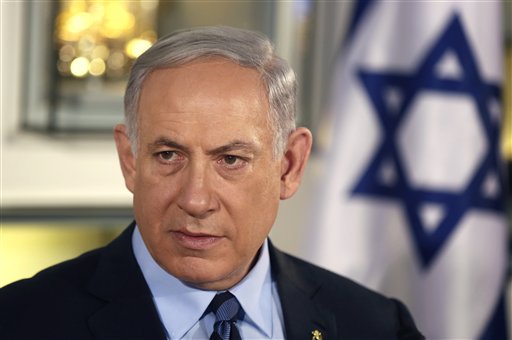
Israeli Prime Minister Benjamin Netanyahu
Source: Atef Safadi/Pool Photo via AP
On March 3, 2015, Israeli Prime Minister Benjamin Netanyahu addressed Congress in an effort to sway the Obama administration against continuing negotiations with Iran over nuclear weapons. Netanyahu called the negotiations to get Iran to freeze its nuclear program "a bad deal." In his speech, he said the deal that the Obama administration wanted "could well threaten the survival of my country" because it would not prevent Iran from having and using nuclear weapons. To the contrary, he said, the deal "will all but guarantee" nuclear arms in Iran.
During his speech, Netanyahu received repeated standing ovations and was greeted by bipartisan members despite the fact that more than 50 democrats were not in attendance. The speech generated controversy in the U.S. because House Speaker John Boehner (R-Ohio) invited Netanyahu to address Congress without consulting the Obama administration, a breach of protocol. The speech was seen by many as an effort by Republicans to undermine Obama's foreign policy. Also, Netanyahu's appearance came just two weeks before Israeli elections. President Obama did not meet with Netanyahu during the prime minister's visit.
After polls leading up to the election had him behind, Israeli Prime Minister Benjamin Netanyahu and his Likud Party won the March 17 election. Netanyahu's Likud Party took 30 out of 120 seats. Likud's main rival, Zionist Union alliance, led by Isaac Herzog, won 24 seats. The win for Likud meant that odds were highly in favor of Netanyahu serving a fourth term as prime minister. Netanyahu must form a government, a task which could be harder after he vowed leading up to the election that no Palestinian state would be established while he was in office, a vow that insulted Arab citizens and alienated some political allies.
However, after a backlash, Netanyahu backtracked from the statements against the establishment of a Palestinian state that he made leading up to the election. In a March 19 TV interview, he said that he remained committed to a two-state vision and Palestinian statehood if conditions in the region improved. "I don't want a one-state solution, I want a sustainable, peaceful two-state solution, but for that circumstances have to change," Netanyahu said in the interview two days after the election.
During the first two weeks of Oct. 2015, 32 Palestinians and seven Israelis were killed in what was the biggest spike in violence the area has seen in recent years. The violence broke out in part over what the Palestinians saw as increased encroachment by Israelis on the al-Aqsa mosque on the Temple Mount in Jerusalem, a site important to both Muslims and Jews. However, the violence quickly spread beyond Jerusalem.
On Oct. 16, at the request of council member Jordan, the United Nations Security Council held a meeting to discuss the area's increasing unrest. During the meeting, France proposed that an international observer be placed at the al-Aqsa mosque, but that idea was rejected by Israel. Meanwhile, U.S. Secretary of State John Kerry called for Israeli and Palestinian leaders to meet and agree on a plan to stop the violence.
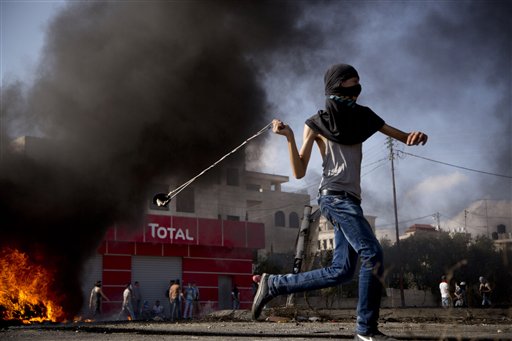
Palestinian hurls a stone in clashes with Israeli troops,
near Ramallah, West Bank, Oct. 2015
Source: AP Photo/Majdi Mohammed
See also Encyclopedia: Israel .
U.S. State Dept. Country Notes: Israel
Central Bureau of Statistics www.cbs.gov.il/engindex.htm and Israel's 60th Anniversary.
Trending
Here are the facts and trivia that people are buzzing about.