|
Travel to Iceland — Unbiased reviews and great
deals from TripAdvisor
Iceland
|
Republic of Iceland
National name: Lydveldid Island
President: Ólafur Ragnar Grímsson
(2004)
Prime Minister: Geir H. Haarde
(2006)
Current government officials
Land area: 38,707 sq mi (100,251 sq km);
total area: 39,768 sq mi (103,000 sq km)1
Population (2007 est.): 301,931 (growth
rate: 0.8%); birth rate: 13.6/1000; infant mortality rate: 3.3/1000;
life expectancy: 80.4; density per sq mi: 8
Capital and largest city (2003 est.):
Reykjavik, 184,200 (metro. area), 114,800
(city proper)
Monetary unit: Icelandic króna
Languages:
Icelandic, English, Nordic languages, German
widely spoken
Ethnicity/race:
homogeneous mixture of Norse/Celtic
descendants 94%, population of foreign origin 6%
Religions:
Lutheran Church of Iceland 85.5%, Reykjavik
Free Church 2.1%, Roman Catholic Church 2%, Hafnarfjorour Free
Church 1.5%, other Christian 2.7%, other or unspecified 3.8%,
unaffiliated 2.4% (2004)
Literacy rate: 99% (2003 est.)
Economic summary: GDP/PPP (2007
est.): $12.14 billion; per capita $38,800 Real growth rate:
3.8%. Inflation: 5%. Unemployment: 1%. Arable
land: 0.07%. Agriculture: potatoes, green vegetables;
mutton, dairy products; fish. Labor force: 180,000;
agriculture, fishing and fish processing 5.1%, industry 23%,
services 71.4% (2005). Industries: fish processing; aluminum
smelting, ferrosilicon production; geothermal power, tourism.
Natural resources: fish, hydropower, geothermal power,
diatomite. Exports: $4.569 billion f.o.b. (2007 est.): fish
and fish products 70%, aluminum, animal products, ferrosilicon,
diatomite. Imports: $5.777 billion (2007 est.): machinery and
equipment, petroleum products, foodstuffs, textiles. Major
trading partners: UK, Germany, Netherlands, U.S., China, Spain,
Denmark, France, Norway, Sweden, Japan (2006).
Communications: Telephones: main lines
in use: 193,700 (2006); mobile cellular: 328,500 (2006). Radio
broadcast stations: AM 3, FM about 70 (including repeaters),
shortwave 1 (1998). Television broadcast stations: 14 (plus
156 low-power repeaters) (1997). Internet hosts: 270,942
(2007). Internet users: 194,000 (2006).
Transportation: Railways: 0 km.
Highways: total: 13,028 km; paved: 4,241 km; unpaved: 8,787
km (2005). Ports and harbors: Grundartangi, Hafnarfjordur,
Hornafjordhur, Reykjavik, Seydhisfjordhur. Airports: 99
(2007).
International disputes: Iceland disputes
Denmark's alignment of the Faroe Islands' fisheries median line;
Iceland, the UK, and Ireland dispute Denmark's claim that the Faroe
Islands' continental shelf extends beyond 200 nm.
1. Including some offshore
islands.
Major sources and definitions
|
|
Geography
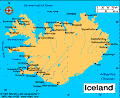
Iceland, an island about the size of Kentucky, lies in the north
Atlantic Ocean east of Greenland and just touches the Arctic Circle. It is
one of the most volcanic regions in the world. More than 13% is covered by
snowfields and glaciers, and most of the people live in the 7% of the
island that is made up of fertile coastland. The Gulf Stream keeps
Iceland's climate milder than one would expect from an island near the
Arctic Circle.
Government
Constitutional republic.
History
The earliest inhabitants of Iceland were Irish hermits, who left the
island upon the arrival of the pagan Norse people in the late 9th century.
A constitution drawn up c. 930 created a form of democracy and provided
for an Althing, the world's oldest practicing legislative assembly.
The island's early history was preserved in the Icelandic sagas of the
13th century.
In 1262–1264, Iceland came under Norwegian rule and passed to ultimate
Danish control through the unification of the kingdoms of Norway, Sweden,
and Denmark (the Kalmar Union) in 1397.
In 1874, Icelanders obtained their own constitution, and in 1918,
Denmark recognized Iceland, via the Act of Union, as a separate state with
unlimited sovereignty. It remained, however, nominally under the Danish
monarchy.
During the German occupation of Denmark in World War II, British, then
American, troops occupied Iceland and used it for a strategic air base.
While officially neutral, Iceland cooperated with the Allies throughout
the conflict. On June 17, 1944, after a popular referendum, the Althing
proclaimed Iceland an independent republic.
The country joined the North Atlantic Treaty Organization in 1949 and
subsequently received an American air force base in 1951. In 1970, it was
admitted to the European Free Trade Association. Iceland unilaterally
extended its territorial fishing limit from 3 to 200 nautical miles in
1972, precipitating a dispute with the UK known as the “cod wars,” which
ended in 1976 when the UK recognized the new limits. In 1980, the
Icelanders elected a woman to the office of the presidency, the first
elected female chief of state (i.e., president as distinct from prime
minister) in the world. After the recession of the early 1990s, Iceland's
economy rebounded.
At the International Whaling Commission meeting in July 2001, Iceland
refused to agree to the continuation of the moratorium on commercial
whaling that had been in effect since 1986. In 2003, after a 14-year lull,
the country began hunting whales for scientific research.
In May 2003, David Oddsson was reelected, making him the
longest-serving prime minister in Europe. In 2004, in a prearranged
agreement made between the two parties of the coalition government,
Oddsson and Foreign Minister Halldór Ásgrímsson switched positions. In
June 2006 Ásgrímsson resigned as prime minister after his party did badly
in local elections. Economic troubles were cited as the main reason for
the Progressive Party's poor showing. Geir Haarde, leader of Iceland's
largest political party, the Independence Party, became prime minister and
announced the implementation of more fiscally conservative measures.
See also Encyclopedia: Iceland. U.S. State Dept. Country Notes:
Iceland Statistics Iceland http://www.hagstofa.is/template40.asp?PageID=261 .
Information Please® Database, © 2007 Pearson Education,
Inc. All rights reserved.
More on Iceland from Infoplease:
- Icelandic language - Icelandic language Icelandic language, member of the North Germanic, or Scandinavian, group of the ...
- Iceland - Iceland Iceland, Icel. Ísland, officially Republic of Iceland, republic (2005 est. pop. ...
- Iceland - Iceland Profile: Geography, People, History, Government, Political Conditions, Defense, Foreign Relations, U.S.-Icelandic Relations
- Iceland - Map of Iceland & articles on flags, geography, history, statistics, disasters current events, and international relations.
- Icelandic literature - Icelandic literature Icelandic literature, the literature of Iceland. For the earliest literature ...
|
|