|
Travel to Ethiopia — Unbiased reviews and
great deals from TripAdvisor
Ethiopia
| Federal Democratic Republic of Ethiopia National name: Ityop'iya Federalawi
Demokrasiyawi Ripeblik President: Girma
Woldegiorgis (2001) Prime
Minister: Meles Zenawi (1995)
Current government officials
Land area: 432,310 sq mi (1,119,683 sq
km); total area: 435,186 sq mi (1,127,127 sq km) Population (2008 est.): 78,254,090 (growth
rate: 2.2%); birth rate: 36.8/1000; infant mortality rate: 90.2/1000;
life expectancy: 49.4; density per sq mi: 69
Capital and largest city (2003 est.):
Addis Ababa, 2,716,200 Monetary unit: Birr
Languages:
Amharic, Tigrigna, Orominga, Guaragigna, Somali,
Arabic, English, over 70 others
Ethnicity/race:
Oromo 40%, Amhara and Tigrean 32%, Sidamo 9%,
Shankella 6%, Somali 6%, Afar 4%, Gurage 2%, other 1%
National Holiday:
Independence Day, May 28
Religions:
Islam 45%–50%, Ethiopian Orthodox
35%–40%, animist 12%, other 3%–8% Literacy rate: 43% (2003 est.) Economic summary: GDP/PPP (2007 est.):
$62.19 billion; per capita $800. Real growth rate: 11.4%.
Inflation: 17%. Unemployment: n.a. Arable land:
10%. Agriculture: cereals, pulses, coffee, oilseed, cotton,
sugarcane, potatoes, qat, cut flowers; hides, cattle, sheep, goats;
fish. Labor force: 27.27 million (1999); agriculture and animal
husbandry 80%, government and services 12%, industry and construction
8% (1985). Industries: food processing, beverages, textiles,
leather, chemicals, metals processing, cement. Natural
resources: small reserves of gold, platinum, copper, potash,
natural gas, hydropower. Exports: $1.2 billion f.o.b. (2007
est.): coffee, qat, gold, leather products, live animals, oilseeds.
Imports: $4.54 billion f.o.b. (2007 est.): food and live
animals, petroleum and petroleum products, chemicals, machinery, motor
vehicles, cereals, textiles. Major trading partners: Djibouti,
Germany, Japan, Saudi Arabia, U.S., UK, Italy, India, China
(2006). Communications: Telephones:
main lines in use: 725,000 (2006); mobile cellular: 866,700 (2006).
Radio broadcast stations: AM 8, FM 0, shortwave 1 (2001).
Television broadcast stations: 1 plus 24 repeaters (2002).
Internet hosts: 89 (2007). Internet users: 164,000
(2005). Transportation: Railways:
total: 699 km (Ethiopian segment of the Addis Ababa-Djibouti railroad)
(2006). Highways: total: 36,469 km ; paved: 6,980 km; unpaved:
29,489 km (2004). Ports and harbors: Ethiopia is landlocked and
has used ports of Assab and Massawa in Eritrea and port of Djibouti.
Airports: 84 (2007). International
disputes: Eritrea and Ethiopia agreed to abide by the 2002
Eritrea-Ethiopia Boundary Commission's (EEBC) delimitation decision,
but despite international intervention, mutual animosities,
accusations and armed posturing prevail, preventing demarcation;
Ethiopia refuses to withdraw to the delimited boundary until technical
errors made by the EEBC that ignored "human geography" are addressed,
including the award of Badme, the focus of the 1998-2000 war; Eritrea
insists that the EEBC decision be implemented immediately without
modifications; Ethiopia has only an administrative line and no
international border with the Oromo region of southern Somalia where
it maintains alliances with local clans in opposition to the
unrecognized Somali Interim Government in Mogadishu; "Somaliland"
secessionists provide port facilities and trade ties to landlocked
Ethiopia; the UNHCR expects most of the remaining 23,000 Somali
refugees in Ethiopia to be repatriated in 2005; efforts to demarcate
the porous boundary with Sudan have been delayed by civil war.
Ethiopian forces invaded southern Somalia and routed Islamist Courts
from Mogadishu in January 2007.
Major sources and definitions
|
|
Geography
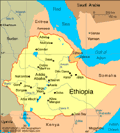
Ethiopia is in east-central Africa, bordered on
the west by the Sudan, the east by Somalia and Djibouti, the south by
Kenya, and the northeast by Eritrea. It has several high mountains, the
highest of which is Ras Dashan at 15,158 ft (4,620 m). The Blue Nile, or
Abbai, rises in the northwest and flows in a great semicircle before
entering the Sudan. Its chief reservoir, Lake Tana, lies in the
northwest.
Government
Federal republic.
History
Archeologists have found the oldest known human
ancestors in Ethiopia, including Ardipithecus ramidus kadabba (c.
5.8–5.2 million years old) and Australopithecus anamensis (c.
4.2 million years old). Originally called Abyssinia, Ethiopia is
sub-Saharan Africa's oldest state, and its Solomonic dynasty claims
descent from King Menelik I, traditionally believed to have been the son
of the queen of Sheba and King Solomon. The current nation is a
consolidation of smaller kingdoms that owed feudal allegiance to the
Ethiopian emperor.
Hamitic peoples migrated to Ethiopia from Asia
Minor in prehistoric times. Semitic traders from Arabia penetrated the
region in the 7th century B.C. Its Red Sea
ports were important to the Roman and Byzantine Empires. Coptic
Christianity was brought to the region in A.D.
341, and a variant of it became Ethiopia's state religion. Ancient
Ethiopia reached its peak in the 5th century, then was isolated by the
rise of Islam and weakened by feudal wars.
Modern Ethiopia emerged under Emperor Menelik
II, who established its independence by routing an Italian invasion in
1896. He expanded Ethiopia by conquest. Disorders that followed Menelik's
death brought his daughter to the throne in 1917, with his cousin, Tafari
Makonnen, as regent and heir apparent. When the empress died in 1930,
Tafari was crowned Emperor Haile Selassie I.
Haile Selassie, called the “Lion of
Judah,” outlawed slavery and tried to centralize his scattered
realm, in which 70 languages were spoken. In 1931, he created a
constitution, revised in 1955, that called for a parliament with an
appointed senate, an elected chamber of deputies, and a system of courts.
But basic power remained with the emperor.
Fascist Italy invaded Ethiopia on Oct. 3, 1935,
forcing Haile Selassie into exile in May 1936. Ethiopia was annexed to
Eritrea, then an Italian colony, and to Italian Somaliland, forming
Italian East Africa. In 1941, British troops routed the Italians, and
Haile Selassie returned to Addis Ababa. In 1952, Eritrea was incorporated
into Ethiopia.
On Sept. 12, 1974, Haile Selassie was deposed,
the constitution suspended, and Ethiopia proclaimed a Socialist state
under a collective military dictatorship called the Provisional Military
Administrative Council (PMAC), also known as the Derg. U.S. aid stopped,
and Cuban and Soviet aid began. Lt. Col. Mengistu Haile Mariam became head
of state in 1977. During this period Ethiopia fought against Eritrean
secessionists as well as Somali rebels, and the government fought against
its own people in a campaign called the “red terror.”
Thousands of political opponents were killed. Mengistu remained leader
until 1991, when his greatest supporter, the Soviet Union, dismantled
itself.
A group called the Ethiopian People's
Revolutionary Democratic Front seized the capital in 1991, and in May a
separatist guerrilla organization, the Eritrean People's Liberation Front,
took control of the province of Eritrea. The two groups agreed that
Eritrea would have an internationally supervised referendum on
independence. This election took place in April 1993 with almost unanimous
support for Eritrean independence. Ethiopia accepted and recognized
Eritrea as an independent state within a few days. Sixty-eight leaders of
the former military government were put on trial in April 1996 on charges
that included genocide and crimes against humanity.
Since Eritrea's independence, Eritrea and
Ethiopia had disagreed about the exact demarcation of their borders, and
in May 1998 Eritrea initiated border clashes that developed into a
full-scale war that left more than 80,000 dead and further destroyed both
countries' ailing economies. After a costly and bloody two-year war, a
formal peace agreement was signed in Dec. 2000. The United Nations has
provided more than 4,000 peacekeeping forces to patrol the buffer zone
between the two nations. An international commission defined a new border
between the two countries in April 2002. Ethiopia disputed the new border,
escalating tensions between the two countries once again. In Dec. 2005, an
international Court of Arbitration ruled that Eritrea had violated
international law in attacking Ethiopia in the 1998 war.
In 2003, in an effort to solve its chronic
shortage of food and to lessen its dependence on international aid,
Ethiopia began relocating 2 million farmers from their parched highland
homes to areas with more fertile soil in the western part of the country.
The largest relocation program in African history, however, has turned
into a disaster. The majority of those resettled are still unable to
support themselves, and, most alarmingly, much of the fertile regions
where the farmers have been resettled are rife with malaria.
In June 2006, an Islamist militia seized control
of the capital of neighboring Somalia and established control in much of
that country's south. Ethiopia, which has clashed in the past with
Somalia's Islamists and considers them a threat to regional security,
began amassing troops on Somalia's border, in support of Somalia's weak
transitional government, led by President Abdullah. In mid-December,
Ethiopia launched air strikes against the Islamists, and in a matter of
days Ethiopian ground troops and Somali soldiers regained of Mogadishu. A
week later most of the Islamists had been forced to flee the country.
Ethiopia announced that its troops would remain in Somalia until stability
was assured and a functional central government had been established. It
was far from clear when that would happen, however. Battles between the
insurgents and Somali and Ethiopian troops intensified in March, leaving
300 civilians dead in what has been called the worst fighting in 15
years.
A group of separatist rebels from the Ogaden
region of eastern Ethiopia attacked a Chinese-run oilfield in April,
killing 65 Ethiopian soldiers and nine Chinese workers.
In May, Ethiopia’s Supreme Court sentenced
former strongman Mengistu Haile Mariam to death in absentia. He has lived
in Zimbabwe since 1991. Mengistu’s military regime, called the Derg,
rose to power after overthrowing Emperor Haile Selassie in 1974. He
presided over a brutal campaign called the “red terror," in which
tens of thousands of his political opponents were killed.
See also Encyclopedia: Ethiopia. U.S. State Dept. Country Notes:
Ethiopia
Information Please® Database, © 2008 Pearson
Education, Inc. All rights reserved.
More on Ethiopia from Infoplease:
- Ethiopia - Ethiopia Ethiopia , officially Federal Democratic Republic of Ethiopia, republic (2005 est. pop. ...
- Ethiopia - Ethiopia Profile: Geography, People, History, Government and Political Conditions, Economy, Defense, Foreign Relations, U.S.-Ethiopia Relations
- Ethiopia - Map of Ethiopia & articles on flags, geography, history, statistics, disasters current events, and international relations.
- Ethiopia: Bibliography - Bibliography See C. Clapham, Haile Selassie's Government (1969); E. Ullendorff, The Ethiopians ...
- Ethiopia: History - History Early History Cushitic language speakers are believed to have been the original inhabitants ...
|
|