
DK Science: Skeletal System
The body is supported and its internal parts protected by a strong yet flexible framework of BONES called the skeleton. These bones meet at JOINTS, most of which allow movement between the bones they connect. As well as protection and movement, bones provide a store for the mineral calcium, which is vital to the working of nerves and muscles. They also contain bone marrow, which makes blood cells and stores fat.
The skeleton contains 206 bones. Babies have over 270, but by adulthood many of these have fused together. Some of the main individual bones, and groups of bones, are labelled here. They fall into two groups: the axial skeleton, made up of the bones of the head, spine, ribs, and breastbone; and the appendicular skeleton, containing the bones of the limbs, the pelvis, the shoulder blades, and the collarbones.
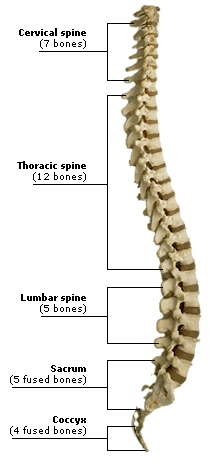
This highly flexible structure, also called the vertebral column, supports the head and body. It also protects the delicate tissues of the spinal cord. It is made up of 33 bones called vertebrae, separated by intervertebral discs, which act as shock absorbers. The bones of the spine are kept in place and supported by attached ligaments and muscles.

The skull consists of 22 bones (excluding the three bones in each middle ear). All the larger skull bones are shown in this exploded view. They fall into two main groups. One group (including the frontal, parietal, and temporal bones) surrounds the brain and is fused together to form the cranium. The remainder of the bones form the face.
Bones are relatively light, yet five times stronger than steel. They contain cells, minerals, protein, and water. Bones are composed of two types of tissue: cancellous (spongy) and compact bone. These are living tissues that are constantly broken down and rebuilt by the cells they contain.
Bones have an outer layer of compact bone, one of the body’s hardest materials. On the inside is an area of cancellous bone, which may contain red bone marrow. In adult long bones, like the femur, the shaft is compact bone overlaying an area that may contain yellow bone marrow (a fatty tissue).
Compact bone consists of units called osteons, each about 1 mm (1/25 in) across. One osteon is shown here. It is made up of numerous tiny rings of a hard tissue arranged around a central canal, through which blood vessels and nerves pass.
In cancellous (spongy) bone, struts of rigid bone tissue called trabeculae connect up to form a honeycomblike structure. Cancellous bone is less dense than compact bone but is still very strong.
Joints are the parts of the body where bones meet. Some, such as the joints in the cranium, allow no movement between the bones. Others, such as the joints in the spine, allow limited movement. A few, such as the hip joints, permit a wide range of movement. The bones of many joints are held in place by muscles and bands of tissue called ligaments.
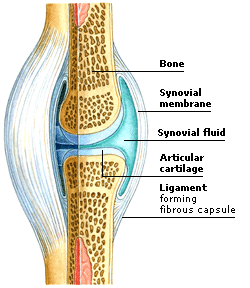
All free-moving joints, such as the finger, hip, knee, and elbow joints, are called synovial joints and have a similar structure. The synovial membrane that lines the joint produces a fluid that lubricates movement. The bone ends are covered by a layer of articular cartilage, which is smooth and so minimizes friction. The joint is kept in place by a fibrous capsule, which encases the joint completely.
