DK Science: Movement
All animals are mobile for at least some part of their lives because they need to find food. Most movement is controlled by a nervous system that causes MUSCLES to contract and relax in a co-ordinated way. The SKELETON provides anchorage for these muscles. To move efficiently through water, land, and air, animals have special adaptations, such as fins, legs, and wings.
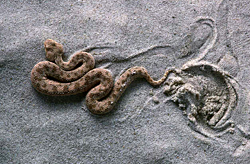
Sand is not easy to cross because it shifts under an animal’s weight. Side-winder snakes move across soft sand and mud by looping along in S-shaped curves in a movement called side-winding. Instead of slithering across the sand, they throw their bodies through the air in a series of sideways leaps.
Ungulates (animals with hooves) are hunted by many predators. Gazelles use their speed and endurance to escape capture. Their lower legs are very long, which lengthens their stride. They also have two toes instead of five, which needs less muscle and so saves energy.
Several tree-living animals glide from tree to tree using flaps of skin like parachutes. Flying frogs have large, webbed feet that they hold out when they leap so they can fly further without falling to the ground. They can glide up to 15 m (50 ft).
Although fish are strong swimmers, many other marine animals drift along at the mercy of the ocean currents. Jellyfish are able to control their movement to a limited extent. They have a ring of muscle around the edge of their bell-shaped body, which can be contracted and relaxed, like an umbrella opening and closing. This pushes the water backwards, making the jellyfish move in the opposite direction.
Insects are the smallest animals capable of powered flight. Four-winged insects, such as butterflies, use muscles directly attached to the base of their wings to move the wings up and down. Bees fly by using muscles attached to the top and bottom of their body. When the muscles contract, the wings move upward; when they relax, the wings drop down.
Muscles are bundles of fibres that provide the power for animals to move. When a nerve stimulates a muscle into action, the muscles contract (pull back), causing movement. In simple animals, such as snails, muscles contract in waves from one end of the body to the other, pushing the animal along. In vertebrates, such as the horse, muscles work in pairs and pull against bones. The area where different bones meet is called a joint.
Fleas need to jump around in order to find an animal from which to suck blood. They can leap an amazing 33 cm (13 in), using muscle energy that is stored in a pad of springy material, called resilin, in their legs. When the leg muscles are triggered to jump, the flea is catapulted into the air.
Many animals have a rigid skeleton to support their bodies and some have jointed legs, which allow them to move rapidly. Mammals have the most complex skeletons of all animals. They have backbones made up of many small bones called vertebrae and limbs with several joint types. This complicated skeleton enables them to make lots of different movements.

Animals with exoskeletons, such as crabs, have several pairs of jointed legs. Each pair is made up of a series of hollow sections joined together at joints. Pairs of muscles joined to the inner surface of the joint allow the crab to scuttle sideways quickly.
Sharks bodies are specialized for moving fast through water. They have skeletons made from a firm elastic substance called cartilage. Cartilage is lighter than bone, enabling sharks to swim efficiently. Using rhythmic contractions of their body muscle, and with additional push from their tail, they reach speeds of 30–50 kph (19–31 mph).