
DK Science: Changing States
All matter exists as solids, liquids, or gases. These are called the states of matter. Matter can change from one state to another if heated or cooled. If ice (a solid) is heated it changes to water (a liquid). This change is called MELTING. If water is heated, it changes to steam (a gas). This change is called BOILING. The particles of ice, water, and steam are identical, but arranged differently.
When solid, the particles of a substance are tightly packed together, making it rigid. A substance can change from a solid state to a liquid state, and from a liquid state to a solid state.
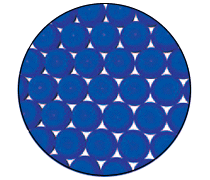
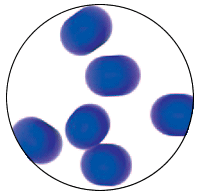
The particles in a liquid can move past one another. This allows liquids to flow. A substance in a liquid state can change to a solid state and also to a gas state.

Particles in a gas are spread out and free to move around. This is why gases fill all the space around them. A substance that is a gas can change to a liquid, and a liquid substance can change to a gas.
The glowing corona of the Sun visible during a total eclipse is made of a fourth state of matter called plasma. Plasma is formed when a lot more energy is given to a gas, such as by heating the gas or passing electricity through it. This extra energy splits the particles of the gas into even smaller pieces so hot that they glow.
When a solid is heated, the particles are given more energy and start to vibrate faster. At a certain temperature, the particles vibrate so much that their ordered structure breaks down. At this point the solid melts into liquid. The temperature at which this change from solid to liquid happens is called the melting point. Each solid has a set melting point at normal air pressure. At lower air pressure, such as up a mountain, the melting point lowers.
Lava is liquid rock, which erupts through a volcano at temperatures as high as 1,500ºC (2,732ºF) through a volcano. However, the red-hot lava cools as it meets the Earth’s surface, and turns back into solid rock again. This change from liquid to solid is called freezing or solidifying. It is the opposite process to melting.
When a liquid is heated, the particles are given more energy. They start to move faster and further apart. At a certain temperature, the particles break free of one another and the liquid turns to gas. This is the boiling point. The boiling point of a substance is always the same; it does not vary.
Water boils when it reaches its boiling point of 100ºC (212ºF). This is the temperature at which water turns to steam. Steam is an invisible gas. When it reaches the lid it cools back to a liquid.
Even without boiling water in a kettle, some of the liquid water changes to gas. This is evaporation. It occurs when a liquid turns into a gas far below its boiling point. There are always some particles in a liquid that have enough energy to break free from the rest to become a gas.
