
DK Science: Carbon
Carbon is the sixth most common element in the universe and is the main element in every living thing on Earth. Carbon atoms are passed between living things through the CARBON CYCLE. Carbon is present as carbon dioxide in the air, and makes up a large part of coal, crude oil, and natural gas. Pure carbon is very rare in nature, although it can be found in one of several different forms, or ALLOTROPES.
Anything that burns well usually contains carbon. Coal, charcoal, wood, and paper are packed full of carbon. Carbon atoms joined together store a lot of energy. When carbon burns, each carbon atom breaks away from its surrounding atoms and reacts with oxygen in the air to form carbon dioxide. The stored energy is released as heat.
The atoms of some elements can link up in different ways to create different forms called allotropes. Carbon is found in three allotropes: diamond, graphite, and fullerene. Each allotrope has very different physical properties. Graphite, diamond, and fullerene contain only carbon atoms, but the atoms are arranged differently in each allotrope.
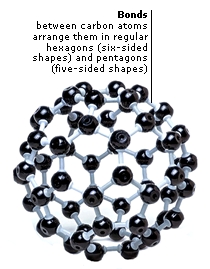
In a fullerene, the carbon atoms link together to form a ball-shaped cage. Fullerenes may contain 100, 80, or 60 carbon atoms. This fullerene contains 80 atoms. The first fullerene discovered was buckminsterfullerene in the 1980s, which has 60 carbon atoms. It is named after Buckminster Fuller, an American architect who designed buildings similar in shape to the fullerene molecule.

The hardest known mineral, diamond, has carbon atoms tightly bound to each other in an extremely rigid grid called a crystal lattice. Diamond is formed by the compression of molten rock over millions of years. It is used in industrial cutting machines and for jewellery.
Some lubricating engine oils and all pencil leads contain graphite. Graphite has layers of carbon atoms that can slide across one another. There are strong bonds between the carbon atoms of each layer, but weak bonds between the different layers. Because the layers can move over one another, graphite is quite a soft material.
The stable structure of fullerenes works well on large-scale buildings. In the 1940s, architect Buckminster Fuller designed a type of building called a geodesic dome. It is made of a network of triangles that together form a sphere. This shape is very stable and encloses a lot of space with little building material, making it strong but light.
Carbon atoms continually circulate through the air, animals, plants, and the soil. This recycling of carbon atoms in nature is called the carbon cycle. The bodies of all living things contain carbon. The carbon comes originally from carbon dioxide gas in the air. Green plants and some bacteria take in the carbon dioxide and use it to make food. When animals eat plants, they take in some of the carbon. Carbon dioxide goes back into the air when living things breathe out, and when they produce waste, die, and decay.
Green plants use carbon dioxide from the air to make food. When an animal eats a plant, it uses the carbon to build body tissue. When the animal breathes out, it returns carbon into the air as carbon dioxide. When the animal dies and decays, the carbon in its body returns to the soil. Decomposers such as worms, bacteria, and fungi, feed on the decaying remains of animals. As they feed, the decomposers breathe out carbon dioxide into the air. Green plants then take in carbon dioxide from the air, and the cycle is repeated.
