
DK People & Places: Scandinavia & Iceland
- NORWEGIAN FJORD
- WHERE DO MOST SCANDINAVIANS LIVE?
- WHY IS TIMBER SO IMPORTANT TO FINLAND?
- DO SCANDINAVIANS HAVE A GOOD STANDARD OF LIVING?
- DO SCANDINAVIANS PROTECT THE ENVIRONMENT?
- WHERE IS THE LAND OF THE MIDNIGHT SUN?
- WHAT IS LAPLAND?
- HOW DOES ICELAND USE ITS ACTIVE VOLCANOES?
- FACTFILE: SCANDINAVIA & ICELAND
- FIND OUT MORE
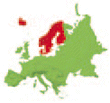
Scandinavia, the most northerly region in Europe, is made up of Norway, Sweden, Denmark, and Finland. Together with the volcanic island of Iceland, this is a sparsely populated land of mountains, pine forests, and unpolluted lakes. In the far north, snow falls for six months of the year. Parts of Scandinavia are highly industrialized, but agriculture is important in Denmark and parts of Finland, where the flatter land is more suitable for farming.
Norway’s west coast is heavily indented with long, deep inlets called fjords. These were carved out by glaciers during past ice ages. Today, the fjords shelter villages and towns and make perfect natural harbors.
Most Scandinavians live in the south of the region, away from the harsh northern climate. Towns, cities, roads, and railroads have been built on flat land in valleys, beside lakes, and along coasts. Many coastal towns, including all the capital cities, are important ports. Scandinavia has so many lakes and rivers that boats are a vital form of transportation for people and their goods.
Trees are Finland’s most important natural resource. About three-fourths of the country is covered in forests of pine, spruce, and birch. The softwood timber they provide supplies the building and furniture industries, and accounts for about a third of the country’s exports. In addition, Finland is the world’s largest producer of plywood, wood pulp, and paper.
The people of the region enjoy high living standards. All Scandinavian countries have small populations, and provide good child-care facilities, schools and universities, and health care for all. With low levels of unemployment, these services are funded through high taxation.
People in Scandinavia value their unspoiled country and work hard to protect it. They avoid pollution by recycling waste materials and making use of natural sources of energy. Electricity is generated by wind power in Denmark, geothermal power in Iceland, and hydroelectric power across the whole region.
The far north of Scandinavia is known as the land of the “Midnight Sun.” In midsummer, the sun never sets, and there are 24 hours of daylight. During midwinter, the sun hardly rises and there are just a few hours of natural daylight. The darkness has an effect on some of the population, who suffer from seasonal affective disorder, or SAD.
Lapland is a region that stretches across the northernmost parts of Norway, Sweden, and Finland, deep inside the Arctic Circle. The Sami people have lived in Lapland for centuries, surviving the long, harsh winters by herding reindeer for meat, milk, and skins. Today, the Sami still keep their own language and customs, but increased development is threatening their traditional way of life.
Iceland has more than 100 volcanoes. At least 20 of these are active and could erupt at any time. The underground heat created by volcanoes is known as geothermal power and is used to produce electricity. Geothermal power stations are clean, cheap, and also provide hot water and heating. Together with the electricity from water-powered stations, they supply all of Iceland’s energy needs.
Capital city: Copenhagen
Area: 16,639 sq miles (43,094 sq km)
Population: 5.3 million
Official language: Danish
Major religion: Evangelical Lutheran
Currency: Danish krone
Capital city: Helsinki
Area: 130,127 sq miles (337,030 sq km)
Population: 5.2 million
Official languages: Finnish and Swedish
Major religion: Evangelical Lutheran
Currency: Euro
Capital city: Reykjavik
Area: 39,768 sq miles (103,000 sq km)
Population: 283,000
Official language: Icelandic
Major religion: Evangelical Lutheran
Currency: Icelandic króna
Capital city: Oslo
Area: 125,181 sq miles (324,220 sq km)
Population: 4.5 million
Official language: Norwegian
Major religion: Evangelical Lutheran
Currency: Norwegian krone
