International Affairs
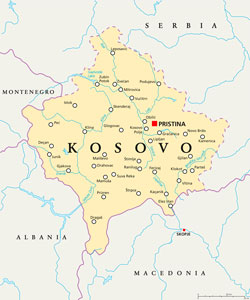
International Disputes: Serbia with several other states protest the US and other states' recognition of Kosovo's declaration of its status as a sovereign and independent state. Ethnic Serbian municipalities living in Kosovo along the northern border challenge final status of Kosovo-Serbia boundary. Several thousand NATO-led Kosovo Force peacekeepers under UN Interim Administration Mission in Kosovo authority continue to keep the peace within Kosovo between the ethnic Albanian majority and the Serb minority in Kosovo. Kosovo and Macedonia completed demarcation of their boundary in September 2008
IDPs: 16,000 (primarily ethnic Serbs displaced during the 1998-1999 war fearing reprisals from the majority ethnic-Albanian population; a smaller number of ethnic Serbs, Roma, Ashkali, and Egyptians fled their homes in 2,004 as a result of violence) (2017)
Economy
Kosovo experienced its first federal budget deficit in 2012, when government expenditures climbed sharply. In May 2014, the government introduced a 25% salary increase for public sector employees and an equal increase in certain social benefits. Central revenues could not sustain these increases, and the government was forced to reduce its planned capital investments. The government, led by Prime Minister MUSTAFA - a trained economist - recently made several changes to its fiscal policy, expanding the list of duty-free imports, decreasing the Value Added Tax (VAT) for basic food items and public utilities, and increasing the VAT for all other goods.
While Kosovo’s economy continued to make progress, unemployment has not been reduced, nor living standards raised, due to lack of economic reforms and investment.
Overview
GDP/PPP: $19.6 billion (2017 est.)
Growth Rate: 3.7% (2017 est.)
Inflation: 4.2% (2017 est.)
Government Revenues: 29% of GDP (2017 est.)
Public Debt: 21.2% of GDP (2017 est.)
Labor Force
Working Population: 500,300 (2017 est.)
Employment by Occupation: Agriculture: 4.4%, Industry: 17.4%, Services: 78.2% (2017 est.)
Unemployment: 30.5% (2017 est.)
Population Below the Poverty Line: 17.6% (2017 est.)
Trade
Total Exports: $428 million (2017 est.)
Major Exports: Mining and processed metal products, scrap metals, leather products, machinery, appliances, prepared foodstuffs, beverages and tobacco, vegetable products, textiles and apparel
Export Partners: Albania 16%, India 14%, Macedonia, The Former Yugo Rep of 12.1%, Serbia 10.6%, Switzerland 5.6%, Germany 5.4% (2017)
Total Imports: $3.22 billion (2017 est.)
Major Imports: Foodstuffs, livestock, wood, petroleum, chemicals, machinery, minerals, textiles, stone, ceramic and glass products, electrical equipment
Import Partners: Germany 12.4%, Serbia 12.3%, Turkey 9.6%, China 9.1%, Italy 6.4%, Macedonia, The Former Yugo Rep of 5.1%, Albania 5%, Greece 4.4% (2017)
Products
Agricultural Products: Wheat, corn, berries, potatoes, peppers, fruit; dairy, livestock; fish
Major Industries: Mineral mining, construction materials, base metals, leather, machinery, appliances, foodstuffs and beverages, textiles
Resources
Natural Resources: Nickel, lead, zinc, magnesium, lignite, kaolin, chrome, bauxite.
Land Use: Agricultural land: 52.8% (arable land 27.4%; permanent crops 1.9%; permanent pasture 23.5%), Forest: 41.7%, Other: 5.5% (2011 est.)
Communications
Telephones
Fixed Lines: 831,470, 45 per 100 residents (2016 est.)
Cell Phones: 562,000, 31 per 100 residents, (2016 est.)
International Country Code: 381
Internet
Internet Country Code: .xk
Transportation Infrastructure
Airports
Total Airports: 6 (2013)
With Paved Runways: 3
With Unpaved Runways: 3
Railways
Total: 333 km
Roads
Total: 2,012 km
Paved: 1,921 km (includes 39,143 km of expressways)
Unpaved: 91 km (2012)
Cultural Center of Serbia
The central Balkans were part of the Roman and Byzantine Empires before ethnic Serbs migrated to the territories of modern Kosovo in the 7th century. During the medieval period, Kosovo became the center of a Serbian Empire and saw the construction of many important Serb religious sites, including many architecturally significant Serbian Orthodox monasteries. The defeat of Serbian forces at the Battle of Kosovo in 1389 led to five centuries of Ottoman rule during which large numbers of Turks and Albanians moved to Kosovo. By the end of the 19th century, Albanians replaced Serbs as the dominant ethnic group in Kosovo. Serbia reacquired control over the region from the Ottoman Empire during the First Balkan War of 1912. After World War II, Kosovo's present-day boundaries were established when Kosovo became an autonomous province of Serbia in the Socialist Federal Republic of Yugoslavia (S.F.R.Y.). Despite legislative concessions, Albanian nationalism increased in the 1980s, which led to riots and calls for Kosovo's independence. The Serbs - many of whom viewed Kosovo as their cultural heartland - instituted a new constitution in 1989 revoking Kosovo's autonomous status. Kosovo's Albanian leaders responded in 1991 by organizing a referendum declaring Kosovo independent. Serbia undertook repressive measures against the Kosovar Albanians in the 1990s, provoking a Kosovar Albanian insurgency.
Path to Independence
Beginning in 1998, Serbia conducted a brutal counterinsurgency campaign that resulted in massacres and massive expulsions of ethnic Albanians (some 800,000 ethnic Albanians were forced from their homes in Kosovo). After international attempts to mediate the conflict failed, a three-month NATO military operation against Serbia beginning in March 1999 forced the Serbs to agree to withdraw their military and police forces from Kosovo. UN Security Council Resolution 1244 (1999) placed Kosovo under a transitional administration, the UN Interim Administration Mission in Kosovo (UNMIK), pending a determination of Kosovo's future status. A UN-led process began in late 2005 to determine Kosovo's final status. The 2006-07 negotiations ended without agreement between Belgrade and Pristina, though the UN issued a comprehensive report on Kosovo's final status that endorsed independence. On 17 February 2008, the Kosovo Assembly declared Kosovo independent. Since then, over 110 countries have recognized Kosovo, and it has joined numerous international organizations. In October 2008, Serbia sought an advisory opinion from the International Court of Justice (ICJ) on the legality under international law of Kosovo's declaration of independence. The ICJ released the advisory opinion in July 2010 affirming that Kosovo's declaration of independence did not violate general principles of international law, UN Security Council Resolution 1244, or the Constitutive Framework. The opinion was closely tailored to Kosovo's unique history and circumstances.
Demonstrating Kosovo’s development into a sovereign, multi-ethnic, democratic country the international community ended the period of Supervised Independence in 2012. Kosovo held its most recent national and municipal elections in 2017. Serbia continues to reject Kosovo's independence, but the two countries agreed in April 2013 to normalize their relations through EU-facilitated talks, which produced several subsequent agreements the parties are engaged in implementing, though they have not yet reached a final settlement. Kosovo seeks full integration into the international community, and has pursued bilateral recognitions and memberships in international organizations. Kosovo signed a Stabilization and Association Agreement with the EU in 2015, and was named by a 2018 EU report as one of six Western Balkan countries that will be able to join the organization once it meets the criteria to accede. Kosovo also seeks memberships in the UN and in NATO.