
Dorothy Hamill

The media darling of 1976
by Mike Morrison
 Related LinksMemorable Moments |
In every Olympics, there inevitably seems to be one athlete who becomes the "media darling" of the Gamesâthat performer whose talent, looks, and personality wins the affection of the general public more than any other.
Peggy Fleming , Olga Korbut, Mary Lou Retton, and Kerri Strug have all held that unofficial title. And in 1976 at Innsbruck, Austria, it clearly belonged to American figure skater Dorothy Hamill.
Hamill, 19, was the U.S. champion from 1974 to 1976, but after finishing second to Dutch skater Dianne De Leeuw at the 1975 world championship, she wasn't considered the favorite to win the gold at the 1976 Winter Games.
The judges just couldn't resist, however, rewarding her with mostly 5.8s and 5.9s (out of 6.0). And the audience couldn't resist her either, as the showers of applause indicated.
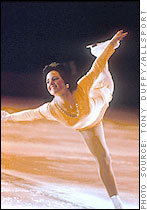
Having studied under renowned coach Carlos Fassi, Hamill became a master of skating technique and artistry. Her strengths lay not in risky triple jumps but in her flowing grace and creativity. She even invented her own trademark move, the "Hamill Camel," where she moved immediately from a camel spin into a sitting spin.
Painfully shy, Hamill tended to let her emotions show on the iceâsometimes too much.
At the 1974 world championship in Munich, she took to the ice to a chorus of boos from the German crowd. Distraught, Hamill left the ice in tears. What she didn't realize was that the boos weren't for her but for the judges who had just given poor marks to a German skater that had just performed. When she was told what had happened, she returned to the ice to the loudest cheers of the competition and skated her way to a silver medal.
Her popularity transcended sports. She became a celebrity in fashionâher short, bobbed haircut, known as a "wedge," inspired throngs of American women to cut their hair. She even signed a contract to advertise for Clairol.
After the Olympics, Hamill went on to win the 1976 world championship, and then she turned professional. She was very active on the pro circuit, winning four consecutive professional world titles in the mid 1980s and then starring inâand eventually buyingâthe financially strapped Ice Capades.
Trending
Here are the facts and trivia that people are buzzing about.




