Our Base in Space

The International Space Station Faces Setbacks During Construction
by Beth Rowen |
 Thousands of people from 16 nations are working together to build the biggest structure to ever float above our planet: the International Space Station (ISS). The ISS is a giant Lego project in the sky. More than 100 major pieces are being assembled 230 miles above Earth, where gravity is much lower than it is on the surface. Related Links
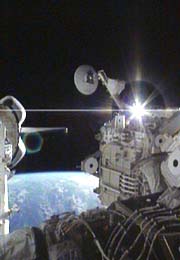
Quick PollIf you could vacation anywhere in space, where would you go? Not long after separation of the Space Shuttle Discovery from the International Space Station (ISS), a crew member onboard the shuttle was able to use a 70mm handheld camera to grab this "edge-on" image of the station, featuring its newest additions. (Source: NASA) |
Thousands of people from 16 nations are working together to build the biggest structure to ever float above our planet: the International Space Station (ISS). The ISS is a giant Lego project in the sky. More than 100 major pieces are being assembled 230 miles above Earth, where gravity is much lower than it is on the surface.
An International Effort
The long-awaited Russian-built temporary living quarters and propulsion system, the Zvezda (meaning "star") service module, was launched and connected to the Zarya ("sunrise") component of the International Space Station (ISS) on July 25, 2000. The Zvezda (a.k.a. the Functional Cargo Block) was originally scheduled to be launched in April 1998, but Russian financial problems and launch failures delayed its delivery. The Zvezda module is also the main docking port for Russian Progress resupply vehicles.
On February 12, 2008, American and European astronauts inaugurated the Columbus science laboratory, Europe's largest contribution to the International Space Station. The 14-ton laboratory cost $2 billion and was the newest addition to the space station. Containing 10 stations where scientists can perform zero-gravity experiments, the Columbus module measures 23 feet long and 15 feet in diameter, and brings the International Space Station one step closer to completion.
On March 26, 2008, Endeavour safely returned from its 16-day mission to the International Space Station. The Endeavour delivered the first section of the Japenese Kibo laboratory and a Canadian Space Agency robot called Dextre—every international partner has now contributed a major part to the ISS.
Assembly Required
The first pieces of the ISS to be joined in orbit were the U.S.-built connecting module Node 1, named Unity, and the U.S.-funded and Russian-built Zarya control module in Dec. 1998. Unity has six hatches that are used as docking ports, and it also serves as a passageway for station crews as they move through the connected modules.
The space shuttle Atlantis launched the U.S. Laboratory Module in Jan. 2001. It is the centerpiece of the ISS, in which unprecedented science experiments will be performed in the near-zero gravity of space.
A Space for Science
The largest man-made object in space, the station will be visible from Earth when it is finished in 2010. The $100 billion complex will weigh 450 tons and measure 361 feet across and more than 290 feet long. It will orbit 246 by 234 statute miles above the earth. The station will circle the globe at an inclination of 51.6 degrees to the equator. This provides an excellent view of 83 percent of the Earth.
An international crew of seven will live and work on the station for between three and four months. The six laboratories will provide more research space than any other spacecraft. Return vehicles will always be attached to the ISS to ensure the safe return of all crew members in an emergency.
Led by the U.S., the International Space Station is the largest and most complex international science and engineering program ever attempted. Partners in the program are Russia, Japan, Canada, and participating countries of the European Space Agency (ESA): Belgium, Denmark, France, Germany, Italy, the Netherlands, Norway, Spain, Sweden, Switzerland, and the United Kingdom.
Trending
Here are the facts and trivia that people are buzzing about.