Vladimir Putin

Prime Minister and President of Russia
by Beth Rowen |
This article was posted in January 4, 2000.
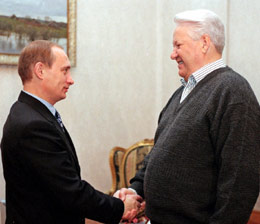 Vladimir Putin shakes hands with his predecessor, Boris Yeltsin. (Source/AP) Related Links |
Russian President Vladimir Putin has enjoyed swift upward mobility within the ranks of the Kremlin that is perhaps only possible in the Kremlin. Following Boris Yeltsin's sudden resignation from the office on December 31, 1999, Putin, the Prime Minister and a popular leader, became acting President. He succeeded Yeltsin in official elections on March 26, 2000.
A Palpable Influence
Putin was born in 1952 in Leningrad. Upon graduating from Leningrad State University in 1975, he served in the K.G.B. as a spy stationed in East Germany until 1989. Putin then joined his alma mater's international affairs department, though many K.G.B. watchers speculate that he remained a spy, keeping tabs on the democratic movement. He went to work as an aide for his former mentor, Anatoly Sobchak, a Leningrad politician. Sobchak was elected mayor in 1991, and Putin joined his administration, becoming first deputy mayor. Although he worked behind the scenes, Putin's influence was nevertheless palpable, especially in luring Western investment.
Putin was recruited from a position in Leningrad's city government to the Kremlin in 1996 as an aide to property manager Pavel Borodin, who now faces bribery and corruption charges. In 1998, Yeltsin appointed Putin head of the Federal Security Service, the successor to the K.G.B., and called on him in March 1999 to head Russia's security council. In August 1999 Yeltsin fired Prime Minister Sergei Stepashin, 47, and his entire cabinet, and promoted Putin, making him heir-apparent to the presidency. It was the fourth time in 17 months that Yeltsin had sacked Russia's government.
Political Neophyte
On New Year's Eve 1999, Yeltsin unexpectedly resigned, and Putin was elevated once again, this time to acting president. The political neophyte had been enjoying tremendous popular support, notably in the wake of his heavy-handed campaign to suppress Islamic militants in Chechnya, who continue their drive for independence and are blamed for a series of bomb attacks in Moscow and other cities. Putin's pursuit of the rebels also contributed to the Unity Party's success in the recent parliamentary elections, another indicator of his popularity. The pro-Kremlin group placed second to the Communists, and ahead of former Prime Minister Yevgeny Primakov's Fatherland-All Russia party.
A pro-market democratic reformer, Putin has vowed to revitalize the foundering economy, fight corruption, subvert Communism, and build a strong Russia. One of his first moves as president was to grant Yeltsin and his family immunity from future investigation into corruption charges.
Trending
Here are the facts and trivia that people are buzzing about.