Nauru | Facts & Information

- Nauru Profile
Infoplease has everything you need to know about Nauru. Check out our country profile, full of essential information about Nauru's geography, history, government, economy, population, culture, religion and languages. If that's not enough, click over to our collection of world maps and flags.

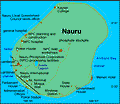
Facts & Figures
-
President: Russ Kun (2022)
Total area: 8 sq mi (21 sq km)
Population (2022 est.): 9,811 (growth rate: 0.42%); birth rate: 21.1/1000; infant mortality rate: 7.84/1000; life expectancy: 67.93
Capital: no official capital; government offices in Yaren District
Monetary unit: Australian dollar
Languages: Nauruan 93% (official, a distinct Pacific Island language), English 2% (widely understood, spoken, and used for most government and commercial purposes), other 5% (includes I-Kiribati 2% and Chinese 2%) note: percentages represent main language spoken at home; Nauruan is spoken by 95% of the population, English by 66%, and other languages by 12% (2011 est.)
Ethnicity/race: Nauruan 88.9%, part Nauruan 6.6%, I-Kiribati 2%, other 2.5% (2007 est.)
Religions: Protestant 60.4% (includes Nauru Congregational 35.7%, Assembly of God 13%, Nauru Independent Church 9.5%, Baptist 1.5%, and Seventh Day Adventist .7%), Roman Catholic 33%, other 3.7%, none 1.8%, unspecified 1.1% (2011 est.)
National Holiday: Independence Day, January 31
Literacy rate: n.a
Economic summary: GDP/PPP (2019 est.): $150 million; per capita $13,5000. Real growth rate: 4% Inflation: 5.1%. Unemployment: 23% (2011 est.). Arable land: 0%. Agriculture: coconuts. Labor force: mining phosphates, public administration, education, and transportation. Industries: phosphate mining, offshore banking, coconut products. Natural resources: phosphates. Exports: $30 million (2018): phosphates. Major trading partners (exports): Thailand 34%, Australia 16%, United States 13%, South Korea 10%, Philippines 9%, Japan 7%, France 5% (2019). Imports: 90 million (2019 est.): food, fuel, manufactures, building materials, machinery. Major trading partners (imports): Taiwan 52%, Australia 28% (2019).
Special relationship within the Commonwealth of Nations
Communications: Telephones: main lines in use: 1,900 (2009); mobile cellular: 10,000 (2020). Broadcast media: 1 government-owned TV station broadcasting programs from New Zealand sent via satellite or on videotape; 1 government-owned radio station, broadcasting on AM and FM, utilizes Australian and British programs (2019). Internet hosts: 8,162 (2012). Internet users: 6,136 (2019),
Transportation: Railways: total: 5 km; note: used to haul phosphates from the center of the island to processing facilities on the southwest coast (2001). Roadways: total: 30 km; paved: 24 km (2002). Ports and harbors: Nauru. Airports: 1 (2021).
International disputes: none.
Trending
Here are the facts and trivia that people are buzzing about.