T – Z
Updated August 5, 2020 |
Infoplease Staff

- telnet
- A way to communicate with a remote computer over a network.
trackball trackball
- Input device that controls the position of the cursor on the screen; the unit is mounted near the keyboard, and movement is controlled by moving a ball.
- terabytes (TB)
- A thousand gigabytes.
- teraflop
- A measure of a computer's speed. It can be expressed as a trillion floating-point operations per second.
- Trojan Horse
- See virus.
- UNIX®
- A very powerful operating system used as the basis of many high-end computer applications.
- upload
- The process of transferring information from a computer to a web site (or other remote location on a network).
- v. To transfer information from a computer to a web site (or other remote location on a network).
- URL
- Uniform Resource Locator.
- 1. The protocol for identifying a document on the Web.
- 2. A Web address (e.g., www.census.gov). A URL is unique to each user. See also domain.
- UPS
- Universal Power Supply or Uninterruptible Power Supply. An electrical power supply that includes a battery to provide enough power to a computer during an outage to back-up data and properly shut down.
- USB
- Universal Serial Bus. An industry standard for connecting different compatible peripheral devices across multiple platforms. Devices include printers, digital cameras, scanners, game pads, joysticks, keyboards and mice, and storage devices. USB peripherals offer the use of plug-and-play convenience by eliminating the need to turn off or restart the computer when attaching a new peripheral. Users can connect USB peripherals whenever they need them. For example, a user producing a newsletter could easily swap a digital camera for a scanner-without any downtime. Small, simple, inexpensive, and easy to attach, USB supports simultaneous connection of up to 127 devices by attaching peripherals through interconnected external hubs.
USB hub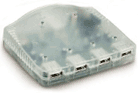 USB hub
- A multiple-socket USB connecter that allows several USB-compatible devices to be connected to a computer.
- USENET
- A large unmoderated and unedited bulletin board on the Internet that offers thousands of forums, called newsgroups. These range from newsgroups exchanging information on scientific advances to celebrity fan clubs.
- user friendly
- A program or device whose use is intuitive to people with a nontechnical background.
- video teleconferencing
- A remote “face-to-face chat,” when two or more people using a webcam and an Internet telephone connection chat online. The webcam enables both live voice and video.
- virtual reality (VR)
- A technology that allows one to experience and interact with images in a simulated three-dimensional environment. For example, you could design a room in a house on your computer and actually feel that you are walking around in it even though it was never built. (The Holodeck in the science-fiction TV series Star Trek: Voyager would be the ultimate virtual reality.) Current technology requires the user to wear a special helmet, viewing goggles, gloves, and other equipment that transmits and receives information from the computer.
- virus
- An unauthorized piece of computer code attached to a computer program or portions of a computer system that secretly copies itself from one computer to another by shared discs and over telephone and cable lines. It can destroy information stored on the computer, and in extreme cases, can destroy operability. Computers can be protected from viruses if the operator utilizes good virus prevention software and keeps the virus definitions up to date. Most viruses are not programmed to spread themselves. They have to be sent to another computer by e-mail, sharing, or applications. The worm is an exception, because it is programmed to replicate itself by sending copies to other computers listed in the e-mail address book in the computer. There are many kinds of viruses, for example:
- Boot viruses place some of their code in the start-up disk sector to automatically execute when booting. Therefore, when an infected machine boots, the virus loads and runs.
- File viruses attached to program files (files with the extension “.exe”). When you run the infected program, the virus code executes.
- Macro viruses copy their macros to templates and/or other application document files.
- Trojan Horse is a malicious, security-breaking program that is disguised as something benign such as a screen saver or game.
- Worm launches an application that destroys information on your hard drive. It also sends a copy of the virus to everyone in the computer's e-mail address book.
- WAV
- A sound format (pronounced “wave”) used to reproduce sounds on a computer.
webcam webcam
- A video camera/computer setup that takes live images and sends them to a Web browser.
- wiki
- Derived from the Haiwaiian word for “quick”, a wiki is a website that can be modified or contributed to by users. Programmer Ward Cunningham created the wiki in 1995, inspired in part by Apple’s HyperCard program. Wiki software is used in a variety of contexts to facilitate online interaction and collaboration.
- Window
- A portion of a computer display used in a graphical interface that enables users to select commands by pointing to illustrations or symbols with a mouse. “Windows” is also the name Microsoft adopted for its popular operating system.
- World Wide Web (“WWW” or “the Web”)
- A network of servers on the Internet that use hypertext-linked databases and files. It was developed in 1989 by Tim Berners-Lee, a British computer scientist, and is now the primary platform of the Internet. The feature that distinguishes the Web from other Internet applications is its ability to display graphics in addition to text.
- word processor
- A computer system or program for setting, editing, revising, correcting, storing, and printing text.
- Worm
- See virus.
- WYSIWYG
- What You See Is What You Get. When using most word processors, page layout programs (See desktop publishing), and web page design programs, words and images will be displayed on the monitor as they will look on the printed page or web page.
.com/ipa/0/9/0/2/8/6/A0902860.html
Trending
Here are the facts and trivia that people are buzzing about.