Geography
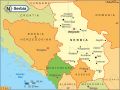
Serbia is largely mountainous. Its northeast section is part of the rich, fertile Danubian Plain drained by the Danube, Tisa, Sava, and Morava river systems. It borders Croatia on the northwest, Hungary on the north, Romania on the northeast, Bulgaria on the east, Macedonia on the south, and Albania, Montenegro, and Bosnia and Herzegovina on the west.
Government
Republic. Serbia was one of six republics that made up the country of Yugoslavia, which broke up in the 1990s. In Feb. 2003, Serbia and Montenegro were the remaining two republics of rump Yugoslavia, forming a loose federation. In 2006, Montenegro split from Serbia.
History
Serbs settled the Balkan Peninsula in the 6th and 7th centuries and adopted Christianity in the 9th century. In 1166, Stefan Nemanja, a Serbian warrior and chief, founded the first Serbian state. By the 14th century, under the rule of Stefan Dusan, it became the most powerful state in the Balkans. After Serbia was defeated in the Battle of Kosovo in 1389, it was absorbed into the Ottoman Empire. Throughout the 19th century its struggle against Ottoman rule intensified, and in 1878 Serbia gained independence after Russia defeated the Ottoman Turks in the Russo-Turkish war of 1877–1878. In the Balkan wars (1912–1913), Serbia and other Balkan states seized hold of more former Ottoman lands on the peninsula.
World War I began when a Serbian nationalist assassinated Archduke Franz Ferdinand of Austria in 1914, which led to Austria's declaration of war against Serbia. Within months, much of Europe was at war. In the war's aftermath, Serbia became part of the Kingdom of the Serbs, Croats, and Slovenes (1918). It included the former kingdoms of Serbia and Montenegro; Bosnia-Herzegovina; Croatia-Slavonia, a semiautonomous region of Hungary; and Dalmatia. King Peter I of Serbia became the first monarch; his son, Alexander I, succeeded him on Aug. 16, 1921. Croatian demands for a federal state led Alexander to assume dictatorial powers in 1929 and to change the country's name to Yugoslavia. Serbian dominance continued despite his efforts, amid the resentment of other regions. A Macedonian associated with Croatian dissidents assassinated Alexander in Marseilles, France, on Oct. 9, 1934, and his cousin, Prince Paul, became regent for the king's son, Prince Peter.
Paul's pro-Axis policy brought Yugoslavia to sign the Axis Pact on March 25, 1941, and opponents overthrew the government two days later. On April 6 the Nazis occupied the country, and the young king and his government fled. Two guerrilla armies—the Chetniks under Draza Mihajlovic supporting the monarchy and the Partisans under Tito (Josip Broz) leaning toward the USSR—fought the Nazis for the duration of the war. In 1943, Tito established a provisional government, and in 1945 he won the federal election while monarchists boycotted the vote. The monarchy was abolished and the Communist Federal People's Republic of Yugoslavia, with Tito as prime minister, was born. Tito ruthlessly eliminated the opposition and broke with the Soviet bloc in 1948. Yugoslavia followed a middle road, combining orthodox Communist control of politics and general overall economic policy with a varying degree of freedom in the arts, travel, and individual enterprise. Tito became president in 1953 and president-for-life under a revised constitution adopted in 1963.
The Rule of Slobodan Milosevic Spurs the Breakup of Yugoslavia
After Tito's death on May 4, 1980, a rotating presidency designed to avoid internal dissension was put into effect, and the feared clash of Yugoslavia's multiple nationalities and regions appeared to have been averted. In 1989, Slobodan Milosevic became president of the Serbian republic. His arch-nationalism and calls for Serbian domination inflamed ethnic tensions and spurred on the breakup of Yugoslavia. In May 1991 Croatia declared independence, and by December so had Slovenia and Bosnia. Slovenia was able to break away with only a brief period of fighting, but because 12% of Croatia's population was Serbian, Serb-dominated Yugoslavia fought hard against its secession. Bosnia's declaration of independence led to even more brutal fighting. The most ethnically diverse of the Yugoslav republics, Bosnia was 43% Muslim, 31% Serbian, and 17% Croatian. The largely Serbian-led Yugoslav military pounded Bosnia, and with Yugoslavia's help, the Bosnian Serb minority took the offensive against Bosnian Muslims. It carried out ruthless campaigns of ethnic cleansing, which involved the expulsion or massacre of Muslims. The war did not end until NATO stepped in, bombing Serb positions in Bosnia in Aug. and Sept. 1995. In Nov. 1995, Bosnia, Serbia, and Croatia signed the Dayton Peace Accords, ending the four-year-long war in which 250,000 people died and another 2.7 million became refugees.
Despite entangling his country in almost continuous war for four years and bringing it to near economic collapse, the Serbian government of Slobodan Milosevic maintained its effective control over the remainder of Yugoslavia. Constitutionally barred from another term as president of Serbia, Milosevic became president of the Federal Republic of Yugoslavia (which at this stage consisted of just Serbia and Montenegro) in July 1997.
In Feb. 1998 the Yugoslav army and Serbian police began fighting against the separatist Kosovo Liberation Army, but their scorched-earth tactics were concentrated on ethnic Albanian civilians—Muslims who make up 90% of Kosovo's population. More than 900 Kosovars were killed in the fighting, and the hundreds of thousands forced to flee their homes were without adequate food and shelter. Although Serbs made up only 10% of Kosovo's population, the region figures strongly in Serbian nationalist mythology.
NATO was reluctant to intervene because Kosovo—unlike Bosnia in 1992—was legally a province of Yugoslavia. The proof of civilian massacres finally gave NATO the impetus to intervene for the first time ever in the dealings of a sovereign nation with its own people. NATO's reason for involvement in Kosovo changed from avoiding a wider Balkan war to preventing a human rights calamity. On March 24, 1999, NATO began launching air strikes. Weeks of daily bombings destroyed significant Serbian military targets, yet Milosevic showed no signs of relenting. In fact, Serbian militia stepped up civilian massacres and deportations in Kosovo, and by the end of the conflict, the UN high commissioner for refugees estimated that at least 850,000 people had fled Kosovo. Serbia finally agreed to sign a UN-approved peace agreement with NATO on June 3, ending the 11-week war.
Milosevic is Deposed but Nationalism and Ethnic Violence Continue
In the Sept. 2000 federal elections, Vojislav Kostunica, a law professor and political outsider, won the presidency, ending the autocratic rule of Milosevic, who had dragged Yugoslavia into economic collapse and relegated it to pariah status throughout much of the world. In 2001, Milosevic was turned over to the United Nations International Criminal Tribunal for the former Yugoslavia in The Hague, charged with 66 war crimes, including genocide and crimes against humanity. His expensive and lengthy trial ended without a verdict when he died in March 2006.
In March 2002, the nation agreed to form a new state, replacing Yugoslavia with a loose federation called Serbia and Montenegro, which went into effect in Feb. 2003. The new arrangement was made to placate Montenegro's restive stirrings for independence and allowed Montenegro to hold a referendum on independence after three years.
The prime minister of the Serbian state, Zoran Djindjic, a reformer who helped bring about the fall of Milosevic, was assassinated in March 2003. Extreme nationalists, organized crime, and Serbia's own police and security services were implicated.
On March 17, 2004, Mitrovica, in Kosovo, experienced the worst ethnic violence in the region since the 1999 war. At least 19 people were killed, another 500 were injured, and about 4,000 Serbs lost their homes. NATO sent in an extra 1,000 troops to restore order.
In June 2004, Democratic Party leader Boris Tadic was elected Serbian president, defeating a nationalist candidate. Tadic planned to work toward gaining EU membership for Serbia, but in 2006, the EU suspended its membership talks with Serbia, after the country repeatedly failed to turn over Ratko Mladic, the Bosnian Serb commander wanted on genocide charges for the 1995 massacre of 8,000 Muslims from Srebrenica.
Montenegro and Kosovo Declare Independence
In May 2006, Montenegro held a referendum on independence, which narrowly passed. On June 4 the federal president of Serbia and Montenegro, Svetozar Marovic, announced the dissolution of his office, and the following day Serbia acknowledged the end of the union. The EU and the United States recognized Montenegro on June 12.
In Feb. 2007, the International Court of Justice ruled that the massacre of some 8,000 Bosnian Muslims by Bosnian Serbs in Srebrenica in 1995 was genocide, but stopped short of saying the government was directly responsible. The decision spared Serbia from having to pay war reparations to Bosnia. The court's president, Judge Rosalyn Higgins, however, criticized Serbia for not preventing the genocide. The court also ordered Serbia to turn over Bosnian Serb leaders, including Ratko Mladic and Radovan Karakzic, who are accused of orchestrating the genocide and other crimes. In April, four Serbs–former paramilitary officers–were found guilty by a war-crimes court of executing six Bosnian Muslims from Srebrenica in Trnovo in 1995. The judge, however, did not link them to the massacre in Srebrenica.
Negotiations between the European Union, Russia, and Washington on the future of Kosovo ended in stalemate in November 2007.
Tomislav Nikolic, of the hardline nationalist Radical Party, prevailed over Tadic in the first round of presidential elections in January 2008, taking 39.6% of the vote to Tadic's 35.5%. Tadic prevailed in February's runoff election, winning 50.5% over Nikolic's 47.7%.
Kosovo's prime minister Hashim Thaci declared independence from Serbia on Feb. 17, 2008. Serbia, as predicted, denounced the move. Serbian prime minister Kostunica said he would never recognize the "false state." Ethnic Albanians, who were brutalized by the Yugoslav army and Serbian police in 1998's civil war, took to the streets in jubilation. International reaction was mixed, with the United States, France, Germany, and Britain indicating that they planned to recognize Kosovo as the world's 195th country. Serbia and Russia, however, called the move a violation of international law. Albanians make up 95% of the population of Kosovo.
Ongoing Internal Strife and Controversy Over Kosovar Independence
Prime Minister Vojislav Kostunica dissolved the government on March 8, 2008, stating that he could not govern with President Tadic, who is in favor of gaining European Union membership and improving relations with the United States. President Tadic called for early elections in May.
On May 11, 2008, President Tadic's coalition won parliamentary elections with 38.7% (103 of 250 seats) of the vote. The Serbian Radical Party earned 29.1%, the Democratic Party of Serbia 11.3%, the Socialist Party of Serbia 7.9%, and the Liberal Democratic Party 5.2% of the vote.
Parliament in July approved a new government, composed of the Democratic Party, led by President Boris Tadic, and the Socialist Party, which was formerly led by Slobodan Milosevic. The Democratic Party's Mirko Cvetkovic became prime minister. The government vowed to tame the nationalistic fervor that has raised concern internationally, particularly when Kosovo declared independence in February 2008. Cveetkovic also said Serbia will reach out to the West and join the European Union.
Radovan Karadzic, the Bosnian Serb president during the war in Bosnia in the 1990s who orchestrated the massacre of almost 8,000 Muslim men and boys in 1995 in Srebrenica, was found outside Belgrade in July 2008. He altered his appearance and had been openly practicing alternative medicine in Serbia. His trial at The Hague began in October 2009.
On October 8, 2008, in a rare move, the United Nations voted to request that the International Court of Justice review the manner in which Kosovo declared independence. Serbia, which initiated the request, considers Kosovo a breakaway territory that acted illegally in declaring independence. Most European Union members abstained from voting on the request.
Serbia Seeks Admission into the European Union
In December 2009, Serbia applied to join the EU. The Serbian parliament apologized for the massacre of Bosnian Serbs at Srebrenica in a landmark March 2010 resolution. Delaying Serbia's request for EU membership was the fact that two major war crimes suspects were still at large. However, the arrest of former Bosnian Serb military commander Ratko Mladic and Croatian Serb leader Goran Hadzic in 2011 eliminated the last remaining roadblocks to Serbia's path to EU admittance, and in March 2012 the EU declared Serbia a membership candidate. Mladic's war crimes trial opened at the Hague opened in May 2012. The EU cleared Serbia for membership talks in April 2013 after Serbia and Kosovo normalized relations in a groundbreaking deal in which Serbia acknowledged that Kosovo's government has control over all of Kosovo, and Kosovo in turn granted autonomy to the Serbian-dominated north. Serbia stopped short of recognizing Kosovo's independence, however.
Nationalist leader Tomislav Nikolic—a former ally of Slobodan Milosevic—pulled off a surprise victory over incumbent Boris Tadic in the second round of presidential elections in May 2012. Nikolic's win followed parliamenteary elections in which his center-right Serbian Progressive Party and its partners took 73 out of 250 seats. Nikolic has tempered his extreme nationalism and now favors European integration.
Mladic War Crimes Trial Delayed
On May 16, 2012, the trial of former Bosnian Serb military commander Ratko Mladic began. The prosecution recounted the atrocities that soldiers directly under Maldic's command allegedly performed. Mladic refused to make a formal plea. The court entered a not guilty plea on his behalf.
On the following day, a judge suspended the trial due to errors made by the prosecution in handing over evidence to the defense. The prosecution acknowledged that there were delays in giving documents to the defense.
2014 Brings Worst Flooding in a Century
In May 2014, Serbia, Bosnia and Herzegovina were hit with the heaviest rains and flooding in over a century. Electricity was lost in several towns and villages. At least 44 people were killed in the flooding, and authorities believed that the death toll could rise. Serbia's Prime Minister Aleksander Vucic declared a state of emergency for the whole country. During a news conference, Vucic said, "This is the greatest flooding disaster ever. Not only in the past 100 years; this has never happened in Serbia's history."
In Bosnia, rivers surpassed record levels and army helicopters had to evacuate dozens stranded in their homes in the town of Maglaj. Authorities could not reach Doboj, a town in northern Bosnia, because all roads leading to the town were washed out. The government sent troops to central and eastern towns where thousands had to be evacuated, their homes destroyed by the floods. Sarajevo meteorologist Zeljko Majstorovic said, "This is the worst rainfall in Bosnia since 1894, when weather measurements started to be recorded."
Seven arrested over 1995 Srebrenica Massacre, Netherlands Held Liable
In July 2014, a Dutch court found the Netherlands liable for the murder of more than 300 Bosnian Muslim men and boys in July 1005. At the time of their murder, the men and boys had been at a United Nations compound in Srebrenica, a compound that was being protected by the Dutch peacekeeping forces, Dutchbat. About 8,000 total were killed by Bosnian-Serb forces during the Bosnian War. The case was brought to the Dutch court by relatives of the victims who called themselves, "Mothers of Srebrenica."
The court ruled that Dutchbat did not do enough to protect the 300 men and boys at the compound. The court also said that Dutchbat should have known that the victims would have been killed when handed over to the Bosnian Serbs. "It can be said with sufficient certainty that, had Dutchbat allowed them to stay at the compound, these men would have remained alive. By co-operating in the deportation of these men, Dutchbat acted unlawfully," the court said in the ruling. Due to the ruling, the Netherlands must pay compensation to the victims' families.
In March 2015, Serbian authorities arrested seven men for their role in killing more than 1,000 Muslims in Srebrenica in July 1995. According to Serbian and Bosnian prosecutors, the seven were among the first to be arrested and charged in Serbia for the Srebrenica Massacre. Previously, Serbia had arrested men who had not been directly involved in the murders. In 2011, Serbia handed over Ratko Mladic to the international tribunal at The Hague where, as of May 2015, he was being tried, accused as the mastermind of the massacre. Also, The Hague has convicted numerous people of genocide who were involved in the Srebrenica massacre.
In April 2015, a Dutch court ruled that General Thom Karremans, commander of Dutchbat at the time of the Srebrenica massacre, should not be prosecuted. The court decided that Karremans was not criminally liable for the murders on grounds of command responsibility.
See also Montenegro.
U.S. State Dept. Country Notes: Serbia and Montenegro
Federal Statistical Office www.szs.sv.gov.yu/homee.htm .
See also Yugoslavia Timeline.