Geography
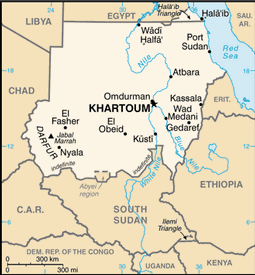
Sudan, in northeast Africa, measures about one-fourth the size of the United States. Its neighbors are Chad and the Central African Republic on the west, Egypt and Libya on the north, Ethiopia and Eritrea on the east, and South Sudan, Kenya, Uganda, and Democratic Republic of the Congo on the south. The Red Sea washes about 500 mi of the eastern coast. It is traversed from north to south by the Nile, all of whose great tributaries are partly or entirely within its borders.
Government
Military government.
History
What is now northern Sudan was in ancient times the kingdom of Nubia, which came under Egyptian rule after 2600 B.C. An Egyptian and Nubian civilization called Kush flourished until A.D. 350. Missionaries converted the region to Christianity in the 6th century, but an influx of Muslim Arabs, who had already conquered Egypt, eventually controlled the area and replaced Christianity with Islam. During the 1500s a people called the Funj conquered much of Sudan, and several other black African groups settled in the south, including the Dinka, Shilluk, Nuer, and Azande. Egyptians again conquered Sudan in 1874, and after Britain occupied Egypt in 1882, it took over Sudan in 1898, ruling the country in conjunction with Egypt. It was known as the Anglo-Egyptian Sudan between 1898 and 1955.
The 20th century saw the growth of Sudanese nationalism, and in 1953 Egypt and Britain granted Sudan self-government. Independence was proclaimed on Jan. 1, 1956. Since independence, Sudan has been ruled by a series of unstable parliamentary governments and military regimes. Under Maj. Gen. Gaafar Mohamed Nimeiri, Sudan instituted fundamentalist Islamic law in 1983. This exacerbated the rift between the Arab north, the seat of the government, and the black African animists and Christians in the south. Differences in language, religion, ethnicity, and political power erupted in an unending civil war between government forces, strongly influenced by the National Islamic Front (NIF) and the southern rebels, whose most influential faction is the Sudan People's Liberation Army (SPLA). Human rights violations, religious persecution, and allegations that Sudan had been a safe haven for terrorists isolated the country from most of the international community. In 1995, the UN imposed sanctions against it.
On Aug. 20, 1998, the United States launched cruise missiles that destroyed a pharmaceutical manufacturing facility in Khartoum which allegedly manufactured chemical weapons. The U.S. contended that the Sudanese factory was financed by Islamic militant Osama bin Laden.
Humanitarian Disaster in Darfur
Just as Sudan's civil war seemed to be coming to an end, another war intensified in the northwestern Darfur region. After the government quelled a rebellion in Darfur in Jan. 2004, it allowed pro-government militias called the Janjaweed to carry out massacres against black villagers and rebel groups in the region. These Arab militias, believed to have been armed by the government, have killed between 200,000 and 300,000 civilians and displaced more than 1 million. While the war in the south was fought against black Christians and animists, the Darfur conflict is being fought against black Muslims. Although the international community has reacted with alarm to the humanitarian disaster—unmistakably the world's worst—it has been ineffective in persuading the Sudanese government to rein in the Janjaweed. Despite the EU and the U.S. describing the killing as genocide, and despite a UN Security Council resolution demanding that Sudan stop the Arab militias, the killing continued throughout 2005.
On Jan. 9, 2005, after three years of negotiations, the peace deal between the southern rebels, led by John Garang of the SPLA, and the Khartoum government to end the two-decades-long civil war was signed, giving roughly half of Sudan’s oil wealth to the south, as well as nearly complete autonomy and the right to secede after six years. But just two weeks after Garang was sworn in as first vice president as part of the power-sharing agreement, he was killed in a helicopter crash during bad weather. Rioting erupted in Khartoum, killing nearly 100. Garang’s deputy, Salva Kiir, was quickly sworn in as the new vice president, and both north and south vowed that the peace agreement would hold.
In 2006, the slaughter in Darfur escalated, and the Khartoum government remained defiantly indifferent to the international communities' calls to stop the violence. The 7,000 African Union (AU) peacekeepers deployed to Darfur proved too small and ill equipped a force to prevent much of it. A fragile peace deal in May 2006 was signed between the Sudanese government and the main Darfur rebel group; two smaller rebel groups, however, refused to sign. The UN reported that there has in fact been a dramatic upsurge in the violence since the agreement. The Sudanese government reneged on essential elements of the accord, including the plan to disarm the militias and allow a UN peacekeeping force into the region to replace the modest AU force. Khartoum eventually agreed to allow the modest AU force to remain in the country until the end of 2006, but rejected a hybrid AU-UN peacekeeping force entering the country. In. Jan. 2007, Sudan and Darfur rebel groups agreed to a 60-day cease-fire, which was intended to lead to peace talks sponsored by the African Union. Libya hosted peace talks ni October, but several rebel groups boycotted the proceedings, and the summit ended shortly after the opening ceremony. In July 2007, the UN Security Council voted unanimously to deploy as many as 26,000 peacekeepers from the African Union and the United Nations forces to help end the violence in Darfur. The African Union peacekeeper base in Darfur was attacked in September. Ten peacekeepers were killed. Days later, the town was razed, leaving some 7,000 Darfuris homeless.
In Feb. 2007, the International Criminal Court at the Hague named Ahmad Harun, Sudan's deputy minister for humanitarian affairs, and Ali Kushayb, also known as Ali Abd-al-Rahman, a militia leader, as suspects in the murder, rape, and displacement of thousands of civilians in the Darfur region. In May, the Court issued arrest warrants for Haroun and Ali Kosheib, a Janjaweed leader, charging them with mass murder, rape, and other crimes. The Sudanese government refused to hand over them over to the Court. Kushayb was arrested by Sudanese police in October 2008. He was not, however, handed over to the ICC.
The Bush administration expanded sanctions on Sudan in May, banning 31 Sudanese companies and four individuals from doing business in the U.S.
Atrocities Continue, Even as the International Community Pushes for Peace
In October 2007, the Sudan People's Liberation Army (SPLA) quit the national unity government, leaving the peace agreement signed in 2005 on the brink of collapse. The SPLA claimed that the governing party, the National Congress Party, had ignored its concerns over boundary between the north and south and how to divide the country's oil wealth.
Sudan faced international criticism once again in January 2008, when Musa Hilal, a Janjaweed leader, was appointed to a top government position as an adviser to the minister of federal affairs. Human Rights Watch called Hilal "the poster child for Janjaweed atrocities in Darfur."
Government forces and the janjaweed resumed their attacks in the Darfur region in February 2008, forcing as many as 45,000 people to flee their homes. The government claimed it was targeting the Justice and Equality Movement, a rebel group that has become increasingly powerful and is believed to be linked to the government of Chad. Civilians in the region, however, say the attacks have continued after the rebels escape. The Justice and Equality Movement launched a bold attack in May, coming within a few miles of Khartoum before being repulsed by government troops. It was the first time that the conflict in Darfur has threatened to spill over into Khartoum.
In July 2008, Luis Moreno-Ocampo, the prosecutor of the International Criminal Court (ICC), indicted Bashir with genocide for planning and executing the decimation of Darfur's three main ethnic tribes: the Fur, the Masalit, and the Zaghawa. Moreno-Ocampo also said Bashir "purposefully targeted civilians" and used "rapes, hunger, and fear" to terrorize civilians. Many observers feared that Bashir would respond to the charges with further violence. The ICC issued an arrest warrant for Bashir in March 2009, charging him with war crimes and crimes against humanity in the Darfur region. An indictment for genocide was rejected by the court, and Moreno-Ocampo appealed the decision. Bashir responded by shutting down the 13 aid agencies that operate relief camps in Sudan and assist millions of people in Darfur. The UN said that as a result, 1.1 million people will be left without food, 1.1 million without health care, and another 1 million without water. In February 2010, Moreno-Ocampo won his appeal and the ICC was ordered to review the evidence to determine if Bashir should be tried for genocide. The court formally charged him with three counts of genocide in July. It was the first time the court has charged a person with genocide.
In July 2009, an international tribunal at The Hague redefined the border of Sudan's oil-rich Abyei region, giving the North rights to the lucrative Heglig oil field, and the South retained rights to other large oil fields in Abyei.
Bashir Wins Election in a Landslide
In April 2010, Bashir easily won Sudan's first multi-party elections since 1986, with 68% of the vote. Several opposition parties boycotted the election, and international observers questioned the fairness of it, citing ballot-box stuffing and other allegations of fraud. Bashir's supporters cite the marked improvement in infrastructure completed during his presidency—new schools, hospitals, and roads. All are products of the oil boom.
Salva Kiir, head of the Sudan People's Liberation Movement, was reelected president of the semi-autonomous South, taking 93% of the vote. A referendum on Southern independence is scheduled for January 2011. President Bashir has vowed to honor the results of the vote. Many fear renewed violence if the referendum passes, as the South is home to about 90% of the country's oil.
Historic Vote in Southern Sudan
In a historic seven-day secessionist referendum that began in southern Sudan on January 9, 2011, 98.8% of voters chose independence from the north. The referendum was a provision of the 2005 Comprehensive Peace Agreement, which ended a 22-year civil war that killed 2.5 million people and displaced 4 million. President Bashir accepted the results and said he would not seek reelection when his term expires in 2015.
The Bush administration negotiated the 2005 Comprehensive Peace Agreement, which in addition to setting the date of the referendum also called for people in the contested region of Abyei to participate in the vote. That vote, however, has been delayed because a decision on what constitutes a resident of Abyei has not been reached. Tribal leaders in the region have made it clear that their loyalty lies with the south, but there has not been a date set for a vote in Abyei. Any declaration of affiliation with the south by Abyei could trigger an attack from the north. Abyei sits between northern and southern Sudan and has historically served as a bridge between the two. Since voting began in southern Sudan, at least 23 people have died in Abyei, confirming speculation that the region continues to be a matter of contention.
On July 9, 2011, the Republic of South Sudan declared its independence and became Africa's 54th state. Thousands celebrated in the streets of South Sudan's capital, Juba. Salva Kiir, South Sudan's president, signed the interim constitution. However, even as South Sudan celebrated its independence, Abyei's uncertainty was only one obstacle that awaits the fledgling state. South Sudan becomes one of the poorest countries in the world with half of the population living on less than $1 per day and an adult literacy rate of less than 25%. South Sudan also needs to establish a new government and constitution.
North and South on the Brink of War
Instability and conflict with Sudan over oil plagued South Sudan since independence. Sudan launched air attacks into South Sudan, the north accused the south of arming militants in the north, and both accused each other of inciting a border war. Tension between the two nations peaked in early 2012 as the economies in both countries continued to shrink and a food crisis intensified in the south, emphasizing the need for oil revenues. As a full-scale war loomed, the two sides negotiated a non-aggression agreement under pressure from the African Union, the U.S., and China. Within days, however, South Sudan accused the north of violating the agreement.
The countries teetered on the brink of border war in April 2012. South Sudan took over disputed oil fields in Heglig, a move the African Union and the UN called illegal. Both sides traded ground and aerial attacks, and Sudan's president Omar al-Bashir said he would not negotiate with South Sudan because it only responds to "the gun and bullets." The South withdrew from the contested region, but the aggression continued, prompting the African Union to give the two sides three months to resolve the issues over oil and the disputed border.
Under significant pressure from the African Union, United Nations, and U.S. Secretary of State Hillary Clinton, Sudan and South Sudan reached an oil deal on Aug. 4, 2012. South Sudan, where the oil reserves are located, has agreed to compensate Sudan for the use of its oil pipeline in the form of both an amortized lump sum as well as a per-barrel payment. Financial details were not released.
Oil Pipeline Deal Achieved
After more than a year of no oil, Sudan and South Sudan reached an agreement in March 2013, brokered by the African Union, to resume oil production within the month. South Sudan gets 98% of its revenue from oil. The agreement established a timeline for resumption of oil production, and addressed other issues including security and border demarcation.
Sudan's President Omar al-Bashir's austerity measures led to the doubling of prices on cooking oil and gas—and the worst riots in decades. Beginning in late Sept. 2013, the crackdown on protesters has left at least 50 people dead, though this number was likely to rise.
In an unofficial referendum held on Oct. 31, 2013, the 65,000 registered voters from the Dinka Ngok tribe of the disputed Abyei region voted to join South Sudan with a 99.9% majority. The unsurprising results were not recognized by the government of either country, nor did the other tribe, the Misseriya—who side with Sudan—nor the African Union support the vote.
ICC Halts Darfur Investigation; President Bashir Re-Elected
The International Criminal Court suspended its investigation into the war crimes perpetrated in Darfur in December 2014, saying the UN Security Council had failed to support the inquiry. "Given this council's lack of foresight on what should happen in Darfur, I am left with no choice but to hibernate investigative activities in Darfur as I shift resources to other urgent cases" said ICC prosecutor Fatou Bensouda.
President Bashir was re-elected to another five-year term as president in April 2015, winning nearly 94% of the vote. The opposition boycotted the election. Voter turnout was low, at 46%. He has been in power since 1989 and is under indictment by the ICC on charges of genocide, war crimes, and crimes against humanity for the atrocities committed in Darfur.
See also Encyclopedia: Sudan .
U.S. State Dept. Country Notes: Sudan