Geography
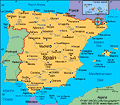
Spain occupies 85% of the Iberian Peninsula, which it shares with Portugal, in southwest Europe. Africa is less than 10 mi (16 km) south at the Strait of Gibraltar. A broad central plateau slopes to the south and east, crossed by a series of mountain ranges and river valleys. Principal rivers are the Ebro in the northeast, the Tajo in the central region, and the Guadalquivir in the south. Off Spain's east coast in the Mediterranean are the Balearic Islands (1,936 sq mi; 5,014 sq km), the largest of which is Majorca. Sixty mi (97 km) west of Africa are the Canary Islands (2,808 sq mi; 7,273 sq km).
Government
Parliamentary monarchy.
History
Spain, originally inhabited by Celts, Iberians, and Basques, became a part of the Roman Empire in 206 B.C., when it was conquered by Scipio Africanus. In A.D. 412, the barbarian Visigothic leader Ataulf crossed the Pyrenees and ruled Spain, first in the name of the Roman emperor and then independently. In 711, the Muslims under Tariq entered Spain from Africa and within a few years completed the subjugation of the country. In 732, the Franks, led by Charles Martel, defeated the Muslims near Poitiers, thus preventing the further expansion of Islam in southern Europe. Internal dissension of Spanish Islam invited a steady Christian conquest from the north.
Aragon and Castile were the most important Spanish states from the 12th to the 15th century, consolidated by the marriage of Ferdinand II and Isabella I in 1469. In 1478, they established the Inquisition, to root out heresy and uncover Jews and Muslims who had not sincerely converted to Christianity. Torquemada, the most notorious of the grand inquisitors, epitomized the Inquisition's harshness and cruelty. The last Muslim stronghold, Granada, was captured in 1492. Roman Catholicism was established as the official state religion and most Jews (1492) and Muslims (1502) were expelled. In the era of exploration, discovery, and colonization, Spain amassed tremendous wealth and a vast colonial empire through the conquest of Mexico by Cortés (1519–1521) and Peru by Pizarro (1532–1533). The Spanish Hapsburg monarchy became for a time the most powerful in the world. In 1588, Philip II sent his invincible Armada to invade England, but its destruction cost Spain its supremacy on the seas and paved the way for England's colonization of America. Spain then sank rapidly to the status of a second-rate power under the rule of weak Hapsburg kings, and it never again played a major role in European politics. The War of the Spanish Succession (1701–1714) resulted in Spain's loss of Belgium, Luxembourg, Milan, Sardinia, and Naples. Its colonial empire in the Americas and the Philippines vanished in wars and revolutions during the 18th and 19th centuries.
In World War I, Spain maintained a position of neutrality. In 1923, Gen. Miguel Primo de Rivera became dictator. In 1930, King Alfonso XIII revoked the dictatorship, but a strong antimonarchist and republican movement led to his leaving Spain in 1931. The new constitution declared Spain a workers' republic, broke up the large estates, separated church and state, and secularized the schools. The elections held in 1936 returned a strong Popular Front majority, with Manuel Azaña as president.
Civil War Leads to Franco's Rule and the Reestablishment of a Ceremonial Monarchy
On July 18, 1936, a conservative army officer in Morocco, Francisco Franco Bahamonde, led a mutiny against the government. The civil war that followed lasted three years and cost the lives of nearly a million people. Franco was aided by Fascist Italy and Nazi Germany, while Soviet Russia helped the Loyalist side. Several hundred leftist Americans served in the Abraham Lincoln Brigade on the side of the republic. The war ended when Franco took Madrid on March 28, 1939. Franco became head of the state, national chief of the Falange Party (the governing party), and prime minister and caudillo (leader).
In a referendum in 1947, the Spanish people approved a Franco-drafted succession law declaring Spain a monarchy again. Franco, however, continued as chief of state. In 1969, Franco and the Cortes (“states”) designated Prince Juan Carlos Alfonso Victor María de Borbón (who married Princess Sophia of Greece in 1962) to become king of Spain when the provisional government headed by Franco came to an end. Franco died on Nov. 20, 1975, and Juan Carlos was proclaimed king on Nov. 22.
Under pressure from Catalonian and Basque nationalists, Prime Minister Adolfo Suárez granted home rule to these regions in 1979. Basque separatists committed hundreds of terrorist bombings and kidnappings. With the overwhelming election of Prime Minister Felipe González Márquez and his Spanish Socialist Workers Party in the Oct. 20, 1982, parliamentary elections, the Franco past was finally buried.
Spain Joins the EU and Aznar's Popular Party Comes to Power
Spain entered NATO in 1982. Spain, along with Portugal, joined the European Economic Community, now the European Union, in 1986. General elections in March 1996 produced a victory for the conservative Popular Party, and its leader, José María Aznar, became prime minister. He and his party easily won reelection in 2000.
In Aug. 2002, Batasuna, the political wing of the Basque terrorist organization ETA, was banned. The wisdom of driving the party underground instead of permitting it a legitimate political outlet has been questioned.
Aznar's backing of the U.S. war in Iraq was highly unpopular—90% of Spaniards opposed the war. (Spain sent no troops to Iraq during the war but contributed 1,300 peacekeeping forces during the reconstruction period.) Yet Aznar's Popular Party did extremely well in municipal elections in May 2003. The country's relative prosperity and the prime minister's tough stance against the ETA were thought to be responsible for the strong showing.
Terrorist Bombing in Madrid Leads to Change in Government
On March 11, 2004, Spain suffered its most horrific terrorist attack: 191 people were killed and 1,400 were injured in bombings at Madrid's railway station. The government at first blamed ETA, but soon evidence emerged that al-Qaeda was responsible. When record numbers of voters went to the polls days later, Aznar's Popular Party experienced a stinging defeat, and José Luis Rodríguez Zapatero of the Socialist Party became the new prime minister. Many Spaniards blamed Aznar's staunch support of the U.S. and the war in Iraq for making Spain an al-Qaeda target. Others were angered by what they saw as the government's politically motivated position that ETA was to blame for the attacks at the same time that links to al-Qaeda were emerging. By April, a dozen suspects, most of them Moroccan, were arrested for the bombings. On April 4, several suspects blew themselves up during a police raid to avoid capture. In May, the new prime minister made good on his campaign promise, recalling Spain's 1,300 soldiers from Iraq, much to the displeasure of the United States, which said Spain was appeasing terrorists.
In June 2005, despite strong opposition from the Catholic Church, Spain legalized gay marriage. (Three other countries permit same-sex marriage: Belgium, the Netherlands, and Canada.)
Separatist Group ETA Disarms and Renounces Violence
After four decades of violence, the militant Basque separatist group ETA, responsible for more than 800 deaths and for terrorizing Spanish society with its bombings and other attacks, announced a permanent cease-fire on March 24, 2006. In June 2007, however, ETA renounced the cease-fire and vowed to begin a new offensive.
ETA, the violent Basque separatist group, announced another cease-fire in September 2011. The Spanish government dismissed the declaration, saying it would not resume peace talks until ETA permanently renounces violence and puts down its arms. The ETA did just that in October. Prime Minister Zapatero said the move was a "a victory for democracy, law and reason."
Socialists Lose Control of Parliament Amid Financial Crisis
The government dissolved Parliament in January 2008 and called for new elections. In the March election, Prime Minister Zapatero of the Socialist Party was reelected, taking 43.7% of the vote. Mariano Rajoy of the Popular Party garnered 40.1%. On April 12, Zapatero announced his cabinet, which for the first time includes more women than men.
Spain was hit particularly hard by the global recession beginning in 2009, with a contracting economy, a yawning budget deficit, and unemployment reaching 20% in March 2010. In May, Prime Minister Zapatero announced austerity measures, including deep spending cuts, pay reductions for government and civil workers, and an increase in the retirement age. Thousands of workers protested against the proposal. Parliament, however, passed the $18 billion spending cuts in late May. The country's woes continued into 2011—unemployment ticked up to 21%—, and anger over the austerity plan took its toll on Zapatero's Socialist Workers Party in local and regional elections in May 2011. Zapatero called for early elections, to be held in November, and said he would not run. In an attempt to close the budget gap, the government brought back a tax on the country's wealthiest citizens that had been abandoned in 2008.
In Nov. 2011 elections, Zapatero's Socialist Workers Party took a drubbing at the polls. The party's representation in the lower house of parliament fell to 110 seats from 169, and the conservative Popular Party won 186 seats, securing a majority in the 350-seat chamber. It was the Socialists' worst performance in about 30 years. Mariano Rajoy succeeded Zapatero as prime minister. Rajoy is no stranger to politics. He held several minsterial roles under José María Aznar from 1996 to 2004. He took over as party leader in 2004 and was expected to become prime minister, but was defeated by Zapatero and the Socialists. The two faced off again in 2008, with Zapatero winning reelection.
In April 2012, Spain was hit with a trifecta of grim economic news: the government released the country's most austere budget since 1975, which called for $36 billion in cuts and tax increases; unemployment hit 24.4%, more than double the European average; and the country fell into recession for the second time in three years. Spain's banks were also suffering, as many Spaniards could not meet their mortgage obligations. In June, Spain accepted a bailout of up to $125 billion from the European Union to recapitalize its banks. In return, Rajoy agreed to impose another round of austerity measures to further reduce the country's budget deficit, which included an increase to the sales tax, a move he had previously resisted.
In September, Rajoy's domestic woes grew more complicated after he rejected a request by the independence-seeking region of Catalona for more control over the collection and distribution of tax money. In response, the president of Catalona called for early elections, prompting concern that the drive for independence would intensify. Days later, Rajoy introduced a 2013 budget that called for increased taxation and spending cuts that he said would help the country meet the deficit-reduction requirements of the EU. In October, the unemployment rate reached 25%, the highest rate in decades.
Spain's prime minister, Mariano Rajoy, remained staid in the face of mounting evidence of financial and political corruption. On July 15, 2013, the Popular Party’s (PP) former treasurer, Luis Bárcenas, went public with documents and text messages implicating party leaders—including Mr. Rajoy—of receiving and distributing illegal funds.
In 2013 on the eve of one of Spain's most important religious festivals honoring St. James, which takes place every year on July 25, at least 79 people died and more than 140 were injured when a train derailed on the outskirts of Santiago de Compostela. The greatest loss of life for the country in 40 years, the accident is under judicial and civil investigation. Preliminary black box data indicated that the train was travelling at more than twice the speed limit for that stretch of track when it derailed.
King Juan Carlos Abdicates
King Juan Carlos announced in June 2014 that he would abdicate after 39 years at the throne. His son, Felipe, 46, succeeded him.
Carlos was praised for guiding Spain during its transition from dictatorship to democracy and for thwarting a military coup in 1981. Recently, however, he lost the confidence of Spaniards who considered him out of touch as he and his family lived lavishly, particularly during the recession of 2012, and were prone to scandal.
Hundreds of Migrants Enter Country
Over two days in August 2014, hundreds of migrants attempted to flee from Africa to Spain when they were intercepted in the Strait of Gibraltar by Spanish authorities. The migrants came from Morocco and have been for over a year. However, the numbers had greatly increased. In just the two days in August as many migrants came as had throughout all of 2013. The numbers were so great that Spanish authorities had to convert two sports centers into shelters.
Spanish officials said that the large number of illegal crossings was due to the failing of Morocco, which controls migration into Spain. Morocco did not take responsibility directly, but Interior Minister Mohamed Hasad did say that “dysfunctions may have happened and will be corrected very quickly,” according to Spanish news media. By late August, the number of migrants decreased.
Catalonia's Vote for Independence; First Ebola Patient outside Africa
Catalonia's parliament approved a referendum for its independence from Spain on Sept. 19, 2014. Later that month, Catalan President Artur Mas scheduled the vote for Nov. 9, 2014. However, the Spanish Constitutional Court suspended the referendum after hearing the Spanish government's appeal on Sept. 29. Spain's government appeal called for all of Spain, not just one region, to decide on the future of the country. Therefore, Catalonia held an unofficial vote on Nov. 9 for their independence. Only 37% turned out, but of those, 81% voted for Catalonia's independence. Spain's government refused to acknowledge the vote, calling it invalid.
On Oct. 13, 2014, Teresa Romero, a nursing assistant, became the first person known to contract Ebola outside of Africa after being in contact with two missionaries who received treatment for the virus at a hospital in Madrid. Romero was declared Ebola free eight days later. Fifteen people who came in contact with Romero were closely monitored.
See also Encyclopedia: Spain .
U.S. State Dept. Country Notes: Spain
National Institute of Statistics www.ine.es/ .