Geography
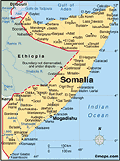
Somalia, situated in the Horn of Africa, lies along the Gulf of Aden and the Indian Ocean. It is bounded by Djibouti in the northwest, Ethiopia in the west, and Kenya in the southwest. In area it is slightly smaller than Texas. Generally arid and barren, Somalia has two chief rivers, the Shebelle and the Juba.
Government
Between Jan. 1991 and Aug. 2000, Somalia had no working government. A fragile parliamentary government was formed in 2000, but it expired in 2003 without establishing control of the country. In 2004, a new transitional parliament was instituted and elected a president.
History
From the 7th to the 10th century, Arab and Persian trading posts were established along the coast of present-day Somalia. Nomadic tribes occupied the interior, occasionally pushing into Ethiopian territory. In the 16th century, Turkish rule extended to the northern coast, and the sultans of Zanzibar gained control in the south.
After British occupation of Aden in 1839, the Somali coast became its source of food. The French established a coal-mining station in 1862 at the site of Djibouti, and the Italians planted a settlement in Eritrea. Egypt, which for a time claimed Turkish rights in the area, was succeeded by Britain. By 1920, a British and an Italian protectorate occupied what is now Somalia. The British ruled the entire area after 1941, with Italy returning in 1950 to serve as United Nations trustee for its former territory.
By 1960, Britain and Italy granted independence to their respective sectors, enabling the two to join as the Republic of Somalia on July 1, 1960. Somalia broke diplomatic relations with Britain in 1963 when the British granted the Somali-populated Northern Frontier District of Kenya to the Republic of Kenya.
On Oct. 15, 1969, President Abdi Rashid Ali Shermarke was assassinated and the army seized power. Maj. Gen. Mohamed Siad Barre, as president of a renamed Somali Democratic Republic, leaned heavily toward the USSR. In 1977, Somalia openly backed rebels in the easternmost area of Ethiopia, the Ogaden Desert, which had been seized by Ethiopia at the turn of the century. Somalia acknowledged defeat in an eight-month war against the Ethiopians that year, having lost much of its 32,000-man army and most of its tanks and planes. President Siad Barre fled the country in late Jan. 1991. His departure left Somalia in the hands of a number of clan-based guerrilla groups, none of which trusted each other.
Drought, Civil War and Anarchy
Africa's worst drought of the century occurred in 1992, and, coupled with the devastation of civil war, Somalia was plunged into a severe famine that killed 300,000. U.S. troops were sent in to protect the delivery of food in Dec. 1992, and in May 1993 the UN took control of the relief efforts from the U.S. The warlord Mohamed Farah Aidid ambushed UN troops and dragged American bodies through the streets, causing an about-face in U.S. willingness to involve itself in the fate of this lawless country. The last of the U.S. troops departed in late March, leaving 19,000 UN troops behind.
Since 1991 Somalia has been engulfed in anarchy. Years of peace negotiations between the various factions were fruitless, and warlords and militias ruled over individual swaths of land. In 1991, a breakaway nation, the Somaliland Republic, proclaimed its independence. Since then several warlords have set up their own ministates in Puntland and Jubaland. Although internationally unrecognized, these states have been peaceful and stable.
In Aug. 2000, a parliament convened in nearby Djibouti and elected Somalia's first government in nearly a decade. After its first year in office, the government still controlled only 10% of the country, and in Aug. 2003, its mandate expired. In Oct. 2002, new talks to establish a government began; in Aug. 2004 a 275-member transitional parliament was inaugurated for a five-year term. Parliament selected a national president in September, Abdullahi Yusuf Ahmed, the president of the breakaway region of Puntland. The new government, however, spent its first year operating out of Kenya—Somalia remained too violent and unstable to enter—eventually settling in the provincial town of Baidoa.
In May 2006, the country's worst outbreak of violence in 10 years began, with Islamist militias, called the Somali Islamic Courts Council (SICC), battling rival warlords. On June 6, the Islamist militia seized control of the capital, Mogadishu, and established control in much of the south. Somalia's transitional government, led by President Abdullahi Yusuf and situated in Baidoa, spent months engaged in unsuccessful peace negotiations with the Islamic Courts Council. In the meantime, neighboring Ethiopia, which has clashed in the past with Somalia's Islamists and considers them a threat to regional security, began amassing troops on the border. In mid-December, Ethiopia launched air strikes against the Islamists, and in a matter of days Ethiopian ground troops and Somali soldiers loyal to the transitional government regained control of Mogadishu. A week later most of the Islamists had been forced to flee the country. Ethiopia announced that its troops would remain in the country until stability was assured and a functional central government had been established, ending Somalia's 15 years of anarchy.
The U.S. and UN Intervene as Islamist Groups Gain Power
In Jan. 2007, the U.S. launched airstrikes on the retreating Islamists, who they believed included three members of al-Qaeda suspected of involvement in the 1998 bombings of the American embassies in Nairobi and Dar es Salaam. The air strikes were strongly criticized in a number of Muslim countries, which accused the Americans of killing Somali civilians. Battles between the insurgents and Somali and Ethiopian troops intensified in March, leaving 300 civilians dead in what has been called the worst fighting in 15 years. The fighting created a humanitarian crisis, with more than 320,000 Somalis fleeing the fighting in Mogadishu in just two months. In July, a national reconciliation conference opened in Mogadishu but was quickly postponed when leading opposition figures failed to appear. The fighting intensified once again in October. The Alliance for the Reliberation of Somalia, a coalition of moderate Islamist leaders, and the transitional government agreed to a cease-fire in June 2008 that called on Ethiopian troops that were propping up the fragile government to be replaced by UN troops. The future of the deal was tenuous from the start and was greeted by much skepticism. Indeed, it was unclear if the UN could assemble a force willing to be deployed to the troubled region, and several powerful Islamist groups did not participate in the negotiations.
Al-Shabab, the militant wing of SICC, began gaining strength in 2007. It allied itself with al-Qaeda and won the support of many local warlords, primarily in the south. The group has raised alarms in the U.S. that its brand of militant Islam would spread throughout eastern Africa and beyond. The group seeks to return Somalia to an Islamist state and has intimidated civilians with stonings, by chopping off hands, and by banning many forms of technology, while continuing to wage war against the transitional government. Al-Shabab has taken advantage of the power vacuum and weak transitional government. By February 2009, the group controlled almost all of southern Somalia.
Prime Minister Ali Muhammad Ghedi resigned in October 2007 after a protracted feud with President Yusuf. He was succeeded by Nur Hassan Hussein.
In October 2008, violence rocked what had been a peaceful region when at least 28 people were killed in five suicide-bombings in northern Somalia. Government officials cast blame on al-Shabab. The highest death toll was in Hargeisa, the capital of the breakaway northern region of Somaliland.
President Yusuf dismissed Prime Minister Nur Hassan Hussein in Dec. 2008, saying Hussein had "failed to accomplish his duties." It was not clear, however, if Yusuf had the authority to make such a move. The following day, Parliament passed, 143-20, a confidence vote in the government of Hussein. Despite the vote, President Yusuf appointed Muhammad Mahmud Guled Gamadhere as prime minister. Guled, resigned, however, saying he did not want to be "seen as a stumbling block to the peace process which is going well now." President Yusuf also resigned in the power struggle. On January 31, 2009, Parliament elected Sheikh Sharif Sheikh Ahmed, a moderate Islamist cleric, as president. Many Somalis greeted the election of Ahmed as an opportunity to move toward peace and end the brutal 18-year war. In February, President Ahmed named Omar Abdirashid Ali Sharmarke as prime minister. Parliament approved the appointment. Observers greeted the appointment with optimism, saying Sharmarke, a former diplomat and the son of Somalia's second civilian president, could help generate support both at home and abroad for the Islamist government.
Amid a growing threat from militant Islamists, Ethiopia began withdrawing troops from Somalia in January 2009.
Al-Shabab Continues to Wreak Havoc
Al-Shabab formally declared allegiance to al-Qaeda in February 2010, sparking further concern that the group posed a global threat. It claimed responsibility for the July bombing at a restaurant in Kampala, Uganda, that killed about 75 people who were watching the final game of the World Cup. The bombing was intended to send a message to countries that have sent troops to support Somalia's transitional government.
Prime Minister Omar Sharmarke, who has been criticized for failing to defeat the Shabab and who has been at odds with President Ahmed, resigned in September 2010. He was succeeded in November by Mohamed Abdullahi Mohamed.
Piracy continued to plague the waters off Somalia and other parts of eastern Africa into 2011. In February, Somalia pirates killed four Americans who were sailing on their yacht in the piracy-laden water off the coast of Somalia.
The summer of 2011 brought drought to a country already laid low by nearly constant conflict, resulting in a UN-declared famine in two regions in southern Somalia. With tens of thousands of Somalis dead of malnutrition and its related causes and ten million more at risk, those who could, fled, trying to reach neighboring Kenya and Ethiopia for help. According to a report released by the Famine Early Warning System Network (FEWS NET) and the United Nations Food and Agriculture Organizationin in April 2013, about 260,000 died in the famine—more than half under age 6. The figure is double early estimates. The report cites the delayed response by donor nations and the Shabab for not allowing the delivery of aid the affected areas.
In June, Prime Minister Mohamed Abdullahi Mohamed resigned; Abdiweli Mohamed Ali became acting prime minister and was approved by parliament and sworn in on June 28, 2011.
Long-awaited Parliament Marks Fresh Start
After more than 20 years and 17 attempts at forming a internationally recognized central government, the Somali parliament held its inaugural session on Aug. 20, 2012. Rife with disorganization, corruption, and concerns for the safety of the participants, the swearing in took place at the airport in Mogadishu and was watched over by African Union troops. This landmark occasion was followed by the election of former labour minister Mohamed Osman Jawa as speaker on Aug. 28.
In September, parliament elected Hassan Sheikh Mohamud, an advocate for civil rights, as president. He prevailed over incumbent Sharif Sheikh Ahmed in the second round of voting. Many observers expressed hope and optimism that Hassan, who is considered above corruption, would set the country on a path torward stability. Just two days after he became president, he survived an assassination attempt by a member of the militant group Shabab.
Shabab was dealt a severe blow in Sept. 2012 when several hundred Kenyan troops, with the help of Somalis, took over Somalia's port city of Kismayu in an amphibious assault. The incursion followed several weeks of air and naval assaults by Kenya on key Shabab positions in Kismayu. The city was the last Shabab stronghold, and the militant group used the port to bring in weapons and raise money by charging hefty import fees. Outmatched militarily, the Shabab withdrew from Kismayu, but said they would take their fight underground, saying Kismayu will "be transformed from a peaceful city governed by Islamic Shariah into a battle zone."
In Oct. 2012, President Hassan Sheikh Mohamud appointed Abdi Farah Shirdon, a businessman who had once worked as an economist for the Somali government, as prime minister. Parliament approved the appointment 215–0. In January 2013, the U.S. formally recognized the Somali government for the first time since 1991.
Militants Terrorize Mall in Nairobi, Kenya
Shabab militants attacked an upscale mall in Nairobi, Kenya, beginning on Sept. 21, 2013, killing nearly 70 people and wounding about 175. The siege lasted for four days, with persistent fighting between government troops and militants. The attack was meticulously planned, and the militants proved to be challenging for the government to dislodge from the Westgate mall. Shabab said the attack was in retaliation for the Kenyan military's presence in Somalia.
Days after the siege ended, U.S. Navy SEALs stormed a villa in Somalia in pursuit of an Al Shabab leader who goes by the name Ikrimah. The commandos were met with strong resistance and engaged in a gun battle with militants before retreating without capturing or killing Ikrimah. U.S. officials did not link Ikrimah to the attack in Nairobi, but did say he is one of the militants in charge of planning attacks outside Somalia and that he was connected to members of Al Qaeda who masterminded the 1998 attack on the American Embassy in Nairobi, Kenya.
Leaders of al-Shabab Killed by American Airstrikes
The U.S. launched airstrikes south of the capital, Mogadishu, in early September 2014, targeting the leader of the Islamist militant group al-Shabab, Ahmed Abdi Godane. Days after the attacks, the U.S. confirmed that Godane had been killed. One of the most wanted men in Africa, Godane was believed by officials to have planned and organized the mall attack in Nairobi in 2013. African Union and Somali troops have made significant progress over the past few years in dislodging al-Shabab from Mogadishu and other strongholds. Ahmad Umar Abu Ubaidah, a cousin of Godane, assumed leadership of the Shabab. In December, another U.S. airstrike killed al-Shabab's intelligence chief, Tahlil Abdishakur. He oversaw the unit that organized suicide attacks in Somalia and Kenya. Tahlil had only been on the job for a few days, having replaced Zakariya Ahmed Ismail Hersi, who surrendered to government officials.
See also Encyclopedia: Somalia .
U.S. State Dept. Country Notes: Somalia