Senegal | Facts & Information

- Senegal Profile
- History
- News and Current Events
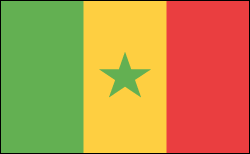
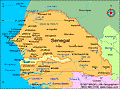
Facts & Figures
-
Republic of Senegal
President: Macky Sall (2012)
Prime Minister: Mohamed Dionne (2014)
Land area: 74,131 sq mi (191,999 sq km); total area: 75,749 sq mi (196,190 sq km)
Population (2014 est.): 13,635,927 (growth rate: 2.48%); birth rate: 35.09/1000; infant mortality rate: 52.72/1000; life expectancy: 60.95; density per sq mi: 169.1
Capital and largest city (2011 est.): Dakar, 3.035 million
Monetary unit: CFA Franc
National name: République du Sénegal
Languages: French (official); Wolof, Pulaar, Jola, Mandinka
Ethnicity/race: Wolof 43.3%, Pular 23.8%, Serer 14.7%, Jola 3.7%, Mandinka 3%, Soninke 1.1%, European and Lebanese 1%, other 9.4%
Religions: Islam 94%, Christian 5% (mostly Roman Catholic), indigenous 1%
Literacy rate: 49.7% (2009 est.)
Economic summary: GDP/PPP (2013 est.): $27.72 billion; per capita $2,100. Real growth rate: 4%. Inflation: 0.8%. Unemployment: 48% (2007 est.). Arable land: 19.57%. Agriculture: peanuts, millet, corn, sorghum, rice, cotton, tomatoes, green vegetables; cattle, poultry, pigs; fish. Labor force: 6.096 million (2013 est.); agriculture 77.5%, industry and services 22.5% (2007 est.). Industries: agricultural and fish processing, phosphate mining, fertilizer production, petroleum refining; iron ore, zircon, and gold mining, construction materials, ship construction and repair. Natural resources: fish, phosphates, iron ore. Exports: $2.691 billion (2013 est.): fish, groundnuts (peanuts), petroleum products, phosphates, cotton. Imports: $5.61 billion (2013 est.): foods and beverages, capital goods, fuels. Major trading partners: India, Mali, France, Nigeria, UK, China, Switzerland, Guinea (2012).
Communications: Telephones: main lines in use: 338,200 (2012); mobile cellular: 11.47 million (2012). Radio broadcast stations: AM 8, FM 20, shortwave 1 (2007). Radios: 1.24 million (1997). Television broadcast stations: 1 (1997). Televisions: 361,000 (1997). Internet Service Providers (ISPs): 237 (2012). Internet users: 1.818 million (2009).
Transportation: Railways: total: 906 km (2008). Highways: total: 14,008 km; paved: 4,099 km; unpaved: 9,909 km (2003). Waterways: 1,000 km total; 785 km on the Senegal river, and 112 km on the Saloum river. Ports and harbors: Dakar, Kaolack, Matam, Podor, Richard Toll, Saint-Louis, Ziguinchor. Airports: 20 (2013).
International disputes: The Gambia and Guinea-Bissau attempt to stem separatist violence, cross border raids, and arms smuggling into their countries from southern Senegal's Casamance region.
Trending
Here are the facts and trivia that people are buzzing about.