Geography
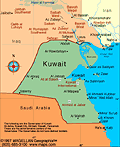
Kuwait is situated northeast of Saudi Arabia at the northern end of the Persian Gulf, south of Iraq. It is slightly larger than Hawaii. The low-lying desert land is mainly sandy and barren.
Government
Kuwait is a constitutional monarchy, governed by the al-Sabah family.
History
Kuwait is believed to have been part of an early civilization in the 3rd millennium B.C. and to have traded with Mesopotamian cities. Archeological and historical traces disappeared around the first millennium B.C. At the beginning of the 18th century, the 'Anizah tribe of central Arabia founded Kuwait City, which became an autonomous sheikdom by 1756. 'Abd Rahim of the al-Sabah became the first sheik, and his descendants continue to rule Kuwait today. In the late 18th and early 19th centuries, the sheikdom belonged to the fringes of the Ottoman Empire. Kuwait obtained British protection in 1897 when the sheik feared that the Turks would expand their hold over the area. In 1961, Britain ended the protectorate, giving Kuwait independence, but agreed to give military aid on request. Iraq immediately threatened to occupy the area, and the British sent troops to defend Kuwait. Soon afterward, the Arab League sent in troops, replacing the British. Iraq's claim was dropped when the Arab League recognized Kuwait's independence on July 20, 1961. Historically, Kuwait followed a neutral and mediatory policy among Arab states.
Citizenry Benefits from Oil Wealth
Oil was discovered in Kuwait in the 1930s, and proved to have 20% of the world's known oil resources. Since 1946 it has been the world's second-largest oil exporter. The sheik, who receives half of the profits, devotes most of them to the education, welfare, and modernization of his kingdom. In 1966, Sheik Sabah designated a relative, Jaber al-Ahmad al-Sabah, as his successor. By 1968, the sheikdom had established a model welfare state, and it sought to establish dominance among the sheikdoms and emirates of the Persian Gulf.
Iraq Invades Kuwait
In July 1990, Iraqi president Saddam Hussein blamed Kuwait for falling oil prices. After a failed Arab mediation attempt to solve the dispute peacefully, Iraq invaded Kuwait on Aug. 2, 1990, set up a pro-Iraqi provisional government, and drained Kuwait of its economic resources. A coalition of Arab and Western military forces drove Iraqi troops from Kuwait in a mere four days, from Feb. 23–27, 1991, ending the Persian Gulf War. The emir returned to his country from Saudi Arabia in mid-March. Martial law, in effect since the end of the Gulf War, ended in late June. The U.S. sent 2,400 troops to the country in Aug. 1992, ostensibly as part of a training exercise, though it was widely interpreted as a show of strength to Saddam Hussein. Iraqi “training” maneuvers near the Kuwaiti border in Oct. 1994 renewed fears of aggression in the country. A Kuwaiti appeal brought the quick deployment of U.S. and British troops and equipment.
Women Win Suffrage in Kuwait
In 1999, the emir gave women the right to vote and run for parliament, but later that year Parliament defeated the ruler's decree. Kuwaiti society has grown increasingly conservative under the influence of Islamic fundamentalists. In 2003, traditionalists won a sweeping victory in parliamentary elections. The emir and crown prince (who served as prime minister) were elderly and ailing; in July 2003, the country's de facto leader, foreign minister Sheik Sabah, replaced the crown prince as prime minister.
In May 2005, Kuwait abandoned its 1999 ban on women's suffrage, and in June a woman was appointed to the cabinet. In April 2006, women voted for the first time.
In Jan. 2006, the emir, Sheik Jabir, died. His cousin, Crown Prince Sheik Saad, briefly became the nation's ruler, but he was forced to abdicate because of extreme ill health. The prime minister, Sheik Sabah, was then nominated and unanimously confirmed by Parliament as emir. Sheik Sabah named his brother, Sheik Nawaf, as crown prince, and his nephew, Sheik Nasser, as prime minister.
Prime Minister Sheik Nasser Muhammad al-Ahmad al-Sabah dissolved the opposition-led parliament in March 2008 and called for new elections. In May's parliamentary elections, radical Islamists took more than half of the body's 50 seats. No women were elected to Parliament. Prime Minister Sabah and his cabinet resigned in November in a dispute with Parliament over the visit to Kuwait by a controversial Iranian cleric. The emir reappointed Sabah in December, and he formed a new government in Jan. 2009, composed largely of previous cabinet members.
Women Continue to Make Inroads
In May 2009, three women are elected to parliament, becoming Kuwait's first female MPs. In October, court rulings further expand the rights of women, allowing them to get passports without the approval of their husbands and not requiring women MPs to wear Islamic headscarves.
In March 2011, the cabinet of Prime Minister al-Sabah resigned. Two months later, Emir Sheik Sabah approved a new government, which included six new ministers.
In June 2012, the emir accepted the resignation of the government of Prime Minister Sheik Jabir Mubarak al-Hamad al-Sabah, and on July 5, he reappointed Sheik Jabir as prime minister. Two weeks later, the cabinet was announced; the only change was Nayef al-Hajraf as finance minister.
Opposition Boycotts Parliamentary Elections
The opposition boycotted parliamentary elections on December 1, 2012, claiming changes to voting laws prevented candidates from forming alliances. The boycott caused voter turnout to be only 39.7%. Two days later, Emir Sheik Sabah accepted Prime Minister al-Sabah's resignation. However, by December 5, 2012, Emir Sheik Sabah asked al-Sabah to put together a new government. A week later, al-Sabah announced a new cabinet, but the only major change was Mustafa al-Shamali as minister of finance.
After the elections on December 1, 2012, protesters gathered almost daily to voice their dissatisfaction. Emir Sheik Sabah denounced the protesters as anti-government factions. In a speech to welcome Prime Minister al-Sabah's new cabinet, Emir Sheik Sabah said, "We will not tolerate attempts from anyone to tear apart the unity of the nation."
The country's Constitutional Court dissolved parliament in June 2013 and ordered new elections, which were held under the laws denounced by the opposition. The election were held in July, and liberals, Islamists, and members of tribal groups fared well, while Shiites lost about half of their seats. Turnout was 52.5%, significantly higher than in the previous election.
Islamic Militants Attack Mosque
In an attempt to stop Houthi rebels from advancing further in Yemen, Saudi Arabia led a coalition of Arab states in an offensive on Houthi targets in late March 2015. Kuwait participated in the campaign.
A suicide bomber claiming to be connected to the Islamic State attacked a Shiite mosque in the capital of Kuwait City in June 2015, killing 27 people and injuring several hundred.
See also Encyclopedia: Kuwait
U.S. State Dept. Country Notes: Kuwait