Korea, South | Facts & Information

- Korea, South Profile
- History
- News and Current Events
Infoplease has everything you need to know about Korea, South. Check out our country profile, full of essential information about Korea, South's geography, history, government, economy, population, culture, religion and languages. If that's not enough, click over to our collection of world maps and flags.
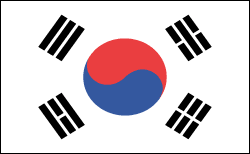
Facts & Figures
Geography
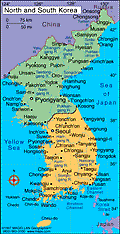
Slightly larger than Indiana, South Korea lies below the 38th parallel on the Korean peninsula. It is mountainous in the east; in the west and south are many harbors on the mainland and offshore islands.
Government
Republic.
History
South Korea came into being after World War II, the result of a 1945 agreement reached by the Allies at the Potsdam Conference, making the 38th parallel the boundary between a northern zone of the Korean peninsula to be occupied by the USSR and southern zone to be controlled by U.S. forces. (For details, see Korea, North. )
Elections were held in the U.S. zone in 1948 for a national assembly, which adopted a republican constitution and elected Syngman Rhee as the nation's president. The new republic was proclaimed on Aug. 15 and was recognized as the legal government of Korea by the UN on Dec. 12, 1948.
U.S., UN Troops Support South Korea
On June 25, 1950, North Korean Communist forces launched a massive surprise attack on South Korea, quickly overrunning the capital, Seoul. U.S. armed intervention was ordered on June 27 by President Harry S. Truman, and on the same day the UN invoked military sanctions against North Korea. Gen. Douglas MacArthur was named commander of the UN forces. U.S. and South Korean troops fought a heroic holding action, but by the first week of August they were forced back to a 4,000-square-mile beachhead in southeast Korea. There they held off superior North Korean forces until Sept. 15, when a major UN amphibious assault was launched deep behind Communist lines at Inchon, the port of Seoul.
By Sept. 30, UN forces were in complete control of South Korea. They then crossed the 38th parallel and pursued retreating Communist forces into North Korea. In late October, as UN forces neared the Sino-Korean border, several hundred thousand Chinese Communist troops entered the conflict, pushing MacArthur's forces back to the border between North and South Korea. By the time truce talks began on July 10, 1951, UN forces had crossed over the parallel again and were driving back into North Korea. Cease-fire negotiations dragged on for two years before an armistice was finally signed at Panmunjom on July 27, 1953, leaving a devastated Korea in need of large-scale rehabilitation. No official peace treaty has ever been signed between the former combatants.
Instability Follows Truce
President Syngman Rhee, after 12 years in office, was forced to resign in 1960 amid rising discontent with his autocratic leadership. Po Sun Yun was elected to succeed him, but political instability persisted. In 1961, Gen. Park Chung Hee seized power and subsequently began a program of economic reforms designed to stimulate the nation's economy. The U.S. stepped up military aid, strengthening South Korea's armed forces to 600,000 men. Park's assassination on Oct. 26, 1979, by Kim Jae Kyu, head of the Korean Central Intelligence Agency, ushered in a liberalizing trend with new president Choi Kyu Hah's freeing of imprisoned dissidents.
The release of opposition leader Kim Dae Jung in Feb. 1980 sparked antigovernment demonstrations that turned into riots, which were brutally suppressed by authorities. Kim, the most visible leader of the opposition, was imprisoned again. Choi resigned on Aug. 16. Chun Doo Hwan, head of a military Special Committee for National Security Measures, was the sole candidate when the electoral college confirmed him as president on Aug. 27. In 1986–1987, South Korea's opposition demanded that the president be selected by direct popular vote. After weeks of protest and rioting, Chun agreed to the demand. A split in the opposition led to Roh Tae Woo's election on Dec. 16, 1987.
In Aug. 1996 Roh was convicted on bribery charges, and Chun was convicted for bribery as well as his role in the 1979 coup and the 1980 crackdown on rioters. In 1997, an accumulation of corrupt business practices and bad loans led to a series of bankruptcies and a massive devaluation of South Korea's currency. The political instability that followed helped former dissident Kim Dae Jung become the first South Korean president ever to be elected from the political opposition.
In 1998, the Asian economic crisis bottomed out in South Korea. The nation began rebounding in 1999, the only sizable Asian economy to do so.
North Korea Tests Sunshine Policy
In June 2000, President Kim Dae Jung met with North Korea's president, Kim Jong Il, in Pyongyang. The summit marked the first-ever meeting of the countries' leaders. Kim Dae Jung won the Nobel Peace Prize in Oct. 2000 for his Sunshine Policy, which included initiating peace and reconciliation with North Korea.
Roh Moo Hyun of the ruling Millennium Democratic Party became president in Feb. 2003 and promptly faced daunting problems. His vow to pursue his predecessor's Sunshine Policy toward North Korea was put to the test as the North continued to taunt the world with boasts about its nuclear capabilities. In addition, many South Koreans had begun to resent U.S. influence over their country. In March 2004, the conservative national assembly voted overwhelmingly to impeach Roh, claiming he had violated election laws. More than 70% of the public, however, condemned the move; the constitutional court dismissed the impeachment in May, and Roh was reinstated as president.
Researchers led by Hwang Woo-suk stunned the world in May 2005, when they announced they had devised a new procedure to produce human stem cell lines from a cloned human embryo. The country's reign as the leader in the field of cloning was brief. In Jan. 2006, a Seoul National University panel reported that Hwang had fabricated evidence for his cloning research. His downfall was a blow to the entire nation. Indeed, he had become a national hero and had received millions in research money from the government.
Series of Leaders Encounter Criticism
Prime Minister Lee Hae Chan resigned under pressure in March 2006, after facing intense criticism for playing golf rather than dealing with a national railway workers' strike. He was replaced by Han Duck Soo.
For the first time in 56 years, trains passed between North and South Korea in May 2007. While the event was mostly symbolic, it was considered an important step toward reconciliation.
In October 2007, President Roh Moo Hyun and North Korean leader Kim Jong Il met for their second ever inter-Korean summit. The leaders forged a deal to work together on several economic projects and agreed to move toward signing a treaty that would formally end the Korean War.
Lee Myung-bak, of the opposition Grand National Party, won December's presidential elections, taking 48.7% of the vote. Chung Dong-yong, who was endorsed by outgoing president Roh Moo-hyun, took 26.1%. Lee had been dogged by allegations of ethical improprieties, and the National Assembly voted two days before the election to reopen an investigation into whether he manipulated the stock of an investment company. In Jan. 2008, he named Han Seung Soo as his prime minister. A special prosecutor cleared Lee of the fraud allegations, and less than a week later he was sworn in as president. Lee said he would work to improve South Korea's economy and forge closer ties with the United States.
In June, just months into his presidency, Lee faced massive protests in Seoul over his decision to resume imports of American beef, which was banned in 2003 after mad cow disease was diagnosed in the U.S. The protests, which took place in Seoul for about six weeks before peaking on June 10, implied overall dissatisfaction with President Lee. Prime Minister Han Seung-soo and all 15 cabinet members submitted their resignations. Three ministers were replaced, but President Lee refused to accept the other resignations. South Korea and the U.S. reached an agreement that said the U.S. would not export beef from cattle under 30 months of age.
Lee's troubles worsened during the global financial crisis that crippled many nations in the fall of 2008. His detractors criticized his response to the turmoil as inconsistent and muddled.
Tension Flares Between North and South Over Sinking of Sub
In March 2010, the South Korean warship Cheonan was sunk in an area of the Yellow Sea that's in dispute with North Korea. Forty-six sailors were killed. South Korea suspected North Korea was responsible and ordered an international investigation so the results of the probe would be perceived as impartial. In May, investigators produced a piece of a torpedo propeller that they believed had a North Korea serial number, evidence, South Korea said, that the North was responsible. South Korea then formally accused North Korea of launching the attack; North Korea denied the accusation and threatened "all out war" if South Korea moved to punish North Korea or retaliate. Tension between the two nations reached a crisis point. South Korea cut trade with North Korea, closed sea lanes, and blasted propaganda at the border through loud speakers.
Prime Minister Chung Un-chan resigned in July 2010 after parliament rejected his plan to move several ministries out of Seoul. At the same time, President Lee reshuffled much of his cabinet. Parliament approved Kim Hwang Sik as prime minister in October.
In March 2012, the four-years-pending free-trade agreement with the U.S. became a reality. South Korea's trade minister looked to the deal to provide an uptick in jobs and increase overall economic health of the country. The agreement was not without its detractors, however; during the vote in the national assembly, an opposition member created chaos by detonating a tear-gas canister.
Rivalry with Japan Intensifies Under Lee
South Korea and Japan were on the verge of signing a military cooperation agreement that would allow the two countries to share military information to better deal with the growing threat posed by North Korea and China's increasing military might, but President Lee backed out of the pact in June 2012 amid an uproar by the opposition and citizens still hostile toward Japan. Then in August, President Lee visited Liancourt Rocks, a pair of islets that are the subject of a long-simmering territorial dispute between South Korea and Japan. Tokyo said the move was "unacceptable," and withdrew its ambassador to South Korea. With his popularity in decline, many observers called the move a political ploy to stir up support and a sense of nationalism.
South Korea Elects First Female President
In December 2012, Park Geun-hye, of the governing Grand National Party, was elected president, becoming the country's first woman to hold the post. She defeated Moon Jae-in, the candidate of the Democratic United Party (DUP). Moon, a former human-rights lawyer, promised to bring change to South Korea and a thaw in relations with North Korea—a resumption of former president Kim Dae Jung's Sunshine Policy, while Park, the daughter of the country's former dictator, ran on a platform of stability. Park also promised to dilute the power of the "chaebol," huge family conglomerates, and close the gaping wealth gap. Despite her father's authoritarianism, he is credited for rebuilding the country's economy after the Korean War.
After two failed attempts in 2009 and 2010, South Korea successfully launched its first satellite into orbit in January 2013—a month after North Korea launched its own satellite. South Korea's satellite will collect and analyze weather data.
President Park's plan to engage North Korea got off to a rocky start. In Feb. 2013, North Korea said it had detonated a nuclear bomb, its third. Another round of UN sanctions followed, as did joint annual military drills by the U.S. and South Korea near the north-south border. Reacting to the sanctions and the exercises, North Korean president Kim Jong-un said he would launch pre-emptive nuclear strike against his country's enemies and said he had voided the 1953 armistice that ended the war between North and South Korea. Kim's threats were mostly dismissed as bluster but were nevertheless the most menacing in years by any leader. He continued his bellicose tone in March and shut down not only Red Cross hotlines between North and South Korea but also military hotlines.
About 360 South Koreans, mostly elderly, traveled to North Korea in Feb. 2014 to meet with relatives from whom they were separated when the Korean Peninsula split after World War II. The reunions, the first since 2010, were part of an effort to improve ties between the North and the South, which have further deteriorated over the status of North Korea's nuclear program.
Government Criticized for Response to Ferry Tragedy
In April 2014, a ferry, the Sewol, carrying 459 people, mostly students, sunk off the southern coast of South Korea. There were 187 confirmed deaths and 115 missing and presumed dead. A majority of the dead and missing were students from Danwon High School, who were on a field trip. The ship's captain, Lee Jun-seok, was not at the helm when the ship began sinking. Instead, the third mate was steering the ship. According to news reports, the crew advised the passengers to remain inside the ship as it continued to list. Lee and 14 other crew members, however, were among the first to escape and boarded Coast Guard boats. They were later charged with accidental homicide.
The Korean government was faulted for its slow and unorganized response to the accident and shoddy enforcement of regulations, and President Park Geun-hye apologized and took responsibility for the tragedy. Prime Minister Chung Hong Won resigned over the tragedy but will remain in office until the rescue effort is complete. Lee Jun-seok was sentenced to 36 years in prison in November 2014 for abandoning the passengers on board. He was found not guilty of murder.
On Feb. 16, 2015, Chung Hong Won was officially replaced by Lee Wan-koo as the new prime minister. The Saenuri Party's floor leader, Lee Wan-koo previously served three terms in parliament and was governor of South Chungcheong Province.
China, South Korea, and Japan Hold First Foreign Minister Talks in Three Years
In March 2015, foreign ministers from China, South Korea, and Japan met for the first formal talks since April 2012. South Korean Foreign Minister Yoon Byung-Se hosted Chinese Foreign Minister Wang Yi and Japanese Foreign Minister Fumio Kishida in Seoul. The three met in an attempt to calm tensions and improve relations. The tension between the countries has revolved around an ongoing dispute between China and Japan over island territories in the East China Sea. However, relations between all three countries have been strained for years, going back to Japan's occupation of sections of China before and during World War II as well as its colonization of Korea.
The March 2015 meeting included a discussion of a possible future summit between the three countries' leaders. Another topic of discussion was how to contain North Korea's nuclear ambitions, a matter that all three foreign ministers agreed was a priority.
Corruption Allegations and Scandal Rock Korean Government
Prime Minister Lee Wan-koo resigned in April 2015 amid a corruption scandal. He was accused of taking about $27,700 in illegal donations from a businessman, Sung Wan-jong. Sung killed himself shortly before he was to face corruption charges. He left behind a note and a taped interview with a journalist detailing cash he had given to Lee and other political figures.
President Park accepted the resignation and ordered an inquiry into the scandal. Sung had only been in office since February. On May 21, 2015, President Park named Minister of Justice Hwang Kyo-ahn as the new prime minister. Parliament confirmed Hwang Kyo-ahn the following month by a vote of 156-120.
Not long after, scandal broke as news spread about President Park's aide Choi Soon-sil. Choi, who held no official office, was accused of leveraging funds from businesses to support foundations in which she held stakes. Additionally, Choi was charged with interfering in matters of policy, and editing the president's speeches. Choi was arrested, and Park impeached. Following Park Geun-hye's impeachment and conviction, her conservative party lost significant ground. In the following election the Democrat Moon Jae-in was elected president.
See also Encyclopedia: Korea .
U.S. State Dept. Country Notes: South Korea
National Statistical Office www.nso.go.kr/ .