Geography
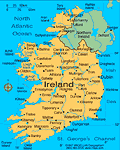
Ireland is situated in the Atlantic Ocean and separated from Great Britain by the Irish Sea. Half the size of Arkansas, it occupies the entire island except for the six counties that make up Northern Ireland. Ireland resembles a basin—a central plain rimmed with mountains, except in the Dublin region. The mountains are low, with the highest peak, Carrantuohill in County Kerry, rising to 3,415 ft (1,041 m). The principal river is the Shannon, which begins in the north-central area, flows south and southwest for about 240 mi (386 km), and empties into the Atlantic.
Government
Republic.
History
In the Stone and Bronze Ages, Ireland was inhabited by Picts in the north and a people called the Erainn in the south, the same stock, apparently, as in all the isles before the Anglo-Saxon invasion of Britain. Around the 4th century B.C., tall, red-haired Celts arrived from Gaul or Galicia. They subdued and assimilated the inhabitants and established a Gaelic civilization. By the beginning of the Christian Era, Ireland was divided into five kingdoms—Ulster, Connacht, Leinster, Meath, and Munster. Saint Patrick introduced Christianity in 432, and the country developed into a center of Gaelic and Latin learning. Irish monasteries, the equivalent of universities, attracted intellectuals as well as the pious and sent out missionaries to many parts of Europe and, some believe, to North America.
Norse incursions along the coasts, starting in 795, ended in 1014 with Norse defeat at the Battle of Clontarf by forces under Brian Boru. In the 12th century, the pope gave all of Ireland to the English Crown as a papal fief. In 1171, Henry II of England was acknowledged “Lord of Ireland,” but local sectional rule continued for centuries, and English control over the whole island was not reasonably secure until the 17th century. In the Battle of the Boyne (1690), the Catholic King James II and his French supporters were defeated by the Protestant King William III (of Orange). An era of Protestant political and economic supremacy began.
By the Act of Union (1801), Great Britain and Ireland became the “United Kingdom of Great Britain and Ireland.” A steady decline in the Irish economy followed in the next decades. The population had reached 8.25 million when the great potato famine of 1846–1848 took many lives and drove more than 2 million people to immigrate to North America.
Partition of Ireland Sets Off Civil War
Anti-British agitation, along with demands for Irish home rule, led to the Easter Rebellion in Dublin (April 24–29, 1916), in which Irish nationalists unsuccessfully attempted to throw off British rule. Guerrilla warfare against British forces followed proclamation of a republic by the rebels in 1919. The Irish Free State was established as a dominion on Dec. 6, 1922, with six northern counties remaining as part of the United Kingdom. A civil war ensued between those supporting the Anglo-Irish Treaty that established the Irish Free State and those repudiating it because it led to the partitioning of the island. The Irish Republican Army (IRA), led by Eamon de Valera, fought against the partition, but lost. De Valera joined the government in 1927 and became prime minister in 1932. In 1937, a new constitution changed the nation's name to Éire. Ireland remained neutral in World War II.
In 1948, De Valera was defeated by John A. Costello, who demanded final independence from Britain. The Republic of Ireland was proclaimed on April 18, 1949, and withdrew from the Commonwealth. From the 1960s onward two antagonistic currents dominated Irish politics. One sought to bind the wounds of the rebellion and civil war. The other was the effort of the outlawed Irish Republican Army and more moderate groups to bring Northern Ireland into the republic. The “troubles”—the violence and terrorist acts between Republicans and Unionists in both the Republic of Ireland and Northern Ireland—would plague the island for the remainder of the century and beyond.
Ireland's First Woman President Heralds Social Change
Under the First Programme for Economic Expansion (1958–1963), economic protection was dismantled and foreign investment encouraged. This prosperity brought profound social and cultural changes to what had been one of the poorest and least technologically advanced countries in Europe. Ireland joined the European Economic Community (now the EU) in 1973. In the 1990 presidential election, Mary Robinson was elected the republic's first woman president. The election of a candidate with socialist and feminist sympathies was regarded as a watershed in Irish political life, reflecting the changes taking place in Irish society. Irish voters approved the Maastricht Treaty, which paved the way for the establishment of the EU, by a large majority in a referendum held in 1992. In 1993, the Irish and British governments signed a joint peace initiative (the Downing Street Declaration), which affirmed Northern Ireland's right to self-determination. A referendum on allowing divorce under certain conditions—hitherto constitutionally forbidden—was narrowly passed in Nov. 1995.
Northern Ireland Commits to Peace with Good Friday Agreement
In 1998, hope for a solution to the troubles in Northern Ireland seemed palpable. A landmark settlement, the Good Friday Agreement of April 10, 1998, called for Protestants to share political power with the minority Catholics and gave the Republic of Ireland a voice in the affairs of Northern Ireland. The resounding commitment to the settlement was demonstrated in a dual referendum on May 22: the North approved the accord by a vote of 71% to 29%, and in the Irish Republic 94% favored it. After numerous stops and starts, the new government in Northern Ireland was formed on Dec. 2, 2000, but it was suspended several times primarily because of Sinn Fein's reluctance to disarm its military wing, the IRA. In 2005, however, the IRA renounced armed struggle, and peace again seemed possible.
Shortly after parliamentary elections in March 2007, Gerry Adams, the leader of Sinn Fein, and Rev. Ian Paisley, the head of the Democratic Unionist Party, met face to face for the first time and hashed out an agreement for a power-sharing government. The historic deal was put into place in May, when Paisley and McGuinness were sworn in as leader and deputy leader, respectively, of the Northern Ireland executive government, thus ending direct rule from London.
Ireland Becomes Economic Powerhouse
Despite a number of recent corruption and bribery scandals, most of which involved the centrist Fianna Fáil Party of Prime Minister Bertie Ahern, the party won 81 of 166 seats in May 2002. Ahern became the first Irish prime minister in 33 years to be elected to a second successive term.
Once a country plagued with high unemployment, high inflation, slow growth, and a large public debt, Ireland has undergone an extraordinary economic transformation in the last 15 years. Formerly an agriculture-based economy, the “Celtic Tiger” has become a leader in high-tech industries. In recent years its economy has grown as much as 10%, and its population for decades diminished by emigration has seen a boom sparked by immigration and fewer people feeling the need to leave the island for better opportunities.
On April 2, 2008, in the midst of corruption accusations, Prime Minister Bertie Ahern announced his resignation. He was succeeded by former finance minister Brian Cowen.
On June 13, 2008, Ireland, the only country in the 27-member EU that put the Lisbon Treaty to a popular vote, rejected the new treaty, jeopardizing the future of the pact that would have strengthened the EU’s influence in global politics. Ireland changed course in October 2009, approving the treaty.
Global Financial Crisis Hits Ireland
Ireland slipped into recession in the global financial crisis of 2008. Unemployment hit 11% in February 2009, the highest rate in 13 years. The financial situation continued to deteriorate in 2009, and the government responded by implementing unpopular spending cuts and tax increases. By the end of 2009, Ireland's economy contracted by 10%. The economic malaise was largely due to a housing bubble that burst, which in turn saddled banks with bad loans, causing the financial sector to nearly collapse under the weight of the bad debt. Indeed, the Celtic Tiger suffered endured a stunning reversal of fortune.
In November 2010, Ireland sought and received a $113 billion (85 billion euro) bailout package from the European Union and the International Monetary Fund to shore up its banks. The rescue took its toll on Prime Minister Cowen, who rejected demands to call for new elections, opting instead to set them for 2011 after a new budget is passed.
On January 22, 2011, Prime Minister Cowen resigned as leader of his party, Fianna Fáil. The next day, the Green Party withdrew from the government coalition, leaving Cowen as the head of a minority government. Finance Minister Brian Lenihan met with delegations from the Fine Gael, Labour, and the Green parties to accelerate passage of a new budget, allowing for general elections earlier than planned. Cowen announced that he was retiring from politics. The general elections were held on February 25 and voters threw out the Fianna Fáil-led government. On March 9, Enda Kenny, of the Fine Gael party, was sworn in as the new prime minister. Kenny promised to secure a better deal from the European Union on Ireland's bail-out.
Michael D. Higgins, a leftist politician and poet, was elected president in October. A veteran politician, Higgins has represented the Labour Party in both houses of Parliament and served as minister of the arts.
Historic Vote Legalizes Same-Sex Marriage
On May 22, 2015, Ireland became the first country to legalize same-sex marriage in a national referendum. Turnout for the vote was 60.5%. Of those who voted, 62.1% chose in favor of changing the country's constitution to allow same-sex marriage.
The vote came 22 years after Ireland decriminalized homosexuality. The referendum's result showed how quickly the historically conservative country has changed. Of the outcome, Prime Minister Enda Kenny said, "With today's vote we have disclosed who we are: a generous, compassionate, bold and joyful people."
See also Northern Ireland, under United Kingdom .
See also Encyclopedia: Ireland .
U.S. State Dept. Country Notes: Ireland
Central Statistics Office www.cso.ie/ .