Iraq | Facts & Information

- Iraq Profile
- History
- News and Current Events
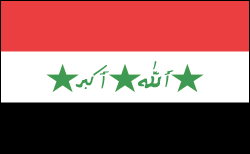
Facts & Figures
-
President: Fouad Massoum (2014)
Prime Minister: Haider al-Abadi (2014)
Land area: 167,556 sq mi (433,970 sq km)
Population (2014 est.): 32,585,692 (growth rate: 2.23%); birth rate: 26.85/1000; infant mortality rate: 37.53/1000; life expectancy: 71.42
Capital and largest city (2011 est.): Baghdad, 6.036 million
Largest cities: Mosul 1.494 million; Erbil 1.039 million; Basra 942,000; As Sulaymaniyah 867,000; Najaf 779,000
Monetary unit: U.S. dollar
National name: Al Jumhuriyah al Iraqiyah
Languages: Arabic (official), Kurdish (official), Turkmen (a Turkish dialect) and Assyrian (Neo-Aramaic) are official in areas where they constitute a majority of the population), Armenian
Ethnicity/race: Arab 75%–80%, Kurdish 15%–20%, Turkoman, Assyrian, or other 5%
Religions: Muslim (official) 99% (Shia 60%-65%, Sunni 32%-37%), Christian 0.8%, Hindu <.1, Buddhist <.1, Jewish <.1, folk religion <.1, unafilliated .1, other <.1
note: while there has been voluntary relocation of many Christian families to northern Iraq, recent reporting indicates that the overall Christian population may have dropped by as much as 50% since the fall of the Saddam HUSSEIN regime in 2003, with many fleeing to Syria, Jordan, and Lebanon (2010 est.)National Holiday: Revolution Day, July 17
Literacy rate: 78.5% (2010 est.)
Economic summary: GDP/PPP (2013 est.): $249.4 billion; per capita $7,100. Real growth rate: 4.2%. Inflation: 2%. Unemployment: 16%. Arable land: 9.19%. Agriculture: wheat, barley, rice, vegetables, dates, cotton; cattle, sheep, poultry. Labor force: 8.9 million; agriculture 21.6%., industry 18.7%, services 59.8%. Industries: petroleum, chemicals, textiles, leather, construction materials, food processing, fertilizer, metal fabrication/processing. Natural resources: petroleum, natural gas, phosphates, sulfur. Exports: $91.99 billion (2013): crude oil (84%), crude materials excluding fuels, food and live animals. Imports: $66.61 billion (2013): food, medicine, manufactures. Major trading partners: U.S., Syria, Turkey, India, China, South Korea, Canada, Spain, Italy (2012).
Communications: Telephones: main lines in use: 1.87 million (2009); mobile cellular: 26.76 million (2009). Broadcast media: the number of private radio and TV stations has increased rapidly since 2003; government-owned TV and radio stations are operated by the publicly-funded Iraqi Public Broadcasting Service; private broadcast media are mostly linked to political, ethnic, or religious groups; satellite TV is available to an estimated 70% of viewers and many of the broadcasters are based abroad; transmissions of multiple international radio broadcasters are accessible (2007). Internet hosts: 26 (2012). Internet users: 325,900 (2009).
Transportation: Railways: total: 2,370 km (2006). Highways: total: 59,623 km; paved: 59,623 km (2012). Waterways: 5,279 km (not all navigable); note: Euphrates River (2,815 km), Tigris River (1,895 km), and Third River (565 km) are principal waterways (2006). Ports and harbors: Al Basrah, Khawr az Zubayr, Umm Qasr. Airports: 102 (2013).
International disputes: Iraq's lack of a maritime boundary with Iran prompts jurisdiction disputes beyond the mouth of the Shatt al Arab in the Persian Gulf; Turkey has expressed concern over the autonomous status of Kurds in Iraq.
Geography
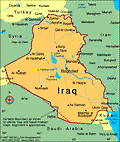
Iraq, a triangle of mountains, desert, and fertile river valley, is bounded on the east by Iran, on the north by Turkey, on the west by Syria and Jordan, and on the south by Saudi Arabia and Kuwait. It is twice the size of Idaho. The country has arid desert land west of the Euphrates, a broad central valley between the Euphrates and the Tigris, and mountains in the northeast.
Government
The dictatorship of Saddam Hussein collapsed on April 9, 2003, after U.S. and British forces invaded the country. Sovereignty was returned to Iraq on June 28, 2004.
History
From earliest times Iraq was known as Mesopotamia—the land between the rivers—for it embraces a large part of the alluvial plains of the Tigris and Euphrates rivers.
An advanced civilization existed in this area by 4000 B.C. Sometime after 2000 B.C., the land became the center of the ancient Babylonian and Assyrian empires. Mesopotamia was conquered by Cyrus the Great of Persia in 538 B.C. and by Alexander in 331 B.C. After an Arab conquest in 637–640, Baghdad became the capital of the ruling caliphate. The country was pillaged by the Mongols in 1258, and during the 16th, 17th, and 18th centuries was the object of Turkish and Persian competition.
Iraq Gains Independence
Nominal Turkish suzerainty imposed in 1638 was replaced by direct Turkish rule in 1831. In World War I, Britain occupied most of Mesopotamia and was given a mandate over the area in 1920. The British renamed the area Iraq and recognized it as a kingdom in 1922. In 1932, the monarchy achieved full independence. Britain again occupied Iraq during World War II because of its pro-Axis stance in the initial years of the war.
Iraq became a charter member of the Arab League in 1945, and Iraqi troops took part in the Arab invasion of Palestine in 1948.
At age 3, King Faisal II succeeded his father, Ghazi I, who was killed in an automobile accident in 1939. Faisal and his uncle, Crown Prince Abdul-Illah, were assassinated in July 1958 in a coup that ended the monarchy and brought to power a military junta headed by Abdul Karem Kassim. Kassim reversed the monarchy's pro-Western policies, attempted to rectify the economic disparities between rich and poor, and began to form alliances with Communist countries.
Rise of the Baath Party
Kassim was overthrown and killed in a coup staged on March 8, 1963, by the military and the Baath Socialist Party. The Baath Party advocated secularism, pan-Arabism, and socialism. The following year, the new leader, Abdel Salam Arif, consolidated his power by driving out the Baath Party. He adopted a new constitution in 1964. In 1966, he died in a helicopter crash. His brother, Gen. Abdel Rahman Arif, assumed the presidency, crushed the opposition, and won an indefinite extension of his term in 1967.
Arif's regime was ousted in July 1968 by a junta led by Maj. Gen. Ahmed Hassan al-Bakr of the Baath Party. Bakr and his second in command, Saddam Hussein, imposed authoritarian rule in an effort to end the decades of political instability that followed World War II. A leading producer of oil in the world, Iraq used its oil revenues to develop one of the strongest military forces in the region.
Saddam Hussein's Ascendancy Brings Series of Wars
On July 16, 1979, President Bakr was succeeded by Saddam Hussein, whose regime steadily developed an international reputation for repression, human rights abuses, and terrorism.
A long-standing territorial dispute over control of the Shatt-al-Arab waterway between Iraq and Iran broke into full-scale war on Sept. 20, 1980, when Iraq invaded western Iran. The eight-year war cost the lives of an estimated 1.5 million people and finally ended in a UN-brokered cease-fire in 1988. Poison gas was used by both Iran and Iraq.
In July 1990, President Hussein asserted spurious territorial claims on Kuwaiti land. A mediation attempt by Arab leaders failed, and on Aug. 2, 1990, Iraqi troops invaded Kuwait and set up a puppet government. The UN unsuccessfully imposed trade sanctions against Iraq to compel withdrawl. On Jan. 18, 1991, UN forces, under the leadership of U.S. general Norman Schwarzkopf, launched the Gulf War (Operation Desert Storm), liberating Kuwait in less than a week.
The war did little to thwart Iraq's resilient dictator. Rebellions by both Shiites and Kurds, encouraged by the U.S., were brutally crushed. In 1991, the UN set up a northern no-fly zone to protect Iraq's Kurdish population; in 1992 a southern no-fly zone was established as a buffer between Iraq and Kuwait and to protect Shiites.
Beginning in 1990, the UN Security Council imposed sanctions that barred Iraq from selling oil except in exchange for food and medicine. The sanctions against Iraq failed to subdue its leader, instead causing catastrophic suffering among its people—the country's infrastructure was in ruins, and disease, malnutrition, and the infant mortality rate skyrocketed.
The UN weapons inspections team mandated to ascertain that Iraq had destroyed all its nuclear, chemical, biological, and ballistic arms after the war was continually thwarted by Saddam Hussein. In Nov. 1997, he expelled the American members of the UN inspections team, a standoff that stretched on until Feb. 1998. In Aug. 1998, Hussein again put a halt to the inspections. On Dec. 16, the U.S. and Britain began Operation Desert Fox, four days of intensive air strikes. From then on, the U.S. and Britain conducted hundreds of air strikes on Iraqi targets within the no-fly zones. The sustained low-level warfare continued unabated into 2003.
After 9/11, the U.S. Launches War in Iraq
After the Sept. 11, 2001, terrorist attacks, President Bush began calling for a “regime change” in Iraq, describing the nation as part of an “axis of evil.” The alleged existence of weapons of mass destruction, the thwarting of UN weapons inspectors, Iraq's alleged links to terrorism, and Saddam Hussein's despotism and human rights abuses were the major reasons cited for necessitating a preemptive strike against the country. The Arab world and much of Europe condemned the hawkish and unilateral U.S. stance. The UK, however, declared its intention to support the U.S. in military action. On Sept. 12, 2002, Bush addressed the UN, challenging the organization to swiftly enforce its own resolutions against Iraq, or else the U.S. would act on its own. On Nov. 8, the UN Security Council unanimously approved a resolution imposing tough new arms inspections on Iraq. On Nov. 26, new inspections of Iraq's military holdings began.
The UN's formal report at the end of Jan. 2003 was not promising, with chief weapons inspector Hans Blix lamenting that “Iraq appears not to have come to a genuine acceptance, not even today, of the disarmament that was demanded of it.” While the Bush administration felt the report cemented its claim that a military solution was imperative, several permanent members of the UN Security Council—France, Russia, and China—urged that the UN inspectors be given more time to complete their task. Bush and Blair continued to call for war, insisting that they would go ahead with a “coalition of the willing,” if not with UN support. All diplomatic efforts ceased by March 17, when President Bush delivered an ultimatum to Saddam Hussein to leave the country within 48 hours or face war.
On March 20, the war against Iraq began at 5:30 A.M. Baghdad time (9:30 P.M. EST, March 19) with the launch of Operation Iraqi Freedom. By April 9, U.S. forces had taken control of the capital, signaling the collapse of Saddam Hussein's regime. Although the war had been officially declared over on May 1, 2003, Iraq remained enveloped in violence and chaos. Iraqis began protesting almost immediately against the delay in self-rule and the absence of a timetable to end the U.S. occupation. In July, the U.S. administrator for Iraq, Paul Bremer, appointed an Iraqi governing council.
No Evidence of Weapons in Iraq
Months of searching for Iraq's weapons of mass destruction yielded no hard evidence, and both administrations and their intelligence agencies came under fire. There were also mounting allegations that the existence of these weapons was exaggerated or distorted as a pretext to justify the war. In fall 2003, President Bush recast the rationale for war, no longer citing the danger of weapons of mass destruction, but instead describing Iraq as “the central front” in the war against terrorism. A free and democratic Iraq, he contended, would serve as a model for the rest of the Middle East.
Continued instability in 2003 kept 140,000 American troops (at a cost of $4 billion a month), as well as 11,000 British and 10,000 coalition troops in Iraq. The U.S. launched several tough military campaigns to subdue Iraqi resistance, which also had the effect of further alienating the populace. The rising violence prompted the Bush administration to reverse its Iraq policy in Nov. 2003; the transfer of power to an interim government would take place in July 2004, much earlier than originally planned.
After eight months of searching, the U.S. military captured Saddam Hussein on Dec. 13. The deposed leader was found hiding in a hole near his hometown of Tikrit and surrendered without a fight. Found guilty of crimes against humanity for the execution of 148 Shiite men and boys from the town of Dujai, Saddam Hussein was hung in Dc. 2006. He was executed before being tried for innumerable other crimes associated with his rule.
In Jan. 2004, the CIA's chief weapons inspector, David Kay, stated that U.S. intelligence about Iraq's weapons of mass destruction “was almost all wrong.” When the final report on the existence of these weapons in Iraq was issued in Oct. 2004, Kay's successor, Charles Duelfer, confirmed that there was no evidence of an Iraqi weapons production program.
The turmoil and violence in Iraq increased throughout 2004. Civilians, Iraqi security forces, foreign workers, and coalition soldiers were subject to suicide bombings, kidnappings, and beheadings. By April, a number of separate uprisings had spread throughout the Sunni triangle and in the Shiite-dominated south. In September alone there were 2,300 attacks by insurgents. In October, U.S. officials estimated there were between 8,000 and 12,000 hard-core insurgents and more than 20,000 “active sympathizers.” Loosely divided into Baathists, nationalists, and Islamists, all but about 1,000 were thought to be indigenous fighters.
Reconstruction efforts, hampered by bureaucracy and security concerns, had also fallen far short of U.S. expectations: by September, just 6% ($1 billion) of the reconstruction money approved by the U.S. Congress in 2003 had in fact been used. Electricity and clean water were below prewar levels, and half of Iraq's employable population was still without work. In April, the U.S. reversed its policy of banning Baath Party officials from positions of responsibility—the U.S. had previously fired all high-ranking members and disbanded the Iraqi army, affecting about 400,000 positions, depleting Iraq of its skilled workforce, and further embittering the Sunni population.
In late April, the physical and sexual abuse and humiliation of Iraqi prisoners at Abu Ghraib prison near Baghdad came to light when photographs were released by the U.S. media. The images sparked outrage around the world. In August, the Schlesinger report's investigation into Abu Ghraib (the furthest reaching of many Pentagon-sponsored reports on the subject) called the prisoner abuse acts of “brutality and purposeless sadism,” rejected the idea that the abuse was simply the work of a few aberrant soldiers, and asserted that there were “fundamental failures throughout all levels of command, from the soldiers on the ground to Central Command and to the Pentagon.”
Insurgency Gathers Steam
On June 28, 2004, sovereignty was officially returned to Iraq. Former exile and Iraqi Government Council member Iyad Allawi became prime minister of the Iraqi interim government, and Ghazi al-Yawar, a Sunni Muslim, was chosen president.
On July 9, the Senate Intelligence Committee released a unanimous bipartisan report, concluding that “most of the major key judgments” on Iraq's weapons of mass destruction were “either overstated, or were not supported by, the underlying intelligence report.” The report also stated that there was no “established formal relationship” between al-Qaeda and Saddam Hussein. The following week, Britain's Butler report on prewar intelligence echoed the American findings.
Iraq's Jan. 30, 2005, elections to select a 275-seat national assembly went ahead as scheduled, and a total of 8.5 million people voted, representing about 58% of eligible Iraqis. A coalition of Shiites, the United Iraq Alliance, received 48% of the vote, the Kurdish parties received 26% of the vote, and the Sunnis just 2%—most Sunni leaders had called for a boycott. In April, Jalal Talabani, a Kurd, became president, and Ibrahim al-Jaafari, a religious Shiite, became prime minister. The elections, however, did not stem the insurgency, which grew increasingly sectarian during 2005 and predominantly involved Sunni insurgents targeting Shiite and Kurdish civilians in suicide bombings. The death toll for Iraqi civilians is estimated to have reached 30,000 since the start of the war.
By December 2005, more than 2,100 U.S. soldiers had died in Iraq and more than 15,000 had been wounded. The absence of a clear strategy for winning the war beyond “staying the course” caused Americans' support for Bush's handling of the war to wane. The U.S. and Iraqi governments agreed that no firm timetable for the withdrawal of U.S. troops should be set, maintaining that this would simply encourage the insurgency. Withdrawal would take place as Iraqi security forces grew strong enough to assume responsibility for the country's stability. “As Iraqis stand up, Americans will stand down,” Bush stated. But the training of Iraqi security forces went far more slowly than anticipated. A July 2005 Pentagon report acknowledged that only “a small number” of Iraqi security forces were capable of fighting the insurgency without American help.
Iraqi Leadership Struggles in Effort to Form a Government
In Aug. 2005, after three months of fractious negotiations, Iraqi lawmakers completed a draft constitution that supported the aims of Shiites and Kurds but was deeply unsatisfactory to the Sunnis. In October, the constitutional referendum narrowly passed, making way for parliamentary elections on Dec. 15 to select the first full-term, four-year parliament since Saddam Hussein was overthrown. In Jan. 2006, election results were announced: the United Iraqi Alliance—a coalition of Shiite Muslim religious parties that had dominated the existing government—made a strong showing, but not strong enough to rule without forming a coalition. It took another four months of bitter wrangling before a coalition government was finally formed. Sunni Arab, Kurdish, and secular officials continued to reject the Shiite coalition's nomination for head of state—interim prime minister al-Jaafari, a religious Shiite considered a divisive figure incapable of forming a government of national unity. The deadlock was finally broken in late April when Nuri al-Maliki, who, like Jaafari, belonged to the Shiite Dawa Party, was approved as prime minister.
On Feb. 23, Sunni insurgents bombed and seriously damaged the Shiites' most revered shrine in Iraq, the Askariya Shrine in Samarra. The bombings ignited ferocious sectarian attacks between Shiites and Sunnis. More than a thousand people were killed over several days, and Iraq seemed poised for civil war. Hope in Prime Minister Maliki's ability to unify the country quickly faded when it became clear that he would not abandon his political ties with Moktada al-Sadr, the radical Shiite cleric who led the powerful Madhi militia. Maliki seemed unwilling or incapable of reining in the rapidly proliferating Shiite death squads, which have kidnapped, tortured, and murdered thousands of civilians.
U.S. Strategy Under Fire
In February, a U.S. Senate report on progress in Iraq indicated that, despite the U.S. spending $16 billion on reconstruction, every major area of Iraq's infrastructure was below prewar levels. Incompetence and fraud characterized numerous projects, and by April, the U.S. special inspector general was pursuing 72 investigations into corruption by firms involved in reconstruction.
In May, a number of news stories broke about a not-yet-released official military report that U.S. Marines had killed 24 innocent Iraqis “in cold blood” in the city of Haditha the previous Nov. 19. The alleged massacre, which included women and children, was said to have been revenge for a bombing that killed a marine. The marines are also alleged to have covered up the killings. The military did not launch a criminal investigation until mid-March, four months after the incident, and two months after TIME magazine had reported the allegations to the military. Several additional sets of separate allegations of civilian murders by U.S. troops have also surfaced.
Abu Musab al-Zarqawi, the leader of al-Qaeda in Iraq and the most-wanted terrorist in the country, was killed by a U.S. bomb. Zarqawi was responsible for many of the most brutal and horrific attacks in Iraq. But his death seemed to have no stabilizing effect on the country. The UN announced that an average of more than 100 civilians were killed in Iraq each day. During the first six months of the year, civilian deaths increased by 77%, reflecting the serious spike in sectarian violence in the country. The UN also reported that about 1.6 million Iraqis were internally displaced, and up to 1.8 million refugees have fled the country.
At the end of July, the U.S. announced it would move more U.S. troops into Baghdad from other regions of Iraq, in an attempt to bring security to the country's capital, which had increasingly been subject to lawlessness, violence, and sectarian strife. But by October, the military acknowledged that its 12-week-old campaign to establish security in Baghdad had been unsuccessful.
In September, a classified National Intelligence Estimate—a consensus view of all 16 U.S. intelligence agencies, signed off by director of national intelligence John D. Negroponte—concluded that the “Iraq war has made the overall terrorism problem worse.” By this time, many authorities characterized the conflict as a civil war—as one political scientist put it, the level of sectarian violence is “so extreme that it far surpasses most civil wars since 1945.” The White House, however, continued to reject the term: it would be difficult to justify the role of American troops in an Iraqi civil war, which would require the U.S. to take sides.
The increasingly unpopular war and President Bush's strategy of “staying the course” were believed responsible for the Republican loss of both Houses of Congress in November midterm elections, and for the resignation of Defense Secretary Donald Rumsfeld immediately thereafter. In December, the bipartisan report by the Iraq Study Group, led by former secretary of state James Baker and former Democratic congressman Lee Hamilton, concluded that “the situation in Iraq is grave and deteriorating” and “U.S. forces seem to be caught in a mission that has no foreseeable end.” The report's 79 recommendations included reaching out diplomatically to Iran and Syria and having the U.S. military intensify its efforts to train Iraqi troops. The report heightened the debate over the U.S. role in Iraq, but President Bush kept his distance from it, indicating that he would wait until Jan. 2007 before announcing a new Iraq strategy. On Dec. 31, 2006, the U.S. death toll in Iraq reached 3,000, and at least 50,000 Iraqi civilians had died in the conflict—the UN reported that more than 34,000 Iraqis were killed from the violence in 2006.
Bush Orders a Surge of U.S. Troops to Iraq
In a Jan. 2007 televised address, President Bush announced that a "surge" of 20,000 additional troops would be deployed to Baghdad to try to stem the sectarian fighting. He also said Iraq had committed to a number of "benchmarks," including increasing troop presence in Baghdad and passing oil-revenue-sharing and jobs-creation plans.
The stability of the Iraqi government further deteriorated in August, when the Iraqi Consensus Front, the largest Sunni faction in Prime Minister Nuri al-Maliki's cabinet, resigned, citing the Shiite-led government's failure to stem violence by militias, follow through with reforms, and involve Sunnis in decisions on security. August also saw the deadliest attack of the war. Two pairs of truck bombs exploded about five miles apart in the remote, northwestern Iraqi towns of Qahtaniya and Jazeera. At least 500 members of the minority Yazidi community were killed and hundreds more were wounded.
A National Intelligence Estimate released in September said the Iraqi government had failed to end sectarian violence even with the surge of American troops. The report also said, however, that a withdrawal of troops would "erode security gains achieved thus far." By September, the level of fatalities in Iraq had decreased, and President Bush said progress was indeed being made in Iraq, citing the fact that relative peace and stability had come to the once restless Anbar Province in large part because several Sunni tribes had allied themselves with the U.S. in its fight against radical Sunni militants.
In highly anticipated testimony, Gen. David Petraeus told members of Senate and House committees in September that the U.S. military needs more time to meet its goals in Iraq. He said the number of troops in Iraq may be reduced from 20 brigades to 15, or from 160,000 troops to 130,000, beginning in July 2008.
On Sept. 16, 17 Iraqi civilians, including a couple and their infant, were killed when employees of private security company Blackwater USA, which was escorting a diplomatic convoy, fired on a car that failed to stop at the request of a police officer. The killings sparked furious protests in Iraq, and Prime Minister Maliki threatened to evict Blackwater employees from Iraq. In November, FBI investigators reported that 14 of the 17 shootings were unjustified and the guards were reckless in their use of deadly force.
Although 2007 culminated as the deadliest year in Iraq for U.S. soldiers, the U.S. military reported in November that for several consecutive weeks, the number of car bombs, roadside bombs, mines, rocket attacks, and other violence had fallen to the lowest level in nearly two years. In addition, the Iraqi Red Crescent reported that some 25,000 refugees (out of about 1.5 million) who had fled to Syria had returned to Iraq between September and the beginning of December. However, many of these returning refugees found their homes occupied by squatters. In addition, previously diverse neighborhoods had become segregated as a result of the sectarian violence.
Iraqi Parliament Gets Down to Business
On Jan. 8, 2008, Parliament passed the Justice and Accountability Law, which allows many Baathists, former members of Saddam Hussein's party, to resume the government jobs they lost after the U.S.-led invasion of Iraq in 2003. In addition, many former Baathists who will not be permitted to return to their positions are entitled to pensions. The law is the first major benchmark of political progress reached by the Iraqi government. It was criticized, however, for being quite vague and confusing, and because of its many loopholes, more Baathists may be excluded from government posts than will be granted employment.
Parliament passed another round of legislation in February, which included a law that outlines provincial powers, an election timetable, a 2008 budget, and an amnesty law that will affect thousands of mostly Sunni Arab prisoners. A divided Iraqi Presidency Council vetoed the package, however.
In March, about 30,000 Iraqi troops and police, with air support from the U.S. and British military, attempted to oust Shiite militias, primarily the Mahdi Army led by radical cleric Moktada al-Sadr, that control Basra and its lucrative ports in southern Iraq. The operation failed, and the Mahdi Army maintained control over much of Basra. Prime Minister Maliki was criticized for poorly planning the assault. After negotiations with Iraqi officials, al-Sadr ordered his militia to end military action in exchange for amnesty for his supporters, the release from prison of his followers who have not been convicted of crimes, and the government's help in returning to their homes Sadrists who fled fighting. The compromise was seen as a blow to Maliki. In addition, more than 1,000 Iraqi soldiers and police officers either refused to participate in the operation or deserted their posts.
After a boycott of almost a year, the largest Sunni block in Iraq's government, Tawafiq, announced in April that it would return to the cabinet of Prime Minister Maliki. Tawafiq's leader, Adnan al-Dulaimi, said that by passing an amnesty law and launching an assault on Shiite militias, the government had met enough of its demands to end the boycott. In July, Parliament approved the nomination of six Sunni members of Tawafiq to the cabinet.
On Sept. 1, the U.S. transferred to the Iraqi military and police responsibility for maintaining security in Anbar Province, which was, until recently, the cradle of the Sunni insurgency.
For much of 2008, Iraqi lawmakers struggled to pass two pieces of critical legislation: an election law and a status of forces agreement. They managed to approve a scaled-down election law in September that calls for provincial elections to be held in early 2009. Elections, which are seen as vital to moving Iraqi's rival ethnic groups toward reconciliation, had originally been scheduled for Oct. 2008. Elections in the disputed city of Kirkuk, however, are postponed until a separate agreement is reached by a committee of Kurds, Turkmens, and Arabs. Kurds dominate the city, but the Turkmens and Arabs have resisted any attempts to dilute their control through a power-sharing plan.
After nearly a year of negotiations with the U.S., the Iraqi cabinet in November passed the status of forces agreement, which will govern the U.S. presence in Iraq through 2011. The terms of the pact include the withdrawal of all U.S. combat troops by Dec. 31, 2011, and the removal of U.S. troops from Iraqi cities by the summer of 2009. In addition, the agreement gives Iraqi officials jurisdiction over serious crimes committed by off-duty Americans who are off base when the crimes occur. Iraqii Parliament must also approve the agreement.
Iraq achieved several milestones in Jan. 2009. On New Year's Day, the government took control of the Green Zone, the heavily fortified area that houses the offices and homes of most American and Iraqi government officials. On January 31, Iraq held local elections to create provincial councils. The elections were notable for their lack of violence and the markedly diminished role the U.S. played in their implementation. Voter turnout varied widely by area, with some regions reporting less than 50% participation and others more than 75%.
In February, President Obama announced his intention to withdraw most American troops from Iraq by August 31, 2010. As many as 50,000 troops, however, will remain there for smaller missions and to train Iraqi soldiers. On June 30, in compliance with the status of forces agreement between the U.S. and Iraq, U.S. troops completed their withdrawal from Iraqi cities and transferred the responsibility of securing the cities to Iraqi troops. Prime Minister Maliki declared June 30 a public holiday called "National Sovereignty Day." The number of suicide bombings had increased in the weeks leading up to the U.S. withdrawal of troops, which raised doubts about the timing of the move.
Two car bombs exploded near the Green Zone in Baghdad on October 25, killing at least 155 people and wounding 700. It was the deadliest attack in Iraq since April 2007. The Islamic State in Iraq, a group linked to al-Qaeda, claimed responsibility. The group has vowed to destabilize the government and disrupt parliamentary elections scheduled for January 2010. Further withdrawal of U.S. combat troops is contingent upon a smooth election process.
Parliament's continued failure to pass an election law also threatened to derail the vote. After missing several deadlines, Parliament approved compromise legislation in November. The main points of contention were whether to have candidates listed by name or political party, and which voter registration list to use in Kirkuk: one from 2005 that included more Arabs and Turkmens, or 2009's, which represented a higher number of Kurds. (Saddam Hussein had expelled tens of thousands of Kurds from Kirkuk and relocated Arabs and Turkmens into the region. After his fall, Kurds returned, and the demographic of the region shifted once again.) Parliament agreed to use the 2009 roll, with oversight by the UN, and Arabs and Turkmens will each be granted an additional seat in Parliament. In addition, legislators also agreed to allow candidates' names to appear on ballots.
Five bombs killed at least 120 people and wounded some 400 at or near government buildings in Baghdad in December 2009. The Islamic State of Iraq al-Qaeda said it carried out the attacks. Authorities suspect that the Sunni insurgents were attempting to discourage cooperation between Shia and Sunnis and destablize the country in the weeks leading up to March's parliamentary elections.
Political Veterans Fare Well in 2010 Parliamentary Elections
Ali Hassan al-Majid, who was known as "Chemical Ali" and was a cousin and close associate of Hussein, was executed in January 2010 for his role in the 1988 poison-gas attack on the village of Halabja, where 5,000 Kurds were killed. He was also a member of the group of leaders responsible for the deaths of approximately 180,000 Kurds in the Iraq-Iran War.
The electoral process was dealt another blow in January 2010 when a parliamentary panel recommended that 500 candidates (out of a total of 6,500) be banned from participating in the election because of their alleged former association with Saddam Hussein's Baath party. The move outraged many Iraqi Sunnis, who threatened to boycott the elections, and intensified sectarian tension. A panel of seven judges, however, overturned the ban in February but said the candidates who run in the elections may still be investigated later for their ties to the Baath party. The de-Baathification movement was effectively ended in May, when a group of politicians quietly agreed they would not disqualify nine winning candidates with Baathist ties.
Sectarian violence increased in the days leading up to the March 7 election, but the tension was less deadly than widely feared. On election day itself, dozens of bombs exploded in Baghdad. Most were non-lethal, but two killed at least 38 people. Iraq's election commission reported that 62% of Iraqis voted in the election, a lower turnout than in the last parliamentary election, held in 2005. Turnout was around 50% in Baghdad, where the violence was most prominent.
Final results, released in late March, gave the Iraqi National Movement, led by former prime minister Ayad Allawi, 91 seats in Parliament out of 325. Allawi gained traction in the weeks leading up to the election. A secular, nationalist Shiite, Allawi received support from Sunni Muslims, and he fared particularly well in Sunni-dominated central and western Iraq. The State of Law alliance, headed by Prime Minister Maliki came in a close second with 89 seats. Both fell far short of the 163 seats needed to form a majority in Parliament. A Shia religious movement, including followers of radical cleric Moktada al-Sadr, won 70. The two main Kurdish parties together received 43 seats.
Maliki challenged the results, and a recount of votes in the Baghdad region confirmed Allawi's slim lead. In October 2010, Maliki formed an alliance with the Shiite bloc led by al-Sadr, his former rival, which put him close to a majority of seats. Negotiations continued, and American officials strongly urged the Sunnis, many of whom backed Allawi, to remain in the negotiations to be assured a role in the government. An agreement to form a unity government was finally reached in November that allowed Maliki to retain his position as prime minister and the Kurds held on to the presidency. Allawi's coalition, Iraqiya, was promised the role of speaker of the Parliament and leadership of a new committee charged with overseeing security. Parliament approved the government in late December.
War in Iraq Is Officially Over but Political Unrest and Violence Continue as ISIS Emerges
On August 31, 2010, more than seven years after the war in Iraq began, U.S. president Barack Obama announced the end of U.S. combat operations in Iraq. Obama emphasized that U.S. domestic problems, mainly the flailing economy and widespread unemployment, are more pressing matters to his country.
As the U.S. was making plans to withdraw troops from Iraq in late summer and fall of 2011, the ongoing insurgent activity in the country cast doubt on the long-term security of the region. This uncertainty was highlighted on Aug. 15, 2011, when insurgents launched more than 40 coordinated attacks throughout the country, mostly on civilians. A total of 89 people died and more than 300 were wounded in the violence, which came in the form of suicide attacks, car bombs, and gunfire. Al-Qaeda in Mesopotamia took credit for the attacks, saying they were retribution for the killing of Osama bin Laden. The lethality of the incursions made it clear that Iraq is far from secure and remains a hotbed of terrorist activity.
In outlining his plan to withdraw troops from Iraq, President Obama had planned to keep about 5,000 troops in the country as advisers and trainers, but he reversed the decision in late October when Iraq said the remaining troops would not be given immunity from Iraqi law. About 150 members of the Defense Department staff will remain in Iraq to maintain the security of the U.S. Embassy and the oversee the sale of military equipment to Iraq. In addition, the CIA will maintain a presence in the country.
On December 15, 2011, the U.S.-led war in Iraq officially ended. The war, launched in March 2003 based on faulty evidence of weapons of mass destruction and a dubious connection to the September 11, 2001, terrorist attacks, lasted nearly nine years, killed more than 4,440 U.S. troops, and cost about $1 trillion.
On Dec. 19, 2011, the Iraqi government issued a warrant for the arrest of Tareq al-Hashemi, Iraq's vice president since 2006. Charged with operating death squads responsible for 150 assorted bombings, killings, and assassinations, al-Hashemi denied the accusations—claiming they were politically motivated—and fled to Turkey. On Sept. 9, 2012, al-Hashemi was sentenced to death by hanging in absentia. The trial stirred up political unrest and ethnic violence. Maliki, who had been seeking to expand control of security in the Kurdish north, sent government troops to the region. The Iraqi and Kurdish troops engaged in a potentially volatile standoff.
In March 2013, ten years after the U.S.-led invasion of Iraq, the country remained politically unstable and vulnerable to another civil war, with mounting tensions between Sunnis and Shiites, Arabs and Kurds.
May 2013 witnessed a surge in violent attacks between Sunnis and Shiites when bomb blasts in Sunni areas on the 17th left more than 66 dead. A deadly echo occurred three days later in Shia sections of Baghdad when car bombs killed 76 civilians. On the same day in Shia-predominant Basra, at least 15 were victims in more bomb attacks; and in an area north of Baghdad, 12 Iranian pilgrims were killed.
In July 2013, Al Qaeda in Iraq orchestrated two bold, well-planned prison escapes using both mortar and suicide attacks that resulted in some 800 dangerous militants going free from facilities at Taji and Abu Ghraib. The sophistication of the operation signaled the growing threat from the militant group as well as the weaknesses in Iraq's security forces. The prison breaks coincided with increased car bombings and sectarian violence throughout the country.
In Aug. 2013, during the Eid al-Fitr festivities marking the end of Ramadan, more than 100 Iraqis—mostly civilians—were killed in sectarian gun and bomb attacks in Baghdad and beyond. Similar violence continued through the end of the year, with the death toll for 2013 reaching close to 9,000, making it the deadliest year since 2008.
The Islamic State in Iraq and Syria (ISIS), an affiliate of al Qaeda made up of Sunni militants—several of whom broke out of prison in 2013, threatened the stability of the country and tested the strength of the Iraqi armed forces at the end of 2013 and into January 2014. Many Sunnis are disappointed with the Shiite-led government of Prime Minister Maliki, claiming it has shut out Sunni leaders and targeted Sunni citizens. Such policies have fueled the insurgency. Forty Sunni members of parliament resigned in December. In early January 2014, ISIS took control of Falluja and most of Ramadi, both cities in Anbar Province that are Sunni strongholds and were major battlegrounds during the U.S.-led war in Iraq. Government troops resumed control of Ramadi, but the militants held on to Falluja.
Al Qaeda severed ties with ISIS in early February 2014, citing the group's refusal to comply with directives from Al Qaeda leadership and its insistence on acting independently of other rebel groups. The rift had been simmering for months, but the final straw seemed to be ISIS's defiance of an order to leave Syria from Al Qaeda leader Ayman Zawahiri.
Moktada al-Sadr, the radical—and influential—Shiite cleric who led the powerful Madhi militia that fueled sectarian violence during the war in Iraq by fighting both Iraqi Sunnis and American troops, announced his departure from politics in February 2014. He had allied himself with Prime Minister Maliki but said the government is "a group of wolves hungry for power and money, backed by the West and the East." He encouraged his allies in Parliament to stay on and continue their work.
In April 2014, Iraq announced the "complete closure" of Abu Ghraib, the infamous prison in which members of the U.S. military physically and sexually abused Iraqi prisoners. Images of the abuse were publicized in April 2004. Saddam Hussein also used the prison to torture and execute inmates.
2014 Parliamentary Elections Unexpectedly Peaceful Despite Rise of ISIS
In May 2014, Iraq held parliamentary elections amid the insurgency in Anbar Province led by Islamic State in Iraq and Syria (ISIS), an extremist Sunni affiliate of al Qaeda. Suicide bombings and attacks on polling stations around Baghdad spiked in the weeks leading up to the vote, and ISIS threatened to disrupt the election and warned Iraqis not to vote. With voter turnout at around 60%, citizens seemed to have ignored the threats. The country took extraordinary precautions and implemented unprecedented security measures to prevent violence, and the efforts seemed largely successful, with only a few incidents of violence being reported. Prime Minister Maliki's State of Law coalition prevailed, taking 92 seats out of 328 seats in Parliament. More than 9,000 candidates competed for the 328 seats.
ISIS was formed in April 2013 and is active in both Iraq and Syria. Foreign jihadists compose the bulk of the organization, which believes that an Islamic state should be created in what is now Syria and Iraq and ruled by strict shariah law. Al Qaeda recently distanced itself from ISIS because of the group's brutal tactics, including attacks on Muslims.
Members of ISIS took control of Mosul in northern Iraq in early June 2014, dealing the government an enormous—and unexpected—blow. The militants released Sunni insurgents from prison, looted banks of about $425 million, and occupied an airport, several government and military buildings, and a police station. Government troops abandoned the fight in droves and joined civilians fleeing the city. As many as 500,000 people fled Mosul. Defection has increased in recent months as the Sunni insurgency has intensified. Prime Minister Maliki was widely blamed for fueling the sectarian crisis by alienating Sunnis from the Shiite-led government and ordering the military to target Sunnis. He declared a state of emergency and appealed for help from international allies. Mosul is the second-largest city in Iraq and an important hub in the country's oil industry.
The militants, who were joined by other Sunni groups, pressed on after occupying Mosul, taking Tikrit. Iraqi air force officials told about 1,700 cadets to return home after the militants won control of Tikrit. The cadets never made it home and were all killed by ISIS militants. Their bodies were found in mass graves in April 2015.
ISIS militants then seized control of the country's largest oil facility, located in Baiji, as they headed south toward Baghdad. As the militants expanded their areas of control and the stability and future of Iraq grew even more dire, Grand Ayatollah Ali Sistani, the country's senior Shiite religious leader, called on all Iraqis to fight the militants, saying it is "the legal and national responsibility of whoever can hold a weapon to hold it to defend the country, the citizens and the holy sites."
Thousands of Shiites heeded Sistani's call and joined the fight. The untrained fighters were met with brutal attacks from ISIS, and hundreds of Shiites were reportedly massacred after taking up arms. ISIS continued to seize more territory in the north and west, putting pressure on the U.S. and other nations to consider a military response. On June 21, President Obama said 300 military advisers would be sent to Iraq but said combat troops would not be deployed.
There were calls from both inside Iraq and by foreign leaders for Maliki to step down to make way for the formation of a unity government. He refused, and headed a caretaker government while Parliament struggled to elect a speaker, a necessary first step to form a government. Parliament failed on two occasions to elect a speaker. On its third attempt, in July, Parliament elected Salim al-Jubouri, a moderate Sunni Islamist, as speaker. Under the Constitution, Parliament has 30 days to elect a president, and two weeks after that it must name a prime minister. As part of a power-sharing agreement, the speaker is a Sunni, the president a Kurd, and the prime minister a Shiite. Parliament elected Fouad Massoum, Kurdish politician, as president on July 24. He was sworn in after the vote.
With the Iraqi army in retreat, Kurds took over the northern, oil-rich city of Kirkuk, which they long dominated but have not fully controlled. The Kurdish security force, the pesh merga, fought back ISIS militants. The Kurds, largely autonomous in northern Iraq, aspire to have an independent state made up of Kurds from Syria, Iraq, Turkey, and Iran. Their initial success in taking control of the city and beating back the advance of ISIS gave Kurds hope that their dream may become a reality. However, in early August, ISIS fighters proceeded north and took over three towns, Sinjar, Zumar, and Wana, after defeating the pesh merga, which proved unfit for such a fight. ISIS threatened to exterminate members of the Yazidi minority who live in Sinjar, and 40,000 members of the group fled to Mount Sinjar with just the clothes on their backs. They were stranded in the heat without food, water, medicine, or other supplies. Yazidis practice a religion based on Zoroastrianism, and ISIS considers them heretics. ISIS, which changed its name to the Islamic State and declared the territory under its control—Anbar province (west of Baghdad) and most of Nineveh (north of Baghdad)—a caliphate, also threatened to kill all Christians in Mosul who didn't convert to Islam. Nearly all of the city's Christians, who numbered about 60,000 ten years ago, fled.
Maliki dispatched Iraq's air force to assist the pesh merga in their fight against the militants. The move seemed tactical only and did not signal an easing of tension between the government and Kurds. The U.S. again became militarily involved in Iraq, with President Barack Obama authorizing airstrikes in August to protect Americans and American facilities in Iraq, particularly in Erbil. The U.S. military also dropped food and medicine to the thousands of Yazidis stranded on Mount Sinjar. Obama said the authorization is narrow and he will not allow the U.S. to become mired in a war in another war in Iraq. "I know that many of you are rightly concerned about any American military action in Iraq, even limited strikes like these," he said. "I understand that. . . As commander in chief, I will not allow the United States to be dragged into fighting another war in Iraq." The first airstrike was launched on Aug. 8 and targeted militants near Erbil. Obama is the fourth consecutive president to bomb Iraq.
Iran, which holds tremendous influence over the Shiite-led government of Iraq, has advised Iraq during the crisis. Qassim Suleimani, head of the Quds Force of the Iranian Revolutionary Guards, traveled to Baghdad to help Maliki and military leaders plan a response to the ISIS advance, and Iran has regularly sent military supplies to Iraq. Syria has also contributed, launching airstrikes targeted at ISIS militants in western Iraq.
In August, ISIS militants took control of the largest dam in Iraq, which is located in Mosul. The dam provides electricity for all of Mosul and is the water supply for the city and much of the surrounding area. The UN has declared the dam is unstable and is vulnerable to collapse. If the dam is compromised, a 65-foot-high wave of water could deluge the city. After about a week of fighting, the pesh merga recaptured the dam.
Members of ISIS beheaded American journalist James Foley, 40, in apparent retaliation for U.S. airstrikes against the group. Foley, who worked for GlobalPost, went missing in Syria in November 2012. ISIS released a graphic video of his killing. After his death, the U.S. announced that troops had attempted to rescue him and other U.S. hostages in July, but they were unable to locate him. ISIS said Steven Sotloff, another kidnapped American journalist, would be killed if the airstrikes continued. President Obama referred to ISIS as a "cancer." "The United States of America will continue to do what we must do to protect our people," he said. "We will be vigilant, and we will be relentless." The U.S. stepped up its airstrikes against the militants following Foley's murder. Two weeks later, ISIS released a video showing the beheading of Sotloff, 31, who worked for Time and other news outlets. He was abducted in 2013 in Syria.
In early September, a coalition of Shiite militias delivered ISIS its first major setback in Iraq. ISIS had been surrounding and attacking Amerli, a town between Erbil and Baghdad that is home to Shiite Turkmens, for about three months before the militias, aided by U.S. airstrikes, beat back ISIS, ending the siege.
President Obama said in September 2014 that he had authorized airstrikes against ISIS and would work with allies in the region to retake areas under ISIS control and decimate the terrorist group, which he has referred to as a "cancer." He was clear that he does not plan to deploy ground troops in the fight against ISIS. He also asked Congress to authorize money to fund and train moderate rebel groups in Syria to aid in the fight. Obama authorized the airstrikes under the 2001 Authorization for Use of Military Force law, which allowed President George W. Bush to use "necessary and appropriate force" against those involved in the Sept. 11, 2001, terrorist attacks.
"ISIL poses a threat to the people of Iraq and Syria, and the broader Middle East—including American citizens, personnel and facilities," Obama said. "If left unchecked, these terrorists could pose a growing threat beyond that region, including to the United States. While we have not yet detected specific plotting against our homeland, ISIL leaders have threatened America and our allies." The White House uses the name Islamic State of Iraq and the Levant (ISIL).
In the days following the speech, the U.S. intensified its attacks on areas taken over by ISIS in Iraq. The strikes targeted areas near Baghdad and regions in the north. While the U.S.-led attacks stopped ISIS from taking over Baghdad, they did little to thwart the advance of ISIS in the north. Indeed, the group continued to expand the area under its control, running schools using strict Islamic curriculum and operating a police force under the name "the Islamic Police of the Islamic State of Iraq."
New Prime Minister Forms a Power-Sharing Government
In August President Fouad Massoum nominated Haider al-Abadi, the first deputy speaker of Parliament, as prime minister. Abadi, a Shiite, is a member of the Dawa Party, which is headed by Prime Minister Maliki. Maliki refused to cede power, saying he will challenge the nomination in court and threatening to use force if necessary. Indeed, officials in Iraq and the U.S. feared a military coup. The U.S. has been pushing for Maliki to step down. Maliki's defiance further destabilized a country already fighting stubborn militants intent on creating an Islamic state and facing a humanitarian crisis brought on by ISIS's brutality against religious minorities. On Aug. 14, Maliki agreed to step aside, paving the way for Abadi to become prime minister in a peaceful transition.
Parliament approved a power-sharing government headed by Abadi in September 2014. Kurds and Sunnis were given posts in the new government. However, the defense and interior ministries, among the most powerful and important positions, were left vacant. Parliament, including some fellow Shiites, rejected several of his nominees, signalling that Abadi has a tough rode ahead of him politically. Maliki, former prime minister Ayad Allawi, and Osama al-Nujaifi, the former speaker of Parliament were named vice presidents. Abadi faces the task of earning the trust of Sunnis and Kurds, who felt under attack and disenfranchised during Maliki's rule.
Abadi won praise in his first weeks as prime minister for reaching out to Sunnis and Kurds. In early December 2014, he reached a deal with the Kurds to share oil revenue, fund the pesh merga troops, and send arms to the Kurds. The deal will likely discourage the Kurds from seeking independence and unify the country as it battles the Islamic State.
Mixed Bag in the Fight Against ISIS
France and the UK approved airstrikes in late September 2014 and immediately began attacking ISIS strongholds in the north. About 60 countries in total joined the fight against ISIS. Pesh merga troops, backed up by U.S. and British airstrikes, took control of a northern Syrian border crossing in the Rabia district from ISIS fighters in September. The pesh merga forces made gains in other areas, including Daquq, south of Kirkuk, and several other towns. However, by the end of October, ISIS maintained its hold on many cities in the largely Sunni Anbar Province, as U.S.-led airstrikes proved largely ineffectual without the support of Iraqi troops on the ground. Many civilians fled, desperate to escape the horrific executions committed by the militants. ISIS began to spread out across the country, making it more difficult for the government to organize an offensive.
Despite making conciliatory gestures toward Sunnis, Prime Minister Abadi failed to encourage them to join the fight against ISIS, and the military remained weakened by desertions, diminished morale, and mistrust of the new government. The U.S. and its allies led the fight against ISIS, launching some 900 airstrikes on ISIS targets by January 2015.
The Iraqi military, aided by Iranian-backed Shiite militias and Iranian troops and advisers, began a major campaign in March 2015 against ISIS in Tikrit, Saddam Hussein's hometown, which ISIS captured in June 2014. Fighters from Shiite militias comprised the bulk of the force, some 20,000 men, while Iraqi troops numbered only about 3,000. A small number of Sunni fighters joined the battle. Despite having only about 3,000 fighters in Tikrit, ISIS put up a stubborn fight, and the offensive stalled. Prime Minister Abadi asked the U.S. for help at the end of March. The Obama administration approved airstrikes after Iran agreed to step aside. A week later, Iraqi forces resumed control of the city.
ISIS fighters launched a lightning-fast advance on Ramadi, the capital of Anbar Province, in mid-May 2015. Overnight, the militants took control of the government compound and then set it on fire. Iraqi troops fled the city, a major setback for the government. Following the loss of Anbar, the U.S. government announced in June that an additional 450 troops would be sent to Anbar Province to establish a new base to train Iraqi troops and then retake Ramadi.
Blackwater Guards Convicted
On Oct. 22, 2014, four security guards for the private security company Blackwater Worldwide were convicted by a jury in a Washington Federal District Court of manslaughter, murder, and weapons charges for their involvement in the September 2007 shooting deaths of 17 unarmed Iraqi civilians. Nicholas Slatten was convicted of murder, and Dustin Heard, Evan Liberty, and Paul Slough were convicted of voluntary manslaughter and weapons violations. The killings sparked furious protests in Iraq.
Prime Minister Calls for Overhaul of Government
Iraq experienced a blistering heatwave during the summer of 2015, with daytime temperatures above 120 degrees. Despite the oppressive heat, government electrical grids could only provide a few hours of air conditioning per day. Angry—and likely irritable—citizens blamed government corruption on the lack of relief and took to the streets in protest. After several weeks, Prime Minister Haider al-Abadi announced an anti-corruption drive and an overhaul of the government, which included abolishing the posts of three vice presidents and three deputy prime ministers and eliminating cabinet positions for Shiites, Sunnis, and Kurds that are based on quotas. Parliament approved the sweeping plan and it won the support of revered Shiite cleric, Grand Ayatollah Ali al-Sistani. The move, though necessary, comes with the risk of further alienating minority Sunnis, who have complained of being disenfranchised.
See also Encyclopedia: Iraq.
U.S. State Dept. Country Notes: Iraq
See also Iraq Timeline.
Trending
Here are the facts and trivia that people are buzzing about.