Hungary | Facts & Information

- Hungary Profile
- History
- News and Current Events
Facts & Figures
-
Official name: Hungary (Magyarország)
Land area: 35,653 sq mi (92,341 sq km)
Total area: 35,919 sq mi (93,030 sq km)
Prime Minister: Viktor Orbán (Since 2010)
President: Janos Ader (Since 2012)
Capital: Budapest, pop. 1.737 million
Currency: Forint
National Holiday: Saint Stephen's Day (8/20)
Population: 9,850,845 (July 2017 est.)
Population Change: Growth rate: -0.25%; 9 births/1,000 population, 12.8 deaths/1,000 population, 1.3 migrant(s)/1,000 population (2017 est.); infant mortality rate: 4.9 deaths/1,000 live births
Life Expectancy: 76.1 years
Nationality/Demonym: Hungarian (Magyar)
Languages: Hungarian (official) 99.6%, English 16%, German 11.2%, Russian 1.6%, Romanian 1.3%, French 1.2%, other 4.2%
Ethnicity/race: Hungarian 85.6%, Romani 3.2%, German 1.9%, other 2.6%, unspecified 14.1% (2011 est.)
note: percentages add up to more than 100% because respondents were able to identify more than one ethnic group; Romani populations are usually underestimated in official statistics and may represent 5–10% of Hungary's population
Religions: Roman Catholic 37.2%, Calvinist 11.6%, Lutheran 2.2%, Greek Catholic 1.8%, other 1.9%, none 18.2%, unspecified 27.2% (2011 est.)
Literacy rate: 99.1% (2015 est.)
Geography
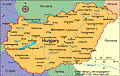
This central European country is the size of Indiana. Most of Hungary is a fertile, rolling plain lying east of the Danube River and drained by the Danube and Tisza rivers. In the extreme northwest is the Little Hungarian Plain. South of that area is Lake Balaton (250 sq mi; 648 sq km).
Hungary shares borders with seven neighboring countries. In order of shared border length, these are: Slovakia (627 km), Romania (424 km), Croatia (348 km), Austria (321 km), Serbia (164 km), Ukraine (128 km), and Slovenia (94 km).
Government
Hungary is a parliamentary democracy. The current state, the Third Hungarian Republic, was formed in 1989 as a successor to the Hungarian People's Republic. There have been nine elections since the beginning of the current republic, four of which have resulted in the election of Viktor Orbán.
Hungary's current government is a coalition between Orbán's Fidesz party and the Christian Democratic People's Party (KDNP). These parties have held a supermajority (over 66% of available government seats) since 2010. Fidesz is most commonly considered a national conservative party, meaning they are more supportive of government intervention than other conservatives and are more concerned with national identity. The party is known internationally for their anti-immigration policies.
International Affairs:
International Disputes: Bilateral government, legal, technical and economic working group negotiations continue with Slovakia over Hungary's failure to complete its portion of the Gabcikovo-Nagymaros hydroelectric dam project along the Danube; as a member state that forms part of the EU's external border, Hungary has implemented the strict Schengen border rules.
Illicit Drugs: Transshipment point for Southwest Asian heroin and cannabis and for South American cocaine destined for Western Europe; limited producer of precursor chemicals, particularly for amphetamine and methamphetamine; efforts to counter money laundering, related to organized crime and drug trafficking are improving but remain vulnerable; significant consumer of ecstasy.
Refugees and Displaced Persons:
Refugee/Migrant Arrivals: 432,562 (January 2015 - May 2018 est.)
Asylum Applications: 6,220 (2017)
Asylum Recognitions: 1,291 (2017)
Stateless Persons: 135 (2016)
Culture
Thanks to Hungary's unique history of ethnic migrations and conquests, Hungary is quite culturally distinct from its neighbors. While most countries around Hungary speak similar Slavic languages, Magyars (ethnic Hungarians) speak a Finno-Ugric language. Historically, Hungary shared cultural roots with a wide range of peoples. The Magyars had long-standing ties to the Huns and other Central Asian cultures. They also had their own mythology, with similarities to both Mongolian and Norse myths.
Around the world, Hungary is well known for its robust music scene. Some of Hungary's most famous composers include Franz Liszt—one of the defining composers and pianists of the Romantic period—, Béla Bartók and György Ligeti. All three made major contributions to the study and practice of music worldwide. In addition to classical, Hungarian folk music is a major part of Hungarian identity; modern bands from Hungary often incorporate elements of traditional folk music, which has helped give Hungarian pop music and rock music a distinct character.
Other Hungarian contributions to the arts include a long literary tradition, which has started gaining international attention, and widespread contributions to the film industry. Hungarian filmmakers fled in substantial numbers after the devastation of the World Wars and after the Communist takeover in the 1950s. These expatriates have been represented across the spectrum of Academy Award nominations. Recently, with the end of Communist rule and regular relations with the West, local Hungarian film has begun to gain more traction.

For the aspiring visitor, Hungary has an ancient legacy of housing some of Europe's best and most unique spas and public baths. Hungary has a significant number of thermal springs. From Roman times onward, these natural springs have been prime locations for resorts and bathhouses. This would continue through Hungary's many ethnic migrations and conquests as regional settlers continued to love the baths. Many spas in Hungary today show design elements from Roman, Greek, Turkish, and North European architecture. Spa-goers might also enjoy some of Hungary's renowned wines (favored by such big names as Beethoven and Napoleon III), more esoteric drinks like unicum and pálinka, or their ever-popular goulash.
Economy
Since the decline of communism and central planning in the 80s, Hungary's economy has grown and developed into an export-based market economy. Systemic economic challenges include pervasive corruption, long-term and youth unemployment, skilled labor shortages, widespread poverty in rural areas, vulnerabilities to changes in demand for exports, and a heavy reliance on Russian energy imports.
Overview
GDP/PPP: $283.6 billion, $28,900 per capita (2017 est.)
Growth Rate: 3.2% (2017 est.)
Inflation: 2.5% (2017 est.)
Government Revenues: 48.2% of GDP (2017 est.)
Public Debt: 73.9% of GDP (2017 est.)
Labor Force
Working Population: 4.599 million (2017 est.)
Employment by Occupation: Agriculture: 4.9%, Industry: 30.3%, Services: 64.5% (2015 est.)
Unemployment: 4.4% (2017 est.)
Population Below the Poverty Line: 14.9% (2015 est.)
Trade
Total Exports: $98.72 billion (2017 est.)
Major Exports: machinery and equipment 53.4%, other manufactures 31.2%, food products 8.4%, raw materials 3.4%, fuels and electricity 3.9% (2012 est.)
Export Partners: Germany 28.2%, Romania 5.2%, Slovakia 5%, Austria 4.9%, France 4.8%, Italy 4.8%, Czech Republic 4.2%, Poland 4.2% (2016)
Total Imports: $93.28 billion (2017 est.)
Major Imports: machinery and equipment 45.4%, other manufactures 34.3%, fuels and electricity 12.6%, food products 5.3%, raw materials 2.5% (2012)
Import Partners: Germany 26.3%, Austria 6.4%, China 6.3%, Poland 5.5%, Slovakia 5.3%, Netherlands 4.9%, Czech Republic 4.9%, France 4.8%, Italy 4.8% (2016)
Products
Agricultural Products: wheat, corn, sunflower seed, potatoes, sugar beets; pigs, cattle, poultry, dairy products
Major Industries: mining, metallurgy, construction materials, processed foods, textiles, chemicals (especially pharmaceuticals), motor vehicles
Resources
Natural Resources: bauxite, coal, natural gas, fertile soils, arable land
Land Use: Agricultural land: 58.9% (arable land 48.5%; permanent crops 2%; permanent pasture 8.4%), Forest: 22.5%, Other: 18.6% (2011 est.)
Communications
Telephones
Fixed Lines: 3,119,735, 32 per 100 residents (2016 est.)
Cell Phones: 11,779,908, 120 per 100 residents, (2016 est.)
International Country Code: 36
Internet
Internet Country Code: .hu
Internet Users: 7,826,695, 79.3% (2016 est.)
Broadcast Media
mixed system of state-supported public service broadcast media and private broadcasters; the 5 publicly owned TV channels and the 2 main privately owned TV stations are the major national broadcasters; a large number of special interest channels; highly developed market for satellite and cable TV services with about two-thirds of viewers utilizing their services; 4 state-supported public-service radio networks; a large number of local stations including commercial, public service, nonprofit, and community radio stations; digital transition completed at the end of 2013; government-linked businesses have greatly consolidated ownership in broadcast and print media (2016)
Transportation Infrastructure
Airports
Total Airports: 41 (2013)
With Paved Runways: 20
With Unpaved Runways: 21
Registered Air Carriers: 5
Registered Aircraft: 75
Annual Passengers: 20,042,185
Railways
Total: 8,049 km
Broad Gauge: 36 km (1.524-m gauge)
Standard Gauge: 7,794 km (1.435-m gauge)
Narrow Gauge: 219 km (0.760-m gauge)
Roads
Total: 203,601 km
Paved: 77,087 km (includes 1,582 km of expressways)
Unpaved: 126,514 km (2014)
Waterways
Total: 1,622 km (most on Danube River) (2011)
Ports and Terminals: Baja, Csepel (Budapest), Dunaujvaros, Gyor-Gonyu, Mohacs (Danube)
Pre-Hungarian History
For most of human history, the land we now know as "Hungary" wasn't home to the ethnic group known as "Hungarians." The Magyars, who are now the largest native group to the region, didn't arrive en masse until the Medieval Era, when they forcefully made the country their new homeland.
By 14 B.C.E. western Hungary was part of the Roman Empire's province of Pannonia, and by 106 C.E. Rome incorporated more land in the province of Dacia. These provinces were named after the peoples who lived in the area. The Romans also found confederates in the Sarmatian people who lived east of the Danube River, though they weren't incorporated as Roman subjects. The Roman period saw the founding of important cities like Budapest, as well as the widespread adoption of Christianity.
After the decline of Roman authority, the fertile farmland of Hungary was a prime target for settlement by the Huns. The Huns established a sizable empire in the area, though they were eventually driven out by neighboring Germanic peoples. Hungary then saw steady migrations from northern Slavs and Lombards, who were conquered by the Avars, who were in turn conquered by the Franks and the Bulgarians. By the late 800s CE, modern Hungary was split between the nations of East Francia, the Bulgarian Empire, and Great Moravia. As a result of these regular migrations and changes in government, Hungary ended up populated by many different ethnic groups.
The Magyar Conquest
The Hungarian people originally lived on the far side of the Carpathian mountains, where they were divided between seven major ethnic subgroups and upwards of one hundred extended clans. During the Middle Ages, these groups unified.
In the 890s, the Magyars invaded the region in a series of military expeditions and popular migrations. They achieved rapid success. Magyar armies destroyed Great Moravia within a decade, and won subsequent victories that led to their attaining uncontested control of their new homeland.
The Magyars were semi-nomadic and loosely organized. They regularly traveled throughout Hungary, bolstering their economies by striking out into neighboring German and Byzantine lands. This nomadic period of Hungarian history lasted around another century, until the risks of raiding the Magyars' powerful neighbors came to be seen as not worth the reward. This marked the broad transition into a more typical Medieval farming society. By the turn of the millennium, the Kingdom of Hungary was founded and its borders stabilized.
The Kingdom of Hungary
The year 1000 C.E. marks two very important moments in Hungarian history. The first is Stephen I abandoning his old title of "Grand Prince of the Hungarians" and becoming the King of Hungary. Stephen's kingdom would last for around 500 years, and play a significant role in the historic conflicts between the Habsburgs and the Ottoman Empire. The other is Stephen I adopting Christianity as the official religion of Hungary, for which he is revered as a saint in local Christian traditions.
Hungary, like many medieval kingdoms, was embroiled in numerous military engagements. The worst of these was a devastating invasion by the Mongols, which killed half of Hungary's population in 1241. The peak of Hungary's great period of medieval power came a century later during the reign of Louis I the Great (1342–1382), whose dominions touched the Baltic, Black, and Mediterranean seas. After his death, and a several year succession crisis, the Holy Roman Emperor Sigismund would become king, beginning a new era of relations between the HRE and Hungary.
War with the Turks broke out in 1389, and for more than 100 years the Turks advanced through the Balkans. The conflict was somewhat managed through the reign of Matthias Corvinus, who also checked Habsburg encroachment on Hungarian sovereignty by occupying Vienna. Under his rule, Hungary would experience significant economic and cultural growth partly due to top-down policies, as well as changing market forces across Europe. After Corvinus's death, however, the Hungarian state proved less and less capable of resisting the Ottomans—during this same time period, the Ottoman Empire would come under the rule of its most recognized and revered Sultan, Suleiman the Magnificent. The Turks smashed the Hungarian army in 1526, after which the country fragmented. Western and Northern Hungary accepted Habsburg rule to escape Turkish occupation, and Transylvania became independent under Hungarian princes.
The Kingdoms of Hungary
Until the 1700s, the region would experience regular fighting between the different hegemonic powers looking to influence Hungary. The Habsburg Kingdom would eventually win out, and the Austrian monarchy would maintain effective control of the country for some time. The history of Hungary isn't just military conflicts, however. As an important focus of several global powers, Hungary saw a great deal of cultural growth and change during this time period; developments in poetry, folk dance, and craftsmanship all contributed to a slowly cultivated sense of Hungarian identity. This solidifying image of Hungarian culture would contribute to rebellions against Habsburg rule after the end of conflict with the Turks. The most significant of these was the Revolution of 1848, one of the many Revolutions of 1848.
Wars Cost Hungary Much of Its Land
After the suppression of the 1848 revolt, led by Louis Kossuth, against Habsburg rule, the dual monarchy of Austria-Hungary was set up in 1867. The dual monarchy was defeated, along with the other Central Powers, in World War I. After a short-lived republic in 1918, the chaotic Communist rule of 1919 under Béla Kun ended with the Romanians occupying Budapest on Aug. 4, 1919. When the Romanians left, Adm. Nicholas Horthy entered the capital with a national army. The Treaty of Trianon of June 4, 1920, by which the Allies parceled out Hungarian territories, cost Hungary 68% of its land and 58% of its population.
In World War II, Hungary allied with Germany, which aided the country in recovering lost territories. Following the German invasion of Russia on June 22, 1941, Hungary joined the attack against the Soviet Union, but withdrew in defeat from the eastern front by May 1943. Germany occupied the country for the remainder of the war and set up a puppet government. Hungarian Jews and Gypsies were sent to death camps. The German regime was driven out by the Soviets in 1944–1945.
Communist Party Takes Control
By the Treaty of Paris (1947), Hungary had to give up all territory it had acquired since 1937 and to pay $300 million in reparations to the USSR, Czechoslovakia, and Yugoslavia. In 1948, the Communist Party, with the support of Soviet troops, seized control. Hungary was proclaimed a People's Republic and one-party state in 1949. Industry was nationalized, the land collectivized into state farms, and the opposition terrorized by the secret police. The terror, modeled after that of the USSR, reached its height with the trial and life imprisonment of József Cardinal Mindszenty, the leader of Hungary's Roman Catholics, in 1948.
On Oct. 23, 1956, an anti-Communist revolution broke out in Budapest. To cope with it, the Communists set up a coalition government and called former prime minister Imre Nagy back to head the government. But he and most of his ministers sympathized with the anti-Communist opposition, and he declared Hungary a neutral power, withdrawing from the Warsaw Treaty and appealing to the United Nations for help. One of his ministers, János Kádár, established a counterregime and asked the USSR to send in military power. Soviet troops and tanks suppressed the revolution in bloody fighting after 190,000 people had fled the country. Under Kádár (1956–1988), Communist Hungary maintained more liberal policies in the economic and cultural spheres, and Hungary became the most liberal of the Soviet-bloc nations of eastern Europe. Continuing his program of national reconciliation, Kádár emptied prisons, reformed the secret police, and eased travel restrictions.
Hungary Makes Difficult Transition to Democracy
In 1989, Hungary's Communists abandoned their monopoly on power voluntarily, and the constitution was amended in Oct. 1989 to allow for a multiparty state. The last Soviet troops left Hungary in June 1991, thereby ending almost 47 years of military presence. The transition to a market economy proved difficult. In April 1999, Hungary became part of NATO.
The Fidesz Party Forms a New Government
In a decisive victory, Viktor Orban and his center-right political party, Fidesz, won a two-thirds majority in parliamentary elections in April 2010, taking 263 of 386 seats. The ruling party, the Socialists, won just 59 seats, and the far-right Jobbik party and a new liberal-green group, LMP (Politics Can be Different), took the remaining 63. The Jobbik party, with its black-clad paramilitary and anti-Semitic extremism, has worried Hungarians and international leaders alike, particularly now that it has entered parliament for the first time. Economic hardship in Hungary has fueled the nationalistic party, but the newly strong majority of the Fidesz party means that it won't have to negotiate with the Jobbiks, thus weakening their power.
Orban was appointed prime minister. He introduced several laws that increased government control over the media, judiciary, and central bank. In April 2011, parliament approved a new "majoritarian" constitution, which went into effect in January 2012 to widespread disapproval and fear that the document consolidated the power of Fidesz at the expense of democracy. In a rare display of unity, opposition groups joined together in early January and organized protests against the new constitution. About 30,000 people participated.
European Union Warns Hungary
In early January 2012, the European Union (EU) gave Hungary an ultimatum. The European Commission, the executive branch of the EU, warned that it would take legal action by January 17 unless the country modified the new laws it passed at the end of 2011. The laws, along with a new constitution, removed regulations on Prime Minister Viktor Orban's government in areas such as the media, central banking, and the judiciary. Orban relented, and in a speech to parliament said, the issue "could swiftly be resolved and remedied." In a separate warning, the European Commission said Hungary faced a possible loss of development assistance if the country did not do more to rein in its budget deficit. That was followed in March with the European Union telling Hungary it would suspend about 500 million euros in development aid unless the country show progress in cutting its deficit to 2.5% of GDP by June.
President Schmitt resigned in April 2012 after Budapest's Semmelweis University withdrew his doctorate degree. A university committee issued a report that accused Schmitt of plagiarizing in his 1992 thesis. In May, the parliament elected Janos Ader, 52, Hungarian president.
New Amendment to the Constitution Causes Alarm
In March 2013, Hungary's Parliament passed a lengthy amendment to its Constitution. The 386-seat Parliament passed the controversial amendment by a vote of 265 to 11. The amendment was considered controversial because it included several laws seen as a way for the government to regulate media, education, and even the social life of its citizens. For example, one law allowed local police to fine or jail homeless people. Another law required that state scholarship students either stay in Hungary or pay back their scholarships if they leave.
Thousands protested the amendment in Budapest. It also raised concern throughout the international community, including the Council of Europe, European Union, human rights activists, and the United States. A joint statement was released by Thorbjorn Jagland, head of the Council of Europe, and European Commission President José Manuel Barroso. The statement said that the amendment increased "concerns with respect to the principle of the rule of law, European Union law and Council of Europe standards."
In April 2014's parliamentary elections, the ruling Fidesz party won another victory, taking 133 of the 199 available seats. The win handed Orban a third term as prime minister. The election was the first to follow the country's new constitution and electoral rules since Hungary's transition to democracy. In October 2014, the government announced plans to impose a tax on Internet use. Tens of thousands of people took to the streets of Budapest to protest the proposal. In response, Orban said he would put a cap on the tax. It was not enough to quiet the protests, and Orban withdrew the plan just over a week after introducing it.
In Feb. 2015, Hungary's ruling right-wing alliance, led by Prime Minister Orban and his Fidesz party, lost its majority in parliament in a by-election. The results showed an increase in support for the far-right Jobbik party and a fall in the support for Fidesz, only a year after Fidesz swept national elections in an alliance with the KDNP party. The loss of a majority hurt Orban's chances to pass any major legislation or change the constitution. Of the election results, Orban said via social media that Fidesz "cannot sit on its laurels." The next election was planned for 2018.
Hundreds of Migrants Held in Hungary During Crisis of 2015
During the summer of 2015, migrants fleeing war and conflict in Afghanistan, Syria, and regions of Northern Africa poured into the Balkans at a rate of about 3,000 a day. They hoped to end up in Western Europe, but many of those nations only offered refuge to a small number of migrants. The impasse created a crisis in Hungary, where thousands of migrants were stuck at Budapest's Keleti train station in August and early September as they waited for officials to decide their fate. Hungary responded to the influx by building 109-foot razor-wire fence along the Serbian border and passing laws allowing the arrest of migrants who attempt to cross into Hungary from Serbia illegally.
U.S. Department of State Background Note
Hungary
Index:
PEOPLE AND HISTORY
Ethnic groups in Hungary include Magyar (nearly 90%), Romany, German, Serb, Slovak, and others. The majority of Hungary's people are Roman Catholic; other religions represented are Calvinist, Lutheran, Jewish, Baptist, Adventist, Pentecostal, and Unitarian. Magyar is the predominant language.
Hungary has long been an integral part of Europe. It converted to Western Christianity before AD 1000. Although Hungary was a monarchy for nearly 1,000 years, its constitutional system preceded by several centuries the establishment of Western-style governments in other European countries. Following the defeat of the Austro-Hungarian Dual Monarchy (1867-1918) at the end of World War I, Hungary lost two-thirds of its territory and nearly as much of its population. It experienced a brief but bloody communist dictatorship and counterrevolution in 1919, followed by a 25-year regency under Adm. Miklos Horthy. Although Hungary fought in most of World War II as a German ally, it fell under German military occupation following an unsuccessful attempt to switch sides on October 15, 1944. Under occupation, the Hungarian Government deported or executed and seized the property of hundreds of thousands of its minority citizens, mostly members of the Jewish community. On January 20, 1945, a provisional government concluded an armistice with the Soviet Union and established the Allied Control Commission, under which Soviet, American, and British representatives held complete sovereignty over the country. The Commission's chairman was a member of Stalin's inner circle and exercised absolute control.
Communist Takeover
The provisional government, dominated by the Hungarian communist party (MKP), was replaced in November 1945 after elections which gave majority control of a coalition government to the Independent Smallholders' Party. The government instituted a radical land reform and gradually nationalized mines, electric plants, heavy industries, and some large banks. The communists ultimately undermined the coalition regime by discrediting leaders of rival parties and through terror, blackmail, and framed trials. In elections tainted by fraud in 1947, the leftist bloc gained control of the government. Postwar cooperation between the U.S.S.R. and the West collapsed, and the Cold War began. With Soviet support, Moscow-trained Matyas Rakosi began to establish a communist dictatorship.
By February 1949, all opposition parties had been forced to merge with the MKP to form the Hungarian Workers' Party. In 1949, the communists held a single-list election and adopted a Soviet-style constitution, which created the Hungarian People's Republic. Rakosi became Prime Minister in 1952. Between 1948 and 1953, the Hungarian economy was reorganized according to the Soviet model. In 1949, the country joined the Council for Mutual Economic Assistance (CMEA, or Comecon), a Soviet-bloc economic organization. All private industrial firms with more than 10 employees were nationalized. Freedom of the press, religion, and assembly were strictly curtailed. The head of the Roman Catholic Church, Cardinal Jozsef Mindszenty, was sentenced to life imprisonment.
Forced industrialization and land collectivization soon led to serious economic difficulties, which reached crisis proportions by mid-1953, the year Stalin died. The new Soviet leaders blamed Rakosi for Hungary's economic situation and began a more flexible policy called the "New Course." Imre Nagy replaced Rakosi as prime minister in 1953 and repudiated much of Rakosi's economic program of forced collectivization and heavy industry. He also ended political purges and freed thousands of political prisoners. However, the economic situation continued to deteriorate, and Rakosi succeeded in disrupting the reforms and in forcing Nagy from power in 1955 for "right-wing revisionism." Hungary joined the Soviet-led Warsaw Pact Treaty Organization the same year. Rakosi's attempt to restore Stalinist orthodoxy then foundered as increasing opposition developed within the party and among students and other organizations after Khrushchev's 1956 denunciation of Stalin. Fearing revolution, Moscow replaced Rakosi with his deputy, Erno Gero, in order to contain growing ideological and political ferment.
1956 Revolution
Pressure for change reached a climax on October 23, 1956, when security forces fired on Budapest students marching in support of Poland's confrontation with the Soviet Union. The ensuing battle quickly grew into a massive popular uprising. Gero called on Soviet troops to restore order on October 24. Fighting did not abate until the Central Committee named Imre Nagy as prime minister on October 25, and the next day Janos Kadar replaced Gero as party first secretary. Nagy dissolved the state security police, abolished the one-party system, promised free elections, and negotiated with the U.S.S.R. to withdraw its troops.
Faced with reports of new Soviet troops pouring into Hungary despite Soviet Ambassador Andropov's assurances to the contrary, on November 1 Nagy announced Hungary's neutrality and withdrawal from the Warsaw Pact. He appealed to the United Nations and the Western powers for protection of its neutrality. Preoccupied with the Suez Crisis, the UN and the West failed to respond, and the Soviet Union launched a massive military attack on Hungary on November 3. Some 200,000 Hungarians fled to the West. Nagy and his colleagues took refuge in the Yugoslav Embassy. Kadar, after delivering an impassioned radio address on November 1 in support of "our glorious revolution" and vowing to fight the Russians with his bare hands if they attacked Hungary, defected from the Nagy cabinet; he fled to the Soviet Union and on November 4 announced the formation of a new government. He returned to Budapest and, with Soviet support, carried out severe reprisals; thousands of people were executed or imprisoned. Despite a guarantee of safe conduct, Nagy was arrested and deported to Romania. In June 1958, the government announced that Nagy and other former officials had been executed.
Reform Under Kadar
In the early 1960s, Kadar announced a new policy under the motto of "He who is not against us is with us." He declared a general amnesty, gradually curbed some of the excesses of the secret police, and introduced a relatively liberal cultural and economic course aimed at overcoming the post-1956 hostility toward him and his regime. In 1966, the Central Committee approved the "New Economic Mechanism," through which it sought to overcome the inefficiencies of central planning, increase productivity, make Hungary more competitive in world markets, and create prosperity to ensure political stability. However, the reform was not as comprehensive as planned, and basic flaws of central planning produced economic stagnation. Over the next two decades of relative domestic quiet, Kadar's government responded to pressure for political and economic reform and to counterpressures from reform opponents. By the early 1980s, it had achieved some lasting economic reforms and limited political liberalization and pursued a foreign policy which encouraged more trade with the West. Nevertheless, the New Economic Mechanism led to mounting foreign debt incurred to shore up unprofitable industries.
Transition to Democracy
Hungary's transition to a Western-style parliamentary democracy was the first and the smoothest among the former Soviet bloc, inspired by nationalism that long had encouraged Hungarians to control their own destiny. By 1987, activists within the party and bureaucracy and Budapest-based intellectuals were increasing pressure for change. Some of these became reform socialists, while others began movements which were to develop into parties. Young liberals formed the Federation of Young Democrats (Fidesz); a core from the so-called Democratic Opposition formed the Association of Free Democrats (SZDSZ), and the neopopulist national opposition established the Hungarian Democratic Forum (MDF). Civic activism intensified to a level not seen since the 1956 revolution.
In 1988, Kadar was replaced as General Secretary of the MKP, and reform communist leader Imre Pozsgay was admitted to the Politburo. That same year, the Parliament adopted a "democracy package," which included trade union pluralism; freedom of association, assembly, and the press; a new electoral law; and a radical revision of the constitution, among others. A Central Committee plenum in February 1989 endorsed in principle the multiparty political system and the characterization of the October 1956 revolution as a "popular uprising," in the words of Pozsgay, whose reform movement had been gathering strength as communist party membership declined dramatically. Kadar's major political rivals then cooperated to move the country gradually to democracy. The Soviet Union reduced its involvement by signing an agreement in April 1989 to withdraw Soviet forces by June 1991.
National unity culminated in June 1989 as the country reburied Imre Nagy, his associates, and, symbolically, all other victims of the 1956 revolution. A national roundtable, comprising representatives of the new parties and some recreated old parties--such as the Smallholders and Social Democrats--the communist party, and different social groups, met in the late summer of 1989 to discuss major changes to the Hungarian constitution in preparation for free elections and the transition to a fully free and democratic political system.
In October 1989, the communist party convened its last congress and re-established itself as the Hungarian Socialist Party (MSZP). In a historic session on October 16-20, 1989, the Parliament adopted legislation providing for multiparty parliamentary elections and a direct presidential election. The legislation transformed Hungary from a people's republic into the Republic of Hungary; guaranteed human and civil rights; and created an institutional structure that ensures separation of powers among the judicial, executive, and legislative branches of government. But because the national roundtable agreement was the result of a compromise between communist and noncommunist parties and societal forces, the revised constitution still retained vestiges of the old order. It championed the "values of bourgeois democracy and democratic socialism" and gave equal status to public and private property. Such provisions were erased in 1990 as the need for compromise solutions was obviated by the poor performance of the MSZP in the first free elections.
Free Elections and a Democratic Hungary
The first free parliamentary election, held in May 1990, was a plebiscite of sorts on the communist past. The revitalized and reformed communists performed poorly despite having more than the usual advantages of an "incumbent" party. Populist, center-right, and liberal parties fared best, with the Democratic Forum (MDF) winning 43% of the vote and the Free Democrats (SZDSZ) capturing 24%. Under Prime Minister Jozsef Antall, the MDF formed a center-right coalition government with the Independent Smallholders' Party (FKGP) and the Christian Democratic People's Party (KDNP) to command a 60% majority in the parliament. Parliamentary opposition parties included SZDSZ, the Socialists (MSZP), and the Alliance of Young Democrats (Fidesz). Peter Boross succeeded as Prime Minister after Antall died in December 1993. The Antall/Boross coalition governments achieved a reasonably well-functioning parliamentary democracy and laid the foundation for a free market economy.
In May 1994, the socialists came back to win a plurality of votes and 54% of the seats after an election campaign focused largely on economic issues and the substantial decline in living standards since 1990. A heavy turnout of voters swept away the right-of-center coalition but soundly rejected extremists on both right and left. Despite its neocommunist pedigree, the MSZP continued economic reforms and privatization, adopting a painful but necessary policy of fiscal austerity (the "Bokros plan") in 1995. The government pursued a foreign policy of integration with Euro-Atlantic institutions and reconciliation with neighboring countries. But neither an invitation to join NATO nor improving economic indicators guaranteed the MSZP's re-election; dissatisfaction with the pace of economic recovery, rising crime, and cases of government corruption convinced voters to propel center-right parties into power following national elections in May 1998. The Federation of Young Democrats (renamed Fidesz-Hungarian Civic Party (MPP) in 1995) captured a plurality of parliamentary seats and forged a coalition with the Smallholders and the Democratic Forum. The new government, headed by 35-year-old Prime Minister Viktor Orban promised to stimulate faster growth, curb inflation, and lower taxes. Although the Orban administration also pledged continuity in foreign policy, and continued to pursue Euro-Atlantic integration as its first priority, it was a more vocal advocate of minority rights for ethnic Hungarians abroad than the previous government.
In April 2002, the country voted to return the MSZP-Free Democrat coalition to power. The new government, led by Prime Minister Peter Medgyessy, had a very slim majority in Parliament following the closest elections of the post-communist era. The Medgyessy government placed special emphasis on solidifying Hungary's Euro-Atlantic course, which culminated in Hungary’s accession to the European Union on May 1, 2004. Prime Minister Medgyessy resigned in August 2004 after losing coalition support following an attempted cabinet reshuffle. Ferenc Gyurcsany was selected by the governing coalition to succeed Medgyessy, and he was confirmed by the Parliament on September 29, 2004.
In the April 2006 election Prime Minister Ferenc Gyurcsany and his Socialist-liberal coalition were re-elected, the first time since communism that a sitting government has renewed its mandate. The current coalition between MSZP and SZDSZ makes up the parliamentary majority with 210 seats. However, it does not have the “super majority” to produce the two-thirds vote necessary to enact constitutional, legal, and procedural changes. The present configuration of Parliament includes MSZP with 190 seats, SZDSZ with 20 seats, Fidesz with 164 seats, MDF with 11 seats, and the independent Somogyert party with one seat. The Prime Minister has reduced the number of ministries in the cabinet from 17 to 12. The new cabinet has eight ministers from the MSZP party, three ministers from the SZDSZ party, and one independent minister.
GOVERNMENT AND POLITICAL CONDITIONS
The President of the Republic, elected by the National Assembly every 5 years, has a largely ceremonial role, but powers also include appointing the prime minister. The prime minister selects cabinet ministers and has the exclusive right to dismiss them. Each cabinet nominee appears before one or more parliamentary committees in consultative open hearings and must be formally approved by the president. The unicameral, 386-member National Assembly is the highest organ of state authority and initiates and approves legislation sponsored by the prime minister. A party must win at least 5% of the national vote to form a parliamentary faction. National parliamentary elections are held every 4 years (the last in April 2006). A 15-member Constitutional Court has power to challenge legislation on grounds of unconstitutionality.
The Hungarian embassy is located at 3910 Shoemaker St. NW, Washington, DC 20008 (tel. 202-362-6730). Hungary has consulates in New York City and Los Angeles.
ECONOMY
The Hungarian economy prior to WWII was primarily oriented toward agriculture and small scale manufacturing. Hungary's strategic position in Europe and its relative lack of natural resources also have dictated a traditional reliance on foreign trade. In the early 1950s, the communist government forced rapid industrialization after the standard Stalinist pattern in an effort to encourage a more self-sufficient economy. Most economic activity was conducted by state-owned enterprises or cooperatives and state farms. In 1968, Stalinist self-sufficiency was replaced by the "New Economic Mechanism," which reopened Hungary to foreign trade, gave limited freedom to the workings of the market, and allowed a limited number of small businesses to operate in the services sector.
Although Hungary enjoyed one of the most liberal and economically advanced economies of the former Eastern bloc, both agriculture and industry began to suffer from a lack of investment in the 1970s, and Hungary's net foreign debt rose significantly--from $1 billion in 1973 to $15 billion in 1993--due largely to consumer subsidies and unprofitable state enterprises. In the face of economic stagnation, Hungary opted to try further liberalization by passing a joint venture law, adopting an income tax, and joining the International Monetary Fund (IMF) and the World Bank. By 1988, Hungary had developed a two-tier banking system and had enacted significant corporate legislation which paved the way for the ambitious market-oriented reforms of the post-communist years.
The Antall government of 1990-94 began market reforms with price and trade liberation measures, a revamped tax system, and a nascent market-based banking system. By 1994, however, the costs of government overspending and hesitant privatization had become clearly visible. Cuts in consumer subsidies led to increases in the price of food, medicine, transportation services, and energy. Reduced exports to the former Soviet bloc and shrinking industrial output contributed to a sharp decline in GDP, falling 18% from 1990 to 1993.
Unemployment rose rapidly--to about 12% in 1993. The external debt burden, one of the highest in Europe, reached 250% of annual export earnings, while the budget and current account deficits approached 10% of GDP. In March 1995, the government of Prime Minister Gyula Horn implemented an austerity program, coupled with aggressive privatization of state-owned enterprises and an export-promoting exchange rate regime, to reduce indebtedness, cut the current account deficit, and shrink public spending. By the end of 1997 the consolidated public sector deficit decreased to 4.6% of GDP-- with public sector spending falling from 62% of GDP to below 50%--the current account deficit was reduced to 2% of GDP, and government debt was paid down to 94% of annual export earnings.
These reforms and a massive infusion of foreign direct investment (FDI) set Hungary on a path of high growth, falling inflation, and decreasing unemployment. Growth has averaged 4.5% since 1996; inflation fell from 28% to under 7%; and unemployment fell to under 6%, the envy of many EU countries. Eighty percent of GDP is now produced by the private sector, and foreign owners control 70% of financial institutions, 66% of industry, 90% of telecommunications, and 50% of the trading sector. Hungary is now one of Europe's fastest-growing and most open economies, deeply integrated into the European economy, a relationship that was enhanced with Hungary’s accession to the European Union on May 1, 2004.
The Orban government, elected in 1998, maintained the broad macroeconomic reforms of its predecessor. However, it did little to address structural problems in agriculture, health care, and the tax system. Under the slogan "economic patriotism," the government moved to increase the government's role in the economy and switch from an export- to a domestic demand-driven economy. In 2002, the consolidated fiscal deficit doubled to 9.9% of GDP, in part due to overspending by the previous administration prior to the last national elections and by the new government after the elections. The Medgyessy government sought to lower the deficit while creating a business-friendly environment. A large wage increase and a strongly appreciating local currency in 2002-2003, however, decreased Hungary’s competitiveness somewhat. Prime Minister Gyurcsany appointed Finance Minister Veres in April 2005 and continues to focus on deficit reduction.
As part of his economic reform plan, proposed in June 2006, Prime Minister Gyurcsany vowed to attack Hungary’s budget deficit, more than 10% of GDP in 2006, by raising taxes and combating waste in the public sector. The plan consists of austerity measures that involve cutting subsidies on gas, electricity, and medicines as well as a series of deep reforms in four key areas: healthcare, state administration, local government, and education. The Prime Minister aims to cut down on ministry staff by 23%. His goal is to cut the budget deficit to 6.6% of GDP in 2007, about 4% in 2008, and about 3% in 2009. Such reductions could put Hungary on the path to join the Euro zone by 2012, two years later than its original target.
In 1995 Hungary's currency, the forint (HUF), became convertible for all current account transactions, and subsequent to OECD membership in 1996, for almost all capital account transactions as well. In 2001, the Orban government lifted remaining currency controls and broadened the band around the exchange rate, allowing the forint to appreciate by more than 12% in a year. Conflicting fiscal and monetary policy in the summer of 2002 caused confusion briefly in the market, with the forint surging against the Euro for several months. In attempts to reassure the market, the Medgyessy government repeatedly said the country would join the ERM II as soon as possible, with hopes of adopting the Euro by 2008. Prior to the change of regime in 1989, 65% of Hungary's trade was with Comecon countries. By the end of 1997, Hungary had shifted much of its trade to the West. Trade with EU countries and the OECD now comprises over 75% and 85% of the total, respectively. Germany is Hungary's single-most important trading partner. The United States has become Hungary's sixth-largest export market, while Hungary is ranked as the 72d largest export market for the United States. Bilateral trade between the two countries increased 46% in 1997 to more than $1 billion. The United States has Normal Trade Relations with Hungary and has extended to it Overseas Private Investment Corporation insurance, and access to the Export/Import Bank.
Foreign investment was the key to Hungary's success. With more than $60 billion in FDI since 1989, Hungary has been a leading destination for FDI in central and eastern Europe--including the former Soviet Union. Of this, a little less than one-third has come from U.S. companies. The largest U.S. investors include GE, Alcoa, General Motors, Coca-Cola, Ford, IBM, and Pepsico. Foreign companies modernized Hungary's industrial sector and created thousands of new, high-skilled, high-paying jobs. As a result of extensive and continuing liberalization, the private sector produces about 80% of Hungary’s output. Currently, foreign firms control two-thirds of manufacturing, 90% of telecommunications, and 60% of the energy sector. Inflation declined from 14% in 1998 to 3.7% in 2005. Policy challenges include cutting the public sector deficit to 3% of GDP by 2008, from about 6.5% in 2005, and orchestrating an orderly interest rate reduction without sparking capital outflows.
NATIONAL SECURITY
Hungary's key national security focus since joining NATO in 1999 has been contributing to the stability of the region while integrating its armed forces into NATO's force structure. As a "NATO island" in an area of instability, Hungary takes a keen interest in NATO expansion and in the transatlantic link. It shares a more acute sense of the threat than many other European countries and is watching the transition in the Balkans, Ukraine, and Russia with great interest. Hungarians believe that Hungary's own security and that of its ethnic minorities in neighboring countries will be best served by a peaceful, unified region, which will be achieved when EU and NATO membership is extended to the entire region.
Hungary has been slowly modernizing and downsizing its armed forces since it left the Warsaw Pact in 1990. The transition from a heavy, slow-moving Warsaw Pact force to a lighter, versatile NATO force has been a long road, and U.S. advisers have been involved in the process throughout. The force has gone from 130,000 in 1989 to 45,000 in 2001 while dozens of bases have been closed. New training, logistics, and leadership systems have been implemented, while considerable practical experience working with NATO and other forces has been achieved by Hungarians serving in peacekeeping missions (about 1,000 at any given time). Hungary was especially helpful during the Kosovo crisis in 1995, when its airbase at Taszar was used by coalition aircraft. Hungarian military personnel are also present in Afghanistan and Iraq. Hungary spends 1.2% of its GDP on defense, well below the NATO target of 2% and spending levels of other new members.
FOREIGN RELATIONS
Except for the short-lived neutrality declared by Imre Nagy in November 1956, Hungary's foreign policy generally followed the Soviet lead from 1947 to 1989. During the communist period, Hungary maintained treaties of friendship, cooperation, and mutual assistance with the Soviet Union, Poland, Czechoslovakia, the German Democratic Republic, Romania, and Bulgaria. It was one of the founding members of the Soviet-led Warsaw Pact and Comecon, and it was the first central European country to withdraw from those organizations, now defunct.
As with any country, Hungarian security attitudes are shaped largely by history and geography. For Hungary, this is a history of more than 400 years of domination by great powers--the Ottomans, the Habsburgs, the Germans during World War II, and the Soviets during the Cold War--and a geography of regional instability and separation from Hungarian minorities living in neighboring countries. Hungary's foreign policy priorities, largely consistent since 1990, represent a direct response to these factors. Since 1990, Hungary's top foreign policy goal has been achieving integration into Western economic and security organizations. To this end, Hungary joined NATO in 1999 and the European Union in May of 2004. Hungary also has improved its often-chilled neighborly relations by signing basic treaties with Romania, Slovakia, and Ukraine. These renounce all outstanding territorial claims and lay the foundation for constructive relations. However, the issue of ethnic Hungarian minority rights in Slovakia and Romania periodically causes bilateral tensions to flare. Hungary was a signatory to the Helsinki Final Act in 1975, has signed all of the CSCE/OSCE follow-on documents since 1989, and served as the OSCE's Chairman-in-Office in 1997. Hungary's record of implementing CSCE Helsinki Final Act provisions, including those on reunification of divided families, remains among the best in eastern Europe. Hungary has been a member of the United Nations since December 1955.
U.S.-HUNGARIAN RELATIONS
Relations between the United States and Hungary following World War II were affected by the Soviet armed forces' occupation of Hungary. Full diplomatic relations were established at the legation level on October 12, 1945, before the signing of the Hungarian peace treaty on February 10, 1947. After the communist takeover in 1947-48, relations with Hungary became increasingly strained by the nationalization of U.S.-owned property, unacceptable treatment of U.S. citizens and personnel, and restrictions on the operations of the American legation. Though relations deteriorated further after the suppression of the Hungarian national uprising in 1956, an exchange of ambassadors in 1966 inaugurated an era of improving relations. In 1972, a consular convention was concluded to provide consular protection to U.S. citizens in Hungary.
In 1973, a bilateral agreement was reached under which Hungary settled the nationalization claims of American citizens. In January 1978, the United States returned to the people of Hungary the historic Crown of Saint Stephen, which had been safeguarded by the United States since the end of World War II. Symbolically and actually, this event marked the beginning of excellent relations between the two countries. A 1978 bilateral trade agreement included extension of most-favored-nation status to Hungary. Cultural and scientific exchanges were expanded. As Hungary began to pull away from the Soviet orbit, the United States offered assistance and expertise to help establish a constitution, a democratic political system, and a plan for a free market economy.
Between 1989 and 1993, the Support for East European Democracy (SEED) Act provided more than $136 million for economic restructuring and private sector development. The Hungarian-American Enterprise Fund has offered loans, equity capital, and technical assistance to promote private-sector development. The U.S. Government has provided expert and financial assistance for the development of modern and Western institutions in many policy areas, including national security, law enforcement, free media, environmental regulations, education, and health care. Direct investment in Hungary by American companies is rising rapidly. When Hungary acceded to NATO in April 1999, it became a formal ally of the United States. This move has been consistently supported by the 1.5 million-strong Hungarian-American community.
The U.S. Embassy in Hungary is located at Szabadsag Ter 12, Budapest 1054 (tel. (36) 1-475-4400).
TRAVEL AND BUSINESS INFORMATION
The U.S. Department of State's Consular Information Program advises Americans traveling and residing abroad through Consular Information Sheets, Public Announcements, and Travel Warnings. Consular Information Sheets exist for all countries and include information on entry and exit requirements, currency regulations, health conditions, safety and security, crime, political disturbances, and the addresses of the U.S. embassies and consulates abroad. Public Announcements are issued to disseminate information quickly about terrorist threats and other relatively short-term conditions overseas that pose significant risks to the security of American travelers. Travel Warnings are issued when the State Department recommends that Americans avoid travel to a certain country because the situation is dangerous or unstable.
For the latest security information, Americans living and traveling abroad should regularly monitor the Department's Bureau of Consular Affairs Internet web site at http://www.travel.state.gov, where the current Worldwide Caution, Public Announcements, and Travel Warnings can be found. Consular Affairs Publications, which contain information on obtaining passports and planning a safe trip abroad, are also available at http://www.travel.state.gov. For additional information on international travel, see http://www.usa.gov/Citizen/Topics/Travel/International.shtml.
The Department of State encourages all U.S citizens traveling or residing abroad to register via the State Department's travel registration website or at the nearest U.S. embassy or consulate abroad. Registration will make your presence and whereabouts known in case it is necessary to contact you in an emergency and will enable you to receive up-to-date information on security conditions.
Emergency information concerning Americans traveling abroad may be obtained by calling 1-888-407-4747 toll free in the U.S. and Canada or the regular toll line 1-202-501-4444 for callers outside the U.S. and Canada.
The National Passport Information Center (NPIC) is the U.S. Department of State's single, centralized public contact center for U.S. passport information. Telephone: 1-877-4USA-PPT (1-877-487-2778). Customer service representatives and operators for TDD/TTY are available Monday-Friday, 7:00 a.m. to 12:00 midnight, Eastern Time, excluding federal holidays.
Travelers can check the latest health information with the U.S. Centers for Disease Control and Prevention in Atlanta, Georgia. A hotline at 877-FYI-TRIP (877-394-8747) and a web site at http://www.cdc.gov/travel/index.htm give the most recent health advisories, immunization recommendations or requirements, and advice on food and drinking water safety for regions and countries. A booklet entitled "Health Information for International Travel" (HHS publication number CDC-95-8280) is available from the U.S. Government Printing Office, Washington, DC 20402, tel. (202) 512-1800.
Further Electronic Information
Department of State Web Site. Available on the Internet at http://www.state.gov, the Department of State web site provides timely, global access to official U.S. foreign policy information, including Background Notes and daily press briefings along with the directory of key officers of Foreign Service posts and more. The Overseas Security Advisory Council (OSAC) provides security information and regional news that impact U.S. companies working abroad through its website http://www.osac.gov
Export.gov provides a portal to all export-related assistance and market information offered by the federal government and provides trade leads, free export counseling, help with the export process, and more.
STAT-USA/Internet, a service of the U.S. Department of Commerce, provides authoritative economic, business, and international trade information from the Federal government. The site includes current and historical trade-related releases, international market research, trade opportunities, and country analysis and provides access to the National Trade Data Bank.Revised: Aug. 2007
Trending
Here are the facts and trivia that people are buzzing about.